
Molded Clamping Cauls
For those impossible surfaces
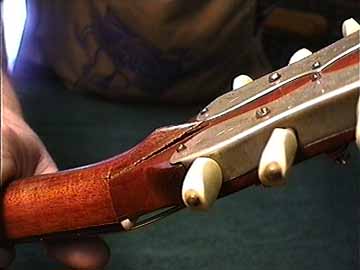
Here's the job:
It's a 1910 Martin style 2 bowl-back mandolin that just happens to be in nearly mint condition. The owner's 9-month old son knocked it down and cracked the peghead loose. The joint did not fail; the wood underneath split. Clearly, this is a case for hide glue and good clamping pressure. The break flexes open very easily so there won't be any difficulty getting glue down in there, but clamping is another matter.
This neck is made of Spanish cedar, which is very delicate indeed. Just look at it hard and you'll dent it! Even a cork or rubber clamp pad will crush the fine detail of this carved "diamond" joint.
Time for a molded clamping caul to distribute the pressure.
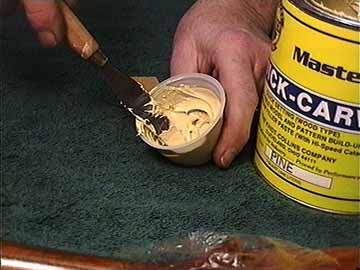
I'll mix up a small batch of Quick-Carve:
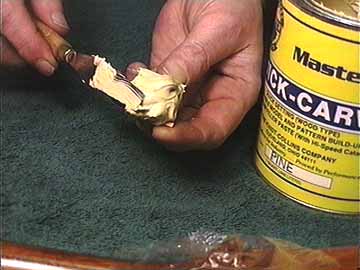
And spread it on a one-inch square of scrap wood:
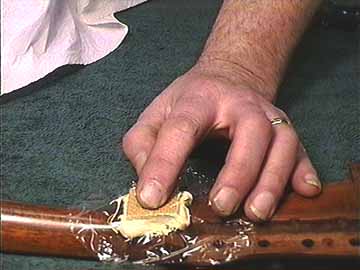
Here's the tricky part. This stuff is really gooey, and rather thin-bodied when first mixed, then it suddenly sets in 5 minutes or so. I'll hold the piece of wood with and keep testing the glop with my finger until I notice it just stiffening up. Then, as quickly as I can, I'll mash it down onto the broken peghead which I've protected with a piece of the thin plastic wrap:
If I'm making a large caul, or the surface doesn't have such fine detail, I'll just mix the glop and place it without waiting for the setting reaction to proceed. In this case, the Quick-Carve just doesn't weigh enough to make the plastic wrap conform to the carved contour I need to clamp.
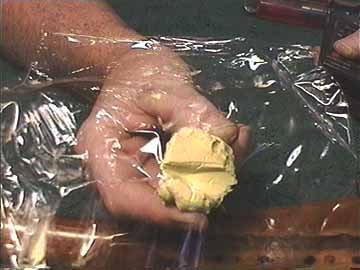
After the Quick-Carve has set, I can just lift it off and I have a perfect impression of the surface:
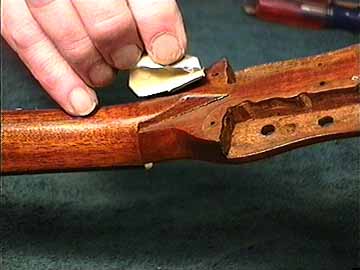
I'll introduce the molded piece to Mr. Beltsander and remove all the excess material that will get in the way of my clamping operation. Then I have a perfect little caul that fits so well I can be confident about my glue-up:
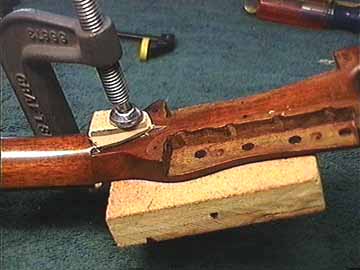
Al I have to do is to squish the glue into the crack, pad the other side of the peghead and clamp normally:
I'm using hide glue, because of the instrument's vintage, the easy water clean-up and most especially because there is no tendency for the glue to "creep" under the high tension of a mandolin tuned to concert pitch.
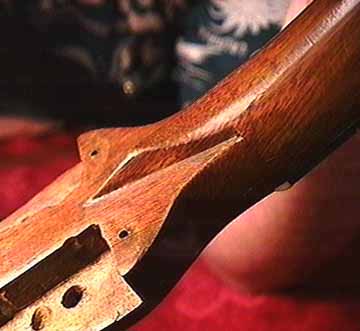
The joint came out looking as good as before the break:
I was able to get perfect distribution of clamping pressure all the way along this carving without the possibility of crushing the soft cedar!