
Installing Strap Buttons
Installing Strap Buttons
Lots of us stand up to play music, yet most acoustic instruments are not made with that in mind. Most are fitted with an end pin at the factory, but few have a strap mounting at the other end. Here's a traditional end pin, which is a tapered peg tightly rammed into a matching tapered hole in the end block of the instrument:
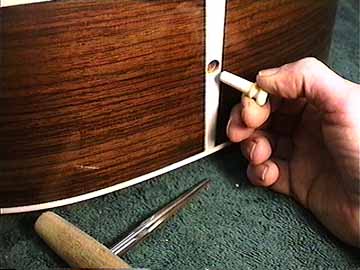
These things can pull out, so make sure yours is tight. If you don't have an end pin, you can always install a screw-in type button.
This isn't a "how-to article," it's more about "where-to." Installing a screw type strap button is a simple piece of woodworking, but instruments are sensitive and it should be left to someone with confidence and experience. Installing a screw requires the drilling the proper pilot hole first.
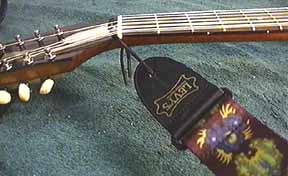
By the way, you can always hang your strap this way:
IT DOES ABSOLUTELY NO HARM TO THE NECK OF YOUR INSTRUMENT TO TIE THE STRAP ON THE PEGHEAD. It's just an old husband's tale that you can warp your neck by using a strap in this way.
Same goes for hanging a guitar on the wall. You can't warp the neck that way. If you really want to warp your neck, you're going to have to leave your instrument in a hot car.
OK, 'nuff of that.
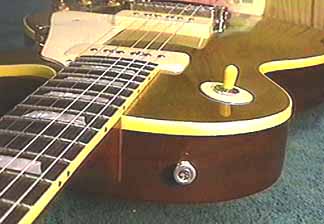
The folks who make electric guitars typically install strap buttons at both ends of the body: This Les Paul has a strap button conveniently located where the guitar will balance well and the strap will be out of the way:
I like this attitude. It relieves us of the stress of trying to decide where to drill a hole in our precious guitar!
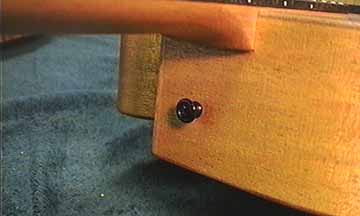
Some acoustic makers are getting the idea, too. Take this Tacoma guitar for example:
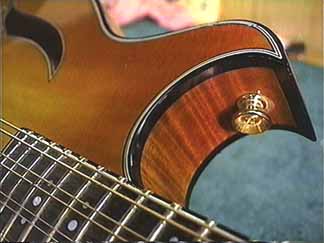
Michael Lewis makes a fine mandolin and installs the strap button so we don't have stress:
Good man.
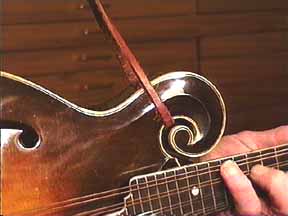
Some Mandolins have built-in strap holders:
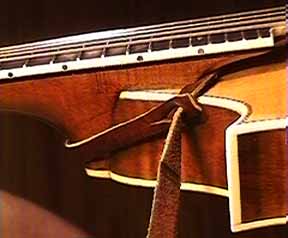
Some guys find creative ways around the problem:
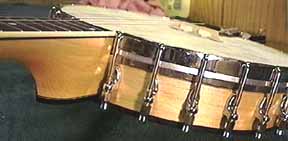
Banjos have 24 strap hangers already built in:
That's cheating!
Let's get to the real issue, where to install a strap button in an acoustic guitar. . .
Screw-in buttons may be metal or plastic, which are equally strong. Metal buttons won't deteriorate with age, so that's what I use. It try to match the plating of the tuners.
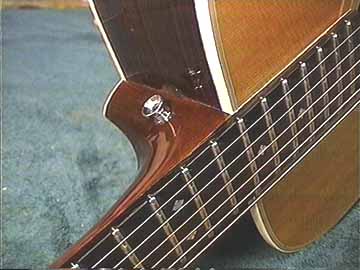
By far the most popular location for a strap button is in the treble side heel of the neck, down where the player doesn't see it, in what Richard Hoover calls the "passenger side" of the neck. Here, the strap draws perpendicular to the button and it's very secure indeed.
When I screw a button in this location, I use a thin leather washer underneath to cushion it against the finish. We don't want to blister or chip the finish. For instruments made with a conventional dovetail joint, the location of the button doesn't matter much except for the visual appeal.
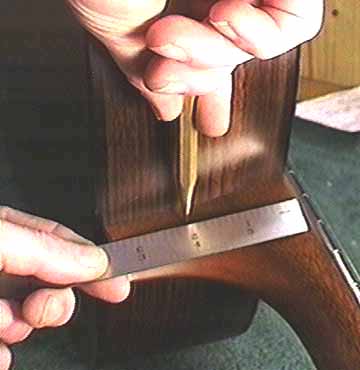
Taylor guitars have bolted necks and the company provides a measurement so the strap button screw won't hit a bolt or crack the heel:
Very thoughtful and typical of Taylor, who likes to nail down all the details.
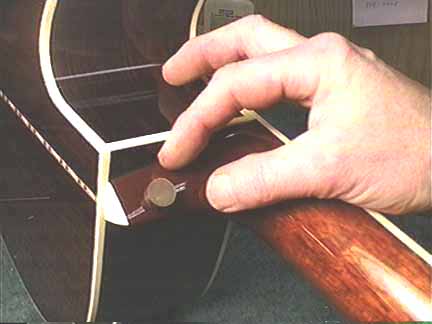
Other makers bolt their necks, and sometimes it's easy to see inside the body where the bolts come through the neck block. If I'm unsure of the bolt location, I'll get out my super-strong rare earth magnet and stick it right on the heel. It's a snap to locate the bolts this way:
Now I can drill a pilot hole midway between the two bolts for my strap button screw.
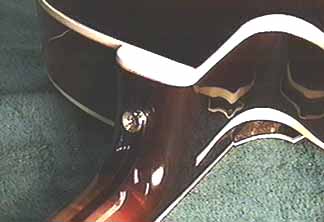
Jazz guitars and others with flat heels make the choice pretty obvious:
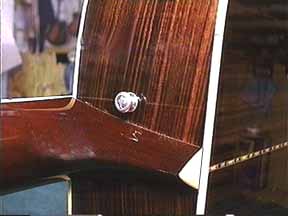
You can place the strap button in the bass side of the guitar next to the neck, screwing through the side and into the thick neck block.
You really don't want to miss that block! A thin guitar side is not able to support a strap button under load.
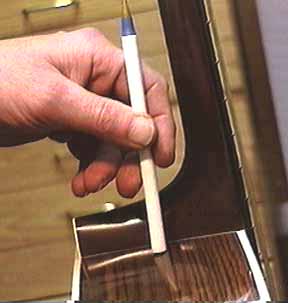
Just like drilling into a plaster wall, you want to hit a stud. It's easy to find the neck block by tapping gently on the side. The tone difference is striking when you tap over the solid block:
Some guitars, such as Taylor and Santa Cruz, have such narrow neck blocks that it's nearly impossible to place a strap button there.
What if you want a strap button in the side and can't hit (or you drill and miss) the neck block. Just glue a 1/4" thick wood reinforcement block inside to hold the screw and all will be fine. Make the block large enough, say an inch wide by two inches high to carry the load. Taper the edges nicely and it'll pass inspection if someone looks way up inside there.
I've noticed that some of the Montana-made Gibson flat top guitars have that sort of reinforcement already built in. Nice idea.
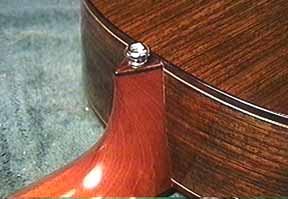
You can put the strap button directly in the heel cap (watch for bolts) and it will be durable and strong there. It's usually the easiest area to touch up if you remove the button later. This is my least favorite position, though, because the guitar has a tendency to "dump" forward when you stand to play.
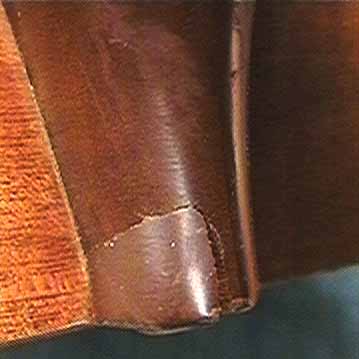
Let me stress the need for a PROPER pilot hole. It's very easy to break these narrow pieces of hardwood, and regardless of the location you must have the right fit for the screw.
Otherwise your guitar could look like this:
It's possible, though not always easy, to split the neck pretty much anywhere you jam in a screw. On maple necks, the likely outcome of a too tight screw is that the screw will break off inside. Yuck!
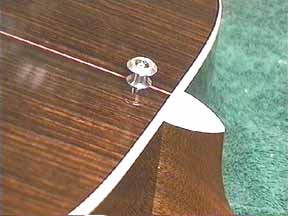
By the way, you can screw the strap button directly into the neck block right through the back:
In case you're wondering, this is the location to choose if you'd like maximum reduction of resale value! (No, I didn't fake the photo. Some guys really do this.)
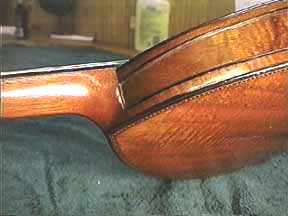
Some instruments just shouldn't have a strap button:
This one has no heel at all, and it would be a shame to drill into the neck or the fancy koa body.
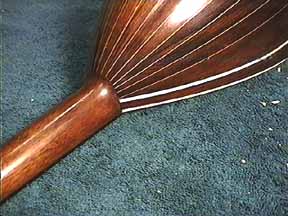
This one has no heel either:
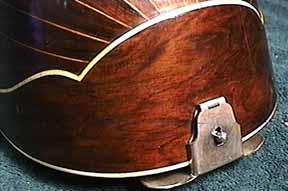
And no place for the other end of the strap:
So, sit down when you play, dang it!
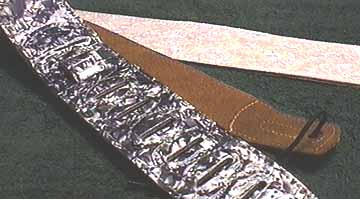
A quick final word on straps. Use any old strap you like:
But if you have a fine lacquered guitar, stay away from vinyl. Lacquer reacts very strongly with vinyl and the results can be disastrous. The backs of some straps are vinyl, and as are the fronts of these. Laying on the strap in your case or sitting in a vinyl or rubber covered guitar stand, the finish can be eaten away. Best to stay away from vinyl, or at least keep the exposure to only the times you're actually playing.