
Fixing Stripped Wood Screws
Here's the simplest woodworking trick in the business!
Almost all guitar tuners, truss rod covers and lots of guitar parts are fastened with really teeny screws. . .
I'll illustrate how to fill and correct the small screw holes that have become stripped by over tightening. In fact, I'll show two variations.
Please read the cautions at the bottom of the page.
If you're working with only a screwdriver, it's still no big deal to correct stripped screws. All you need is a toothpick and a little glue. This trick will work, but not as well, even without the glue.
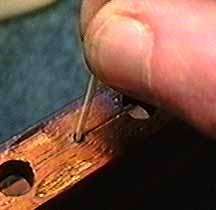
Take a flat toothpick, and stick it in the screw hole:
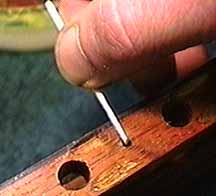
Then, just fold it over to break it off:
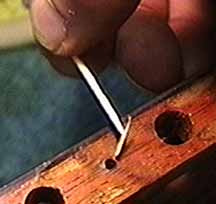
Don't separate the broken piece, just leave it there:
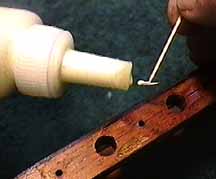
and put a blob of glue on the end:
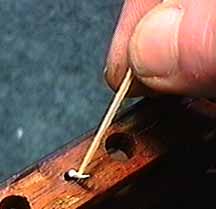
Then stick it back in the hole:
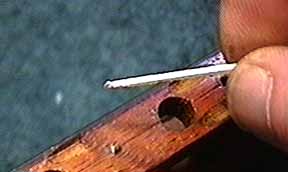
Fold the toothpick over again and twist off the broken end down in the hole:
If there's a little wood fiber sticking up, just mash it back down or break it off with your fingernail.
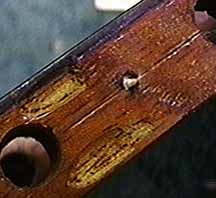
Done!
You can now drive the screw right into the hole while the glue is wet, or you can wait for it to dry, after which the screw will fit more tightly. Note that the hole is filled to about half its diameter.
I know it's almost redundant, but here's an even faster method of doing the same thing. If you have flush cutting pliers like these, or any reasonable facsimile such as a nail clipper, you're in business. A single edge razor blade works well, too, but requires a little more care.
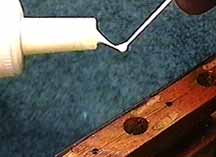
Just take a toothpick and put a glob of glue on the end:
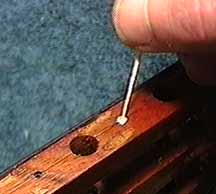
Stick the pick in the hole:
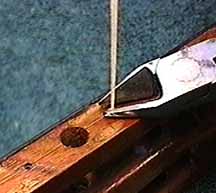
Snip it off:
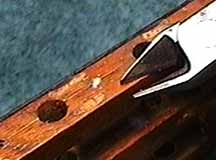
That's it!
Too easy? Then how about some cautions?
1. It's important not to fill the hole completely with a giant piece of toothpick lumber. If you do, let the glue dry overnight. Then you can drill a new pilot hole and reinstall the screw. Otherwise, you could split delicate wood parts or break off the screw because it's going in too tight. I usually try to fill the hole only about 1/2 its diameter. Use flat toothpicks for safety, unless the hole is a real mess.
2. You can use just about any kind of glue. BUT, you have to be careful not to damage surrounding finish. Therefore, it's a good idea to use only water-soluble wood glue (white glue, carpenter glue, etc.) If you use superglue or other strong solvent-based glue you have to be very careful! Too careful, really, since these glues have no advantages in this repair. If you smear water-base glue on the finished surface you can just wipe it of with a wet paper towel.
3. Dealing with a submerged, broken screw is a job for an experienced woodworker. Trying to "drill it out" can cause an accidents and a real mess. . .