
Mandolin Bridge Shim
If a solid bridge is too low, you can usually make one

So here's the problem. This mandolin's action measures 1/32" too low at the 12th fret. It has a nonadjustable bridge:
The top of the mandolin has a slight arch and the bridge fits that arch perfectly.
My job is to raise the bridge 1/16" so that the action will be 1/32" higher at the 12th fret. Generally, I like to glue a shim to the bottom of the bridge to raise it, rather than having to make a new taller bridge.
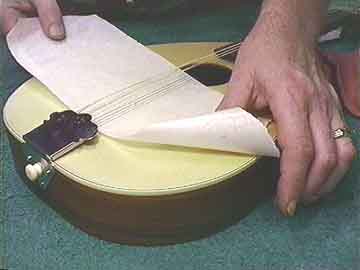
First, I'll protect the top with a wide piece of low tack sign makers transfer tape:
With the tape in place I can fit the bridge without injuring the top of the instrument.
Notice that I'm leaving the strings on, but I've loosened them a lot so I can easily lift them up to remove and replace the bridge.
I'll spend a couple of minutes to make a 1/16" thick shim at least 1/2" longer and about twice as wide as the base of the bridge. Naturally, I'll use material similar to that of the bridge (ebony for this one.) I use my 1"x42" belt sander to make the shim uniformly 1/16" thick.
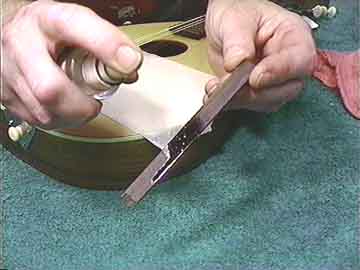
Next, I spray a nice wet coat of cyanoacrylate catalyst (accelerator) on my shim piece before placing it on the mandolin top where the bridge sits:
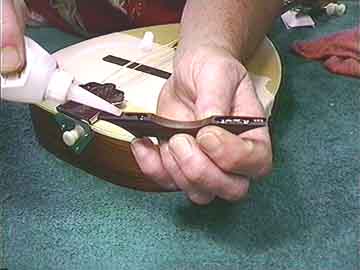
Here I'm laying on a thick bead of medium viscosity cyanoacrylate (super glue)
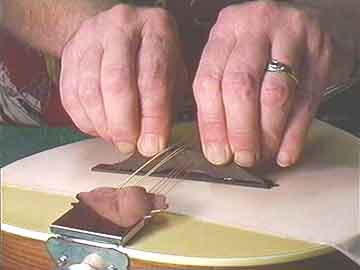
Then, without wasting too much time, I raise the strings and simply hold the bridge firmly in place on top of my shim:
Because the shim is grossly oversize, I don't have to worry about getting the alignment just right. That's a good thing, too, because with all that catalyst the glue sets instantly!
The reason for doing this right on the top of the instrument is so that the shim will fit exactly. If there's any discrepancy in the contour, the catalyzed glue will fill the small voids between the bridge and my shim.
In just a few seconds I can lift the bridge off the mandolin top and slide it out from under the strings. A few passes with my knife, a small plane, or my 1x42 belt sander will make short work of trimming the excess of my shim.
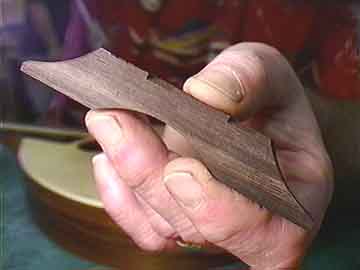
After trimming, the shim is hardly noticeable:
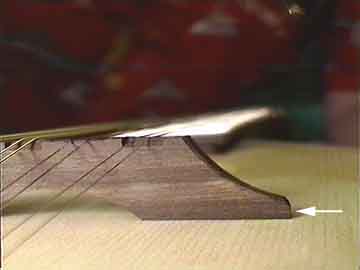
Here's the bridge back in place with its shim glued and neatly trimmed:
If you look closely you can just make out the glue line. The bridge still fits the top very neatly, too.
I could hide the line with a bit of stain, but most of the time it's not really necessary. If I'm working with a particularly black ebony bridge I'll mix a little lampblack in with my medium viscosity cyanoacrylate before I apply it to the bridge bottom. I like cyanoacrylate for this job because the catalyst makes the stuff set right up and because the catalyst also weakens the bond slightly. Later, the shim may be a bit easier to chip off if I need to lower the bridge back to its original height.
Update: July 9, 2000: I just found this little leaflet in a 1914 Gibson mandola case, recommending veneer shims to raise action.