
Cloth Patches
For reinforcing tricky surfaces
First, I'd like to talk about the cloth side reinforcements you frequently see in guitars. They are used to help keep sides from cracking, and for keeping cracks from spreading.
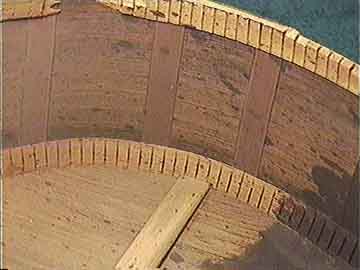
The older instruments were all made using hide glue and regular cotton cloth "ribbons." This is the inside of a 1946 Martin D-28 which had suffered flood, fire, famine and God knows what all:
Notice that the ribbons are still fully glued through their length.
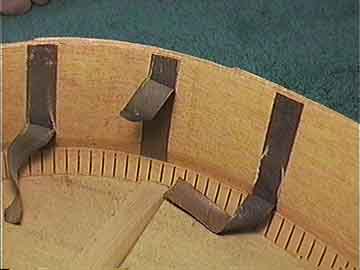
Here's the inside of a more modern D-18:
All the cloth strips have come loose and are simply hanging by their ends. These ribbons were simply stuck in place with a "modern" self adhesive backing. I've seen many modern instruments where the self adhesive ribbons had lost their adhesion.
Clearly, hide glue holds cloth strips far more securely.
Sometimes it's desirable to use heavy cloth as a reinforcement for crack repair, especially on surfaces where it's almost impossible to clamp a wood reinforcement.
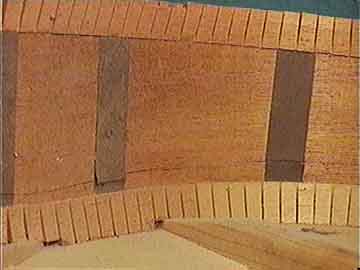
This guitar side is cracked just above the lining.
This is not a "real" repair job. It's only a demo, using parts of a smashed 1965 Martin 0-16NY body. The cloth strip I'm using is bright yellow to make the photography easier. I'd ordinarily use heavy cotton or light canvas, and the color would match the side color as closely as possible.
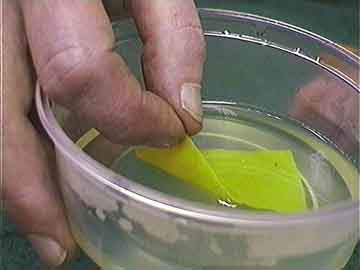
I'll use my regular hot hide glue diluted 1:1 with warm water.
I'm soaking the cloth patch until it is completely saturated in the dilute hide glue. The mixture is at about 150 degrees Fahrenheit, the normal working temperature for hide glue.
If you haven't already, please read my article on using hide glue. It will fill in some of the blanks I'm leaving in the following
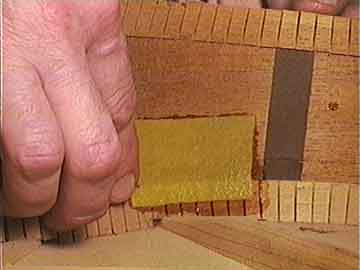
I can reach inside the guitar and rub the cloth patch in place, "ironing" it down, and even sliding it into position if I need to:
As the patch cools and the glue starts to gel, it "sucks down" to the wood and clings nicely.
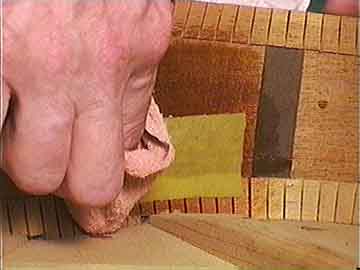
A few minutes later when the patch is fully cooled and the glue gelled, I can dab the excess glue off the patch and surrounding area with a cloth and warm water:
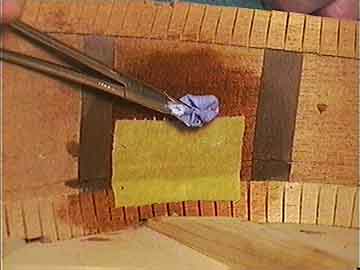
Naturally it's hard to reach way down inside some areas, so there I'll use bits of rag held in a hemostat to clean up the area:
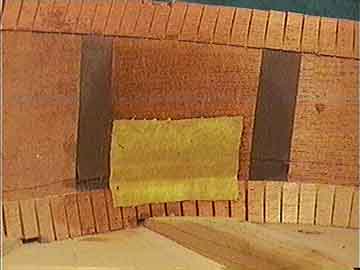
After things dry out, the cloth patch looks pretty good.
There's still a little smear of glue and dust discoloring the side, and I can wash that down again more vigorously, or even sand it lightly if I want to.
The hide glue dries quite rigidly and makes the cloth patch an effective stiffening reinforcement for many situations. Best of all, this is a reversible procedure because the patch can be removed by carefully applying warm water, so future repairs are not compromised.