
Rick Turner Guitars
My field trip to Santa Cruz Rick Turner Guitars
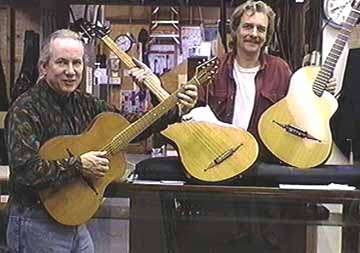
Rick Turner came to visit us at Gryphon yesterday, April 9, 1998
Here he is showing off as he delivers his new guitars to Richard Johnston:Rick is not just a fine guitar builder and designer; he can play standing up without a strap!
I was impressed.

It's April 10, and now it's our turn to visit Rick.
Representatives of the Gryphon repair crew -- Tim Chambers, Mike Gold, and I dropped in at Rick Turner's shop in Santa Cruz.
I must say, he takes a minimalist approach when it comes to the sign outside his shop:
This is the front door. After all it's an industrial place, and not open for the public.
Inside, Rick and his small crew crank out some mighty fine products!
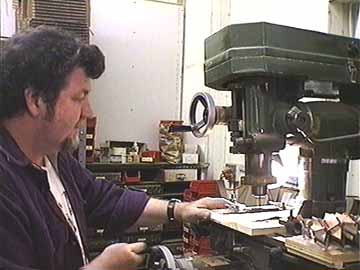
Let's go in and see what they're up to:
Rick's on the phone right now, so Steve Crisp takes a few minutes away from routing bridge saddle slots on the milling machine. By the way, the saddles are slanted backward away from the fingerboard at an angle to improve the downward pressure on the piezo pickup element. A nifty piece of design. That's the kind of small detail that makes Rick's electric acoustic guitars special.
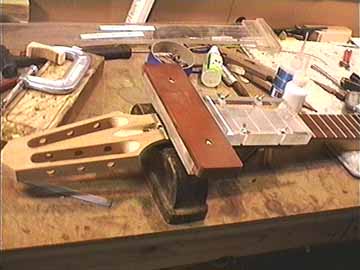
Here's Steve's special nut slot routing fixture:
It's an acrylic jig that fits on top and just level with the end of the fingerboard. The flat plate allows a router to glide across and cut the nut slot perfectly with no damage to neck, fingerboard or peghead veneer. Pretty slick.
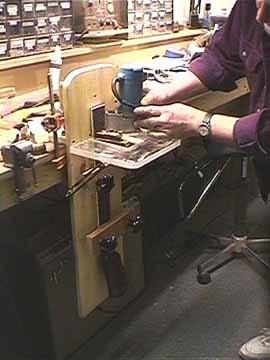
Steve, Rick and the crew also do a bit of repair work.
Steve is showing us a fine router jig he made for truing up the dovetail joint when resetting Martin and other guitar necks. He can set the angle of the acrylic plate to take just a tiny slice off the end of the neck when establishing the new neck angle.
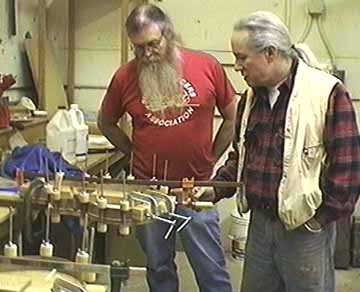
OK, Rick is off the phone and can give us the rest of our tour.
Here he's showing Tim the finer points of their body assembly process.
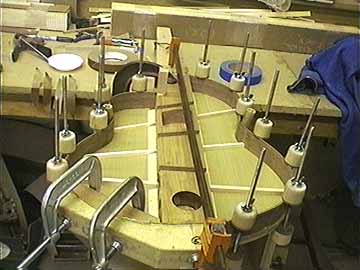
No fancy tooling here, just good common sense and efficiency:
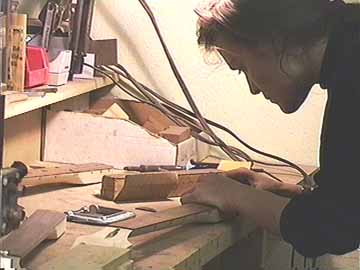
Laura looks intent as she prepares a fingerboard for fretting:
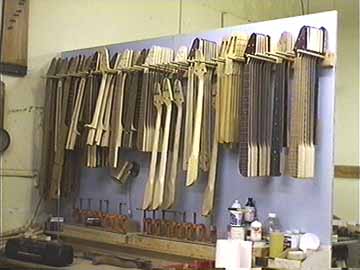
Speaking of necks: here are a bunch of them waiting their turn:
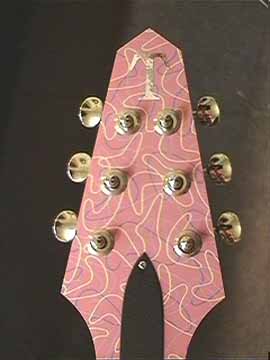
What style!
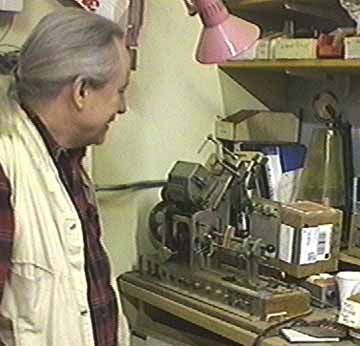
Believe it or not, Rick winds his own pickups right here, too:
Man, this guy is into a lot of projects.
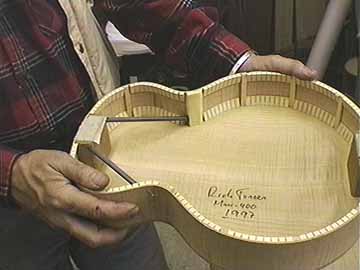
As if that weren't enough, here's a tiny replica of a Gibson Super 400 that Rick is building. He's incorporating another Turner innovation -- a sort of flying buttress affair designed to make the neck block more rigid in its location to resist the string tension and reduce future need for neck resetting:
The two carbon fiber rods make that end of the guitar really stiff without influencing any other part of the instrument. Pretty clever, Rick.
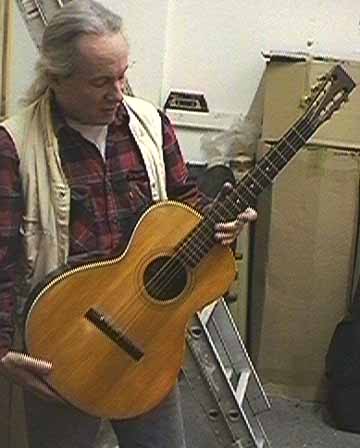
Here's Rick showing us another of his passions:
It's a Howe-Orme patented guitar made by the Elias Howe Company of Boston about a hundred years ago. It has a neck that pivots on the body, so you can adjust the neck angle and action without even removing the strings. There's a little "clock key" adjusting screw right in the heel of the neck, countersunk so you can stick the key right in from the outside.
These instruments have an exaggerated cylindrical "hump" running the length of the top. They are beautifully made and have a unique and high class sound. Rick says he's been collecting them for years and someday would like to make some replicas. I'd like to see those when the time comes!
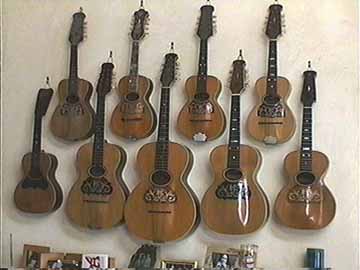
He invited us to his home to see his collection of Howe-Orme mandolin family instruments. Here's the wall in Rick's living room:
You can see the "humped" tops in reflected light. These are really spectacular. Starting from the smallest they are mandolin, tenor mandola, octave mandola, cello mandola. (These are Howe-Orme's designations; the cello mandola is smaller and lighter than other mandocellos.) Only the guitar has the adjustable neck.
It's great to see someone on the cutting edge of instrument development who also recognizes the milestones of the past.