
Figure
Not just wood "grain" or color
Figure is an attractive peculiarity of the appearance of some woods. It may be a deformation of the grain, as in the "crotch" of a tree where the wood fibers are distorted by the branching and weight of the limbs. It may be a wavy grain that appears frequently in some woods and seldom in others. It may be colorful striations of color, such as those found in Brazilian rosewood. Here are a few examples:
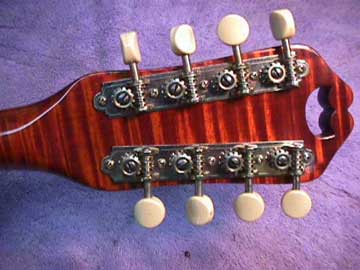
This Martin mandolin neck is made of figured maple:
This pattern of regular waves in the grain occurs frequently in maple and is called "fiddleback maple" because of its popularity among violin makers. Sometimes this figured maple is called by other colorful names, such as "tiger maple," "flamed maple" because of the ancient technique of faking this kind of grain using the soot from a candle flame, "striped maple," or just plain "curly maple."
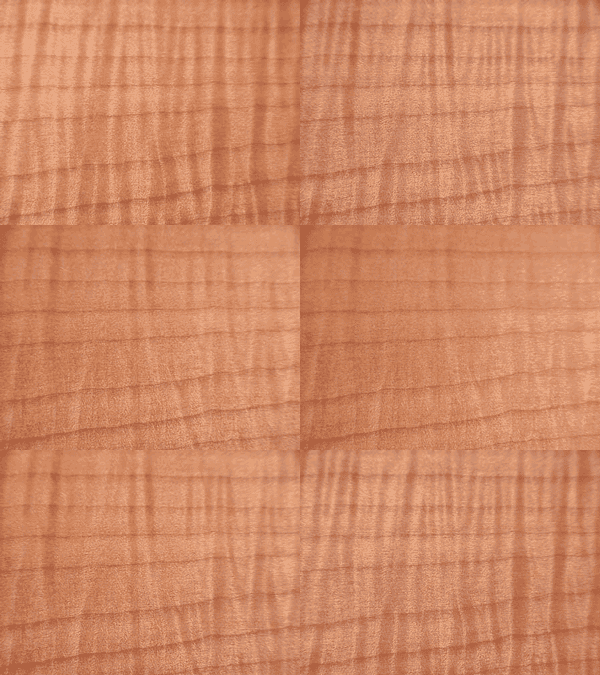
Look at how the curls are highlighted as the direction of the light changes. What you're seeing are reflections from the grain of the wood as it bends up and down the curls.
I took this series of photos by setting my camera on a tripod, and swinging the light in an arc about 180 degrees from left to right.
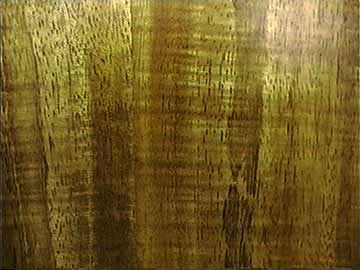
Here's a piece of figured koa:
Even though there's a lot of color variation, we take that as "normal" and refer to the curls in the grain as the "figure" in this piece of wood.
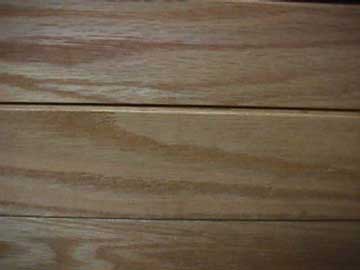
These oak drawers show lots of grain, but nothing we'd call "figure"
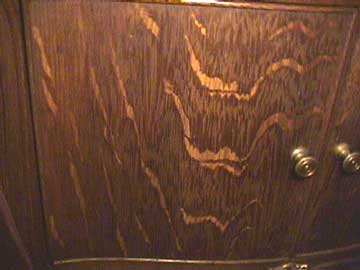
The front of my Victrola is figured oak:
If you cut oak very carefully to maximize the appearance of the normal medulary rays, the result is a stunning figured wood, sometimes called "rift sawn oak."
"Figure" is a somewhat subjective term, but it always refers to a characteristic of the wood grain that's considered attractive. Some characteristics are attractive in some woods and not others, probably for historical and cultural reasons. For instance, knots are generally regarded as a structural defect in lumber, and even "knotty pine" is not considered to be figured wood.
I don't know about you, but I'm starting to get confused. . .