
Tune Up Your Gears!
Sometimes they need your help
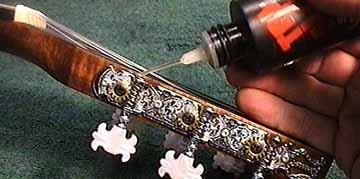
If it moves, OIL it. Not a bad recommendation for all open geared tuners. I see more damage done to open tuners by lack of lubrication than all other causes combined. It takes only a drop at each of the bearing surfaces and on the gears where they meet. Any kind of oil will do, but I like TRI-FLOW, a good household lubricant that's available in bike shops and lots of other places. The best feature of this stuff is the bottle. It comes with a long tube applicator that will reach into almost anywhere, like your car door lock, and will let you see the flow of oil so you can dispense single drops easily. I cut the applicator short for this photo:
Here I'm dosing these gears with a drop on both ends of the "worm" shaft (the spiral shaft that engages the brass gear) a drop on the worm teeth themselves and a drop between the brass gear and the plate. Most inexpensive tuners like these will last a really long time and work smoothly if they get oiled once in a while. How long is a while? Yearly, at most, even if they get used a lot.
By the way, they're called machine heads, machines, tuners, tuning pegs or gears. I like to call them "gears" because that describes how they work. I've always thought "machine heads" sounded stuffy.
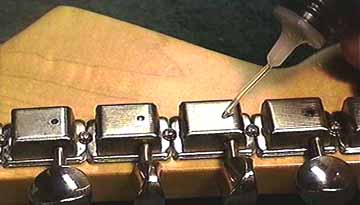
Some enclosed tuners come with little oil holes, and a drop every decade or so couldn't hurt.
Most enclosed tuners, such as the ones later in this article, don't need oil. They come sealed with grease and will generally last a lifetime without a lube job.
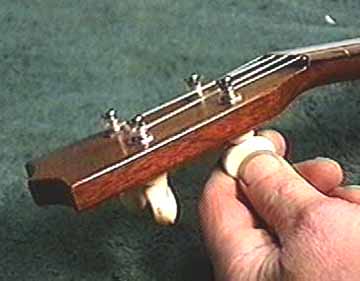
Ukuleles, dulcimers, older banjos and other instruments sometimes come with "friction" pegs. These have no moving parts except the entire peg, and turn directly.
They all count on the friction developed by compressing the parts of the mechanism against the wooden peghead. By tightening the central screw in the button, we can increase the friction and holding power of the peg.
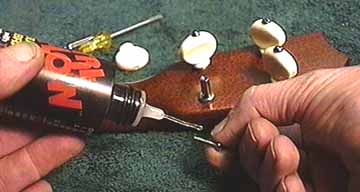
We can improve the performance of these pegs by simply taking out the screw and placing a nice big drop of oil on the threads. When the screw is lubricated we can tighten it more easily without the extra friction caused by corrosion down inside the shaft. It's amazing how easy this procedure is to do and how much it helps these little guys!
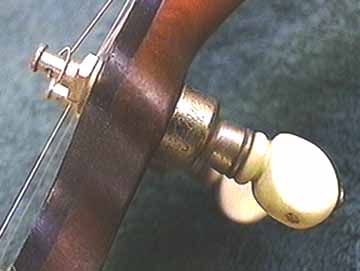
Banjos usually have geared tuners, but they are universally called "pegs" because they are styled to look like friction pegs:
Inside the little housing is a planetary 4:1 gear system. They're lubricated for life, and screw down from the top with a threaded collar like the guitar gears on the next page.
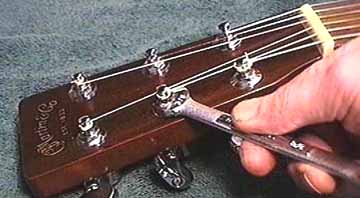
Modern enclosed guitar tuners have cast metal bodies and are usually held in place by a threaded collar that tightens from the face of the peghead. After a guitar has been around a while the wood of the peghead compresses a little and the collars can become just a little loose. This can be very irritating, with loss of tone because the tuner is not rigid. Even more irritating is the buzz caused by the washer rattling under the collar nut. It's very easy to tighten these GENTLY with a little wrench. You don't want to crank hard on these babies, and you generally won't need to do this more than one time. It's just a good idea to check to see that they aren't loose.
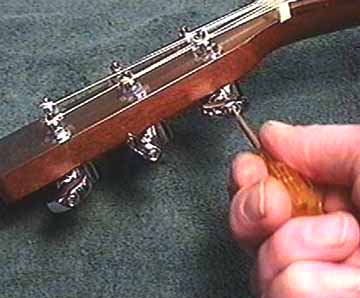
These enclosed tuners, whether made by Grover, Schaller, Gotoh or others, typically have a central screw holding the button. This screw usually adjusts the feel of the tuners by increasing or decreasing the friction between the button and the cast housing of the tuner body. It's a common misconception that making the buttons tighter will make the tuners stay in tune better. It hardly ever works that way, because the worm gear system really can't run backwards. Not a bad idea to check the tuner button screw, especially on older Grover Rotomatic tuners such as those found on Martin guitars:
Here's why:
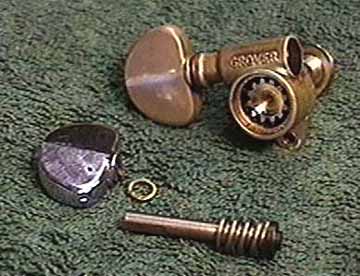
First, let me show you what's inside the gearbox. It's a regular worm and gear assembly just like the open tuners, but it's held together differently. The string post and gear are inserted through the big hole in the back. Later a round plug covers the hole. Then the worm is slipped into the housing and it is retained by the button screwed on at the other end:
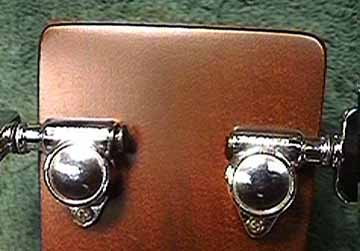
Mostly on older American made Grover Rotomatics, the button screw has a tendency to work loose. (Modern Grover Rotomatics are made in Korea, and don't have this problem.) Then the string tension takes over, forcing the worm back out of the housing the way it was originally assembled. Look at the tuner on the left. The worm has inched out about 1/8" so far. You can actually see the first full turn of the spiral gear:
This is bad news. And insidious. Since the string tension forces the button back toward the housing, the guitar player isn't even able to feel or see the difference from the front of the guitar. Eventually, the worm advances so far that it runs out of teeth to engage the round gear. When that happens, it's very likely the worm will break off one of the gear's teeth, and then the entire mechanism is dead. Moral of the story: If you have older American made Grover Rotomatics, keep a close watch on those dang buttons!
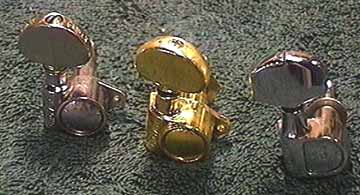
How to tell the difference, you ask. Well, it's very easy. Check out this photo.
On the left we have an American Grover. It has a SLOTTED screw in the button. The gold one in the center is also says "Grover" but it is Korean, with a PHILLIPS screw. Some years ago Grover quit making a lot of products in Cleveland and started importing them from Korea. Just for kicks I threw in the Schaller (German) on the right, which also has a slotted screw.
Should you care, here's a good rule of thumb. American and German gears tend to have slotted screws, and Asian ones have Phillips. In the case of Grover, all American ones have slotted screws and all Asian ones have Phillips.
If you'd like to be prejudicial about it: The real ones have slotted screws in their buttons, the copies have Phillips. Schaller still makes all their own gears in Germany (note the straight edges on the buttons.) There are probably more copies of Schaller tuners than any other. To the best of my knowledge, Schaller copies are not made by or for Schaller.
If a tuner carries the guitar's name, like Martin, Ovation or what, it means that the guitar company simply ordered enough from the gear maker to have their name stamped. None of the guitar makers actually manufactures tuners.
Are the "real" ones better? In my opinion, not necessarily. It's just an opinion, but I see good and bad examples of all these things. . .
Back to the open tuners. Open tuners have their gears held on by a screw. When this screw works loose, the gear can fall off. This is not good. Another very common misconception is that you should tighten the hell out of these screws to make the tuners hold better. It doesn't work that way. The screw just holds the gear on and keeps it from falling off. On some tuners, it's very easy to tighten the screw and unintentionally clamp the gear against the plate, making the whole thing work very poorly indeed.
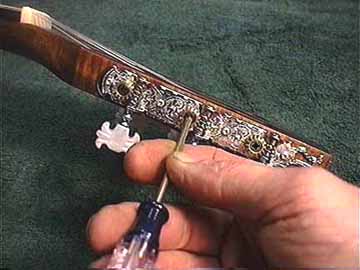
Here's another quickie rule of thumb. If the gear is held on by a Phillips screw, the tuners are more likely to be Asian or European, and less likely to be impaired by over-tightening the screw:
These are Asian gears, and you can tighten the screw without pinching the plate. A good way to check it the screw binds the gear to the plate is to tighten it sometime when you've taken the string off and see if you can wiggle the gear back and forth. If you can move the gear easily with your fingers, then you've got no problem.
The tiny wood screws that fasten the gear plates are easily stripped out by over tightening. Individual gears usually have these tiny little screws, too. These screws should be tight enough to hold the gears in place. If yours are stripped, check out Fixing Stripped Wood Screws. It's easy, and anyone with a screwdriver can fix a stripped wood screw!
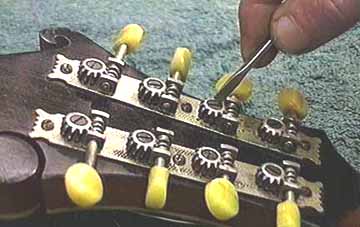
American gears, especially older ones, are much more likely to need sensitive treatment. These tuners are on a Gibson mandolin made about 1920:
I have to be very careful to tighten these screws VERY gently to avoid pinching the plate between the string post and the gear. The looser these screws are, the better the gears work. I mean that literally.
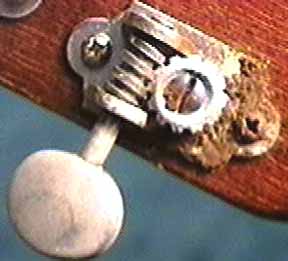
What's wrong with over-tightening the screw? Well, it goes like this: If the gear binds against the plate, then the string will not be able to pull the gear back against the worm. Then when you tune up to a note, you're not only working harder, but the tuner post will tend to stay bound in that position. Since the gear will not be exerting any backward force against the worm, the worm is free to loosen. When the worm backs off a little under normal vibration, it may begin to rattle. That's irritating! Even if the worm doesn't rattle, it can vibrate backward a little. Then at an inopportune moment the tuner post and gear can jerk back, taking up the slack. It's weird, but by tightening and pinching the gear against the plate you can actually cause a tuner to be less likely to hold the pitch. When in doubt, oil them, don't soak them in salt water:
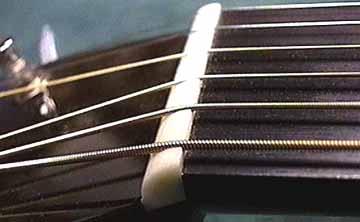
I've included this close-up of a nut to illustrate a popular misconception. It's really common for a string to "bind" in the nut. It could be pinched because the nut slot was cut incorrectly. A string sitting in a nut made of material that is too soft will actually make a negative impression of its windings. These little ribs will cause the string to jump in tiny increments as it is tuned up.
A string that binds in the nut will cause a "ping" sound as it is tuned to pitch. It may ping several times, or every time it's tuned. It may ping just once in a while. It's very common for fragile strings, such as the octave G string on a 12-string guitar, to break before they reach concert pitch. That's because the string is binding in the nut and greater tension is required to tune it.
When you tune your guitar and it pings or breaks strings, it's natural to blame the tuners, but it's more than likely the nut's fault.
It's a simple matter for a guitar technician to clean up the nut slots with special little files, or to make a new nut of bone (my favorite material.)