
Guitar Inspection Camera
It's cool!
This is the INSIGHT guitar inspection camera from Chapin Guitars San Jose, CA
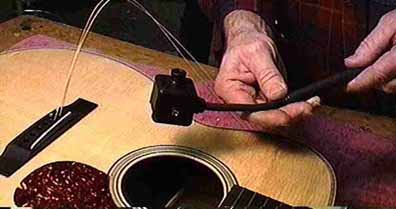
It's a miniature surveillance camera on a little flexible stalk. It fits easily into any flattop guitar's round soundhole and connects to monitor or VCR via standard RCA jack. Even though it's only B&W, it gives an outstanding view using only the light that passes through the soundboard from an ordinary desk lamp. Its lens will focus very close, or afford a full depth of field.
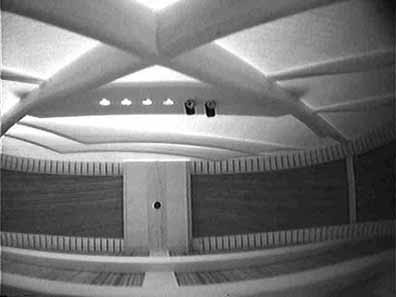
Here's a view inside a Collings OM-2H.
It's like walking into a guitar shaped room!
When Bill Chapin described this camera to me, I thought it sounded a bit too good to be true, but I was wrong (first time ever!) Bill hosted one of the every-other-month meetings of the Northern California Association of Luthiers and showed off the camera rig. I was immediately hooked and when he told me he would be gearing up to produce them for sale I insisted on being his first customer.
So it's a pretty fine tool for examining the inside of a guitar. Even better, it's the most amazing teaching aid. For years I've struggled to explain what I'm doing with my hands & tools inside a guitar. In January 1998 I used it as part of a repair demonstration and lecture a the Roberto-Venn School of Luthiery in Phoenix. You should have seen the eyes popping out like Wile E. Coyote's! For the first time everyone could see what I was doing inside there. . .
Bill says he uses it to show customers the insides of their guitar to be clear in describing the damage that needs repair. I'm starting to use mine that way, too.
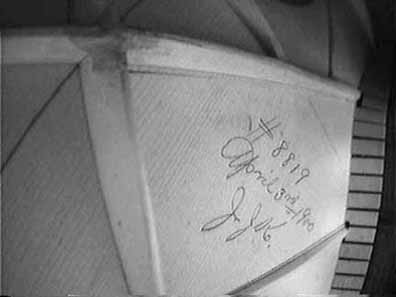
Some more inside shots from the INSIGHT camera. . .
The craftsman at Martin signed the top as this 00-28 was being assembled. Martin guitar tops were customarily signed in this manner from about 1886 to around 1902. You can also see the pencil lines for brace placement.
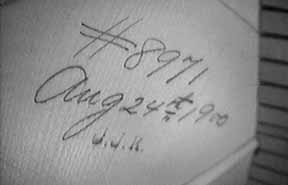
Hey, look at what I found! Here's the same guy signing the top of an 0-34. Looks like he got a rubber stamp later in the year. . .
Yeah, and using that stamp saved him such a lot of work!
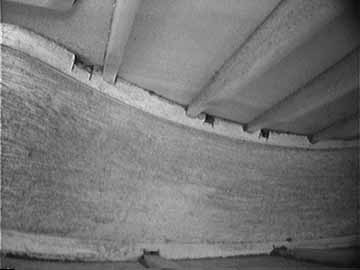
How about this one. It's an original Selmer Maccaferri guitar, just like the one Django played. The top lining was mortised in the wrong place for the braces. No big deal, we'll just chop out new mortises and leave the old holes; nobody will notice:
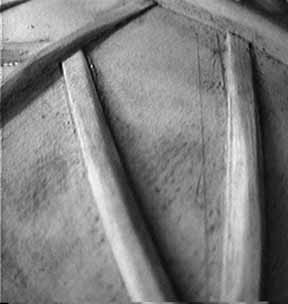
Here is a detail shot of braces and pencil lines in our old Martin harp guitar. It appears they changed the location of one brace at the last minute:
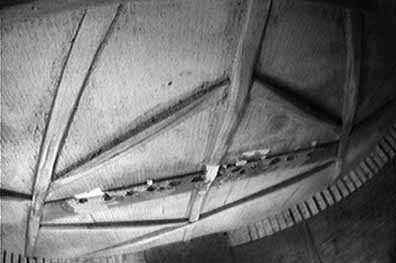
The same harp guitar showing the damage at the bridge plate and the unusual modified fan bracing. Remember this one dates from around 1870 or so:
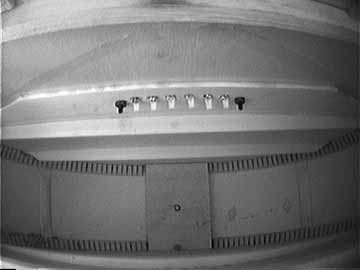
Wow! You ain't gonna believe this one:
It's a mid-50s Gibson J-200. You can see the scars where the original cross braces were removed when this one was skillfully converted to Harmony style "ladder" top bracing. Yep, all the top braces were neatly removed, except for the bridge plate, and transverse braces were installed. You'd be hard pressed to see how this was done, the job is so neat. Obviously the back was removed, but there's nearly no sign of the work.
The current owner bought this guitar used more than 30 years ago, and there was no mention of the "repair." This is one midrange "honker" of a guitar now!
Reminds me that I never see anyone looking inside guitars when they're buying or trading at guitar shows. Why is that?
So, is it a Harmony J-200, or a Gibson Sovereign?