
Vogel Guitars: Shop Tour
Quito, Ecuador
Photos and commentary by Bob Vogel
"How did I get to Ecuador? Now that's a good question. I'm going to write a book on how I got into this situation some day, but let me give you a quick rundown here, without wearing out your ear.
Let's see, I studied architecture at USC, worked 7 years as an architect in Mammoth Lakes California, moved back to L.A. in 1985 and got a degree in Composition and Arranging from Dick Grove School of Music in Studio City, and then traveled extensively. I got married in Quito in 1989, lived for two more years in L.A., and then moved to Quito in 1991 with my Ecuadorian wife Zulay.
Ecuador is a place of great opportunity, and great risk. First I started a record company. I designed and built two recording studios, a mastering studio and offices. I imported audio equipment, set up a cassette duplication facility, and trained the staff. My record company produced Christian music in
Spanish, so I was kind of a "musicianary".
Then in 1994 I became pregnant with the idea of making guitars. A friend gave me a book called 'How to Make an Acoustic Guitar,' a tiny X-Acto knife, and a tiny X-Acto saw. There were no guitar factories in Ecuador, just small workshops limited to making traditional classical guitars. I saw an opportunity.
In January of 1995 I hired two workers, bought a few hand tools and a router, and began to make electric guitars. Alright, I'll admit it; the first guitars were pretty crude, but thank God, amazingly, we sold them and the company was born." - Bob Vogel
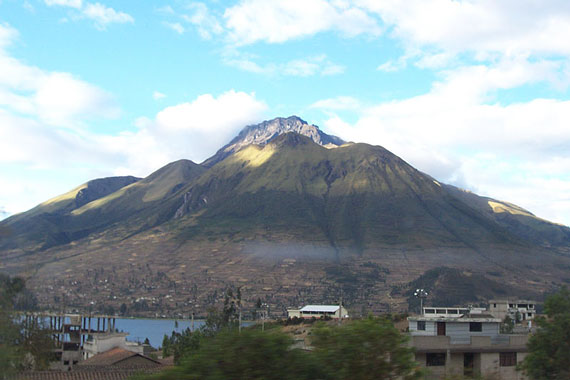
"Ecuador is an ancient land of jungles, volcanoes, Indian villages, and high valleys. My guitar factory is in Quito, the capital of Ecuador, with a population of over a million. The photo is of the Otavalo area, an hour north of Quito, with a view of lake San Pablo, little hand-farmed fields climbing the sides of the volcano, and a layer of wood smoke hovering in the valley."
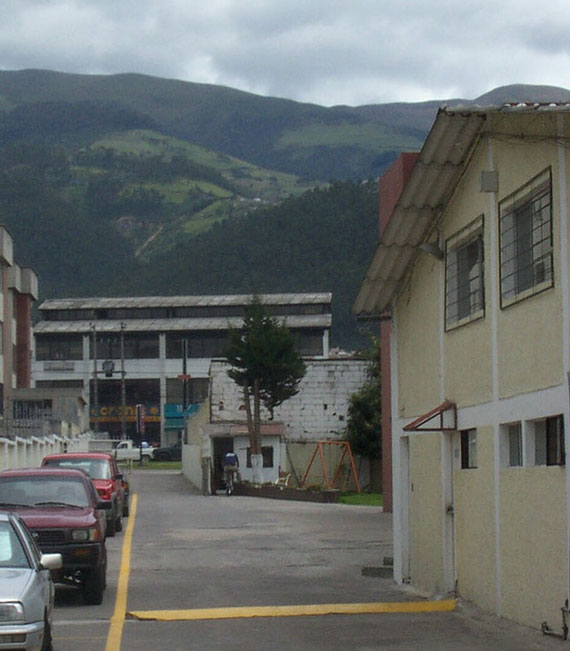
"Here is the outside of our plant. Before we got here an ice cream and plastics factory called this home. Our plant is on the right. You can see the guard shack in the center of the photo. AT the top of the photo is the active volcano Pichincha, which erupted a couple of years ago, spreading layers of ash on Quito. If it ain't one thing it's another."
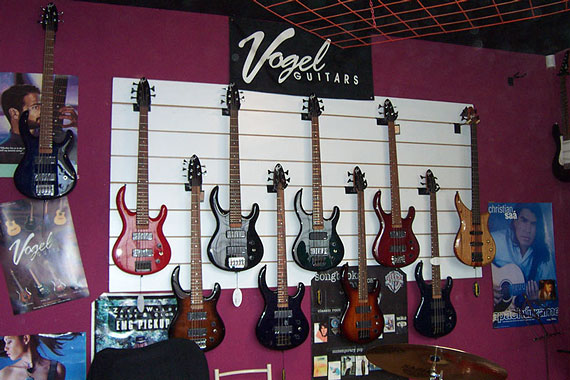
"We have a small retail store next to the factory."
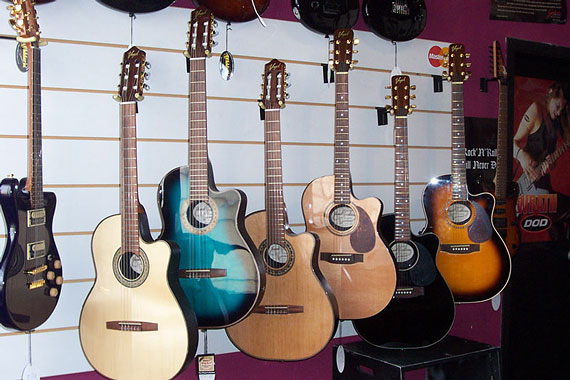
"We make a lot of colorful classic guitars, like the green sunburst in the photo. We make sunburst, green, blue, wine colored, and black classics. Our acoustics, and classics have the same body size, but with different bracing, woods, and interior construction, of course. Ecuadorians, for all their conservative nature, like colorful guitars. On the left is a 12 string electric solid body. These all hardwood guitars sound great!"
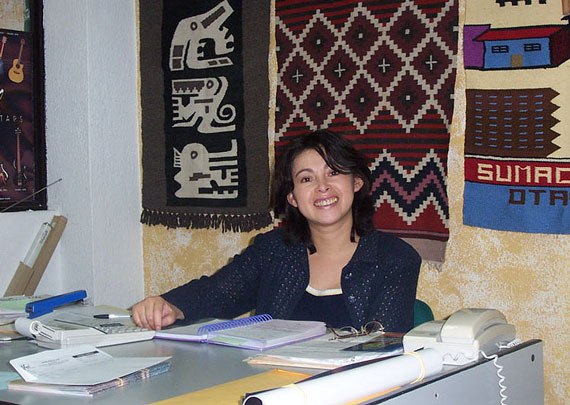
"Sandra Mora is our cheerful saleslady. She also orders parts, runs the office when I'm gone, organizes publicity, deals with around 20 commercial accounts, and generally holds the whole company together with her good business sense. Thanks Sandra."
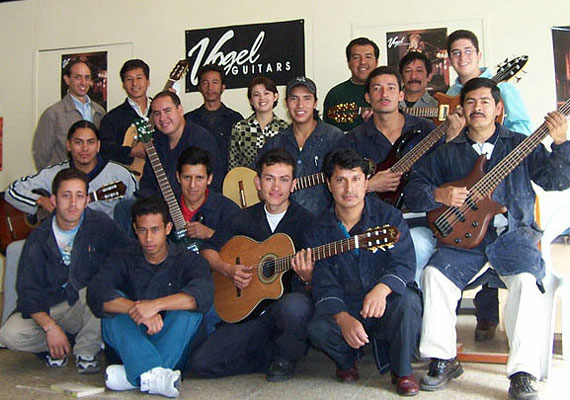
"Vogel Guitars team. We have around 15 guys in the factory, a couple of sales people, a couple of armed guards, and a warehouse man. Our guards work 12-hour shifts, changing every two weeks to work the swing shift. They never take vacations."
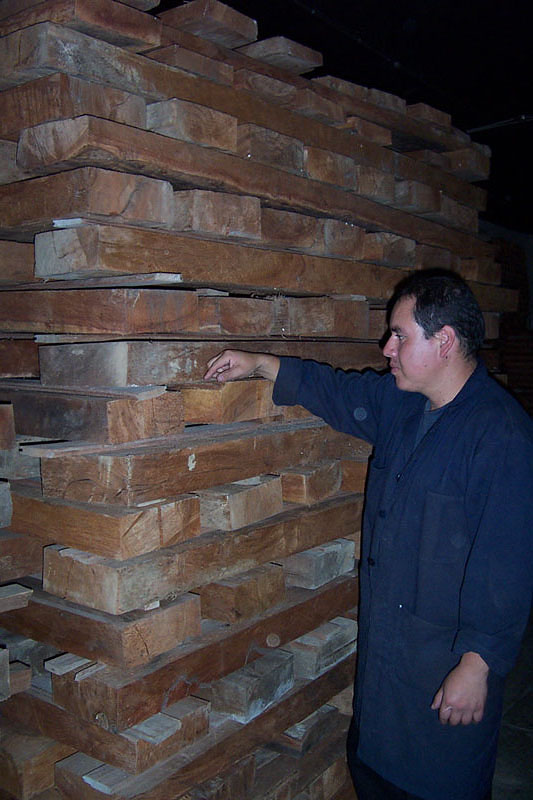
"Wood in Ecuador comes in a standard size called a 'tablon' or some variation of the same: 2x10 'Tablon', 4x10 'Doble-Tablon', 4x8 'Viga' (beam) and occasionally 4x4 'Columna.' Length is always 8 feet long. Wood is felled and cut on-site in the jungle, and trucked up to Quito. Frequently the tablones arrive with mud all over them."
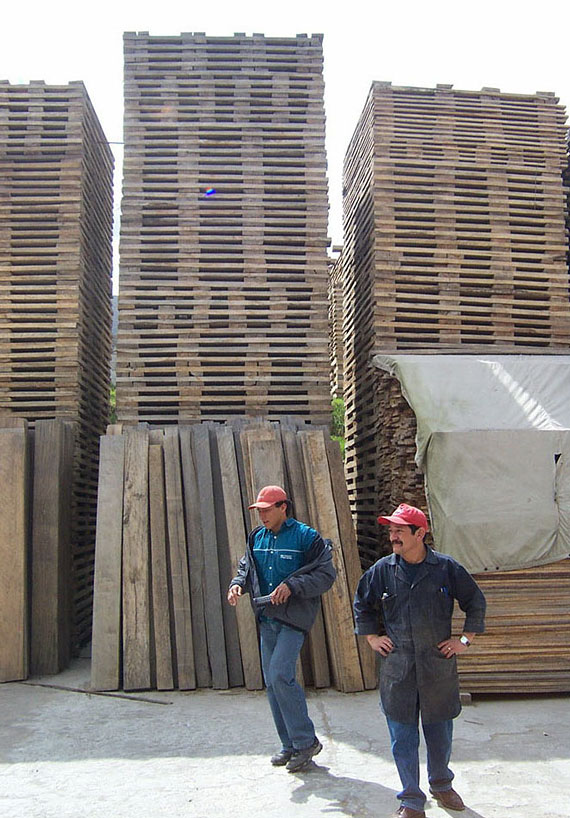
"This is typical of the lumber yards in Ecuador. It hurts me to see all this nice hardwood stacked up outside, exposed to the elements. Air drying in Quito doesn't work well because the air is very dry and the boards dry too fast and check. Many times the boards are useless due to checking and cracking."
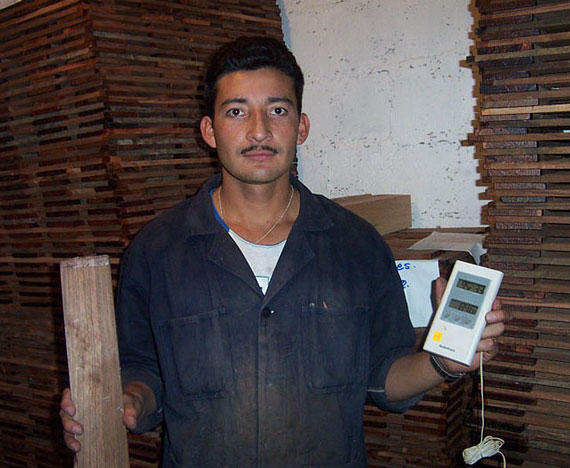
"We air dry the wood for a while in our warehouse, then cut it up and put it in a drying oven. Only hardwood is available, but in a stunning variety from 'Cedro' almost as soft as balsa, to 'Caoba', a wood so dense I'd be surprised if it floats. The Sitka Spruce, Engelmann spruce, and Western Red Cedar tops for the classical and acoustic guitars are imported from Canada."
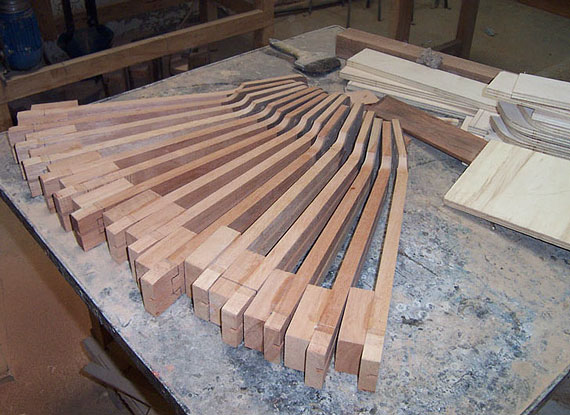
"A batch of Acoustic guitar necks. We use "Colorado Fino" wood for the acoustic necks, which is a variety of hard mahogany, with a fine reddish color. In these necks the adjustable truss rod has been installed, and covered with a strip of wood."
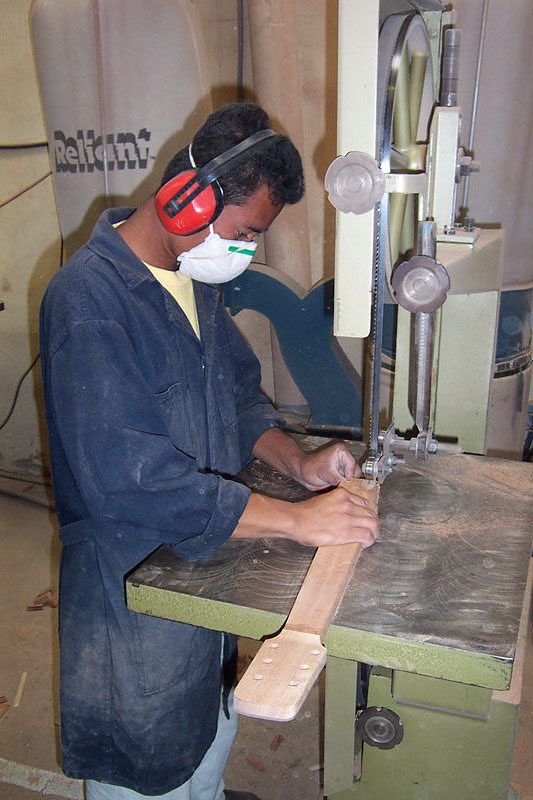
"Wilson band saws out the necks. Then we use a jig on the pin router to clean up the edges."
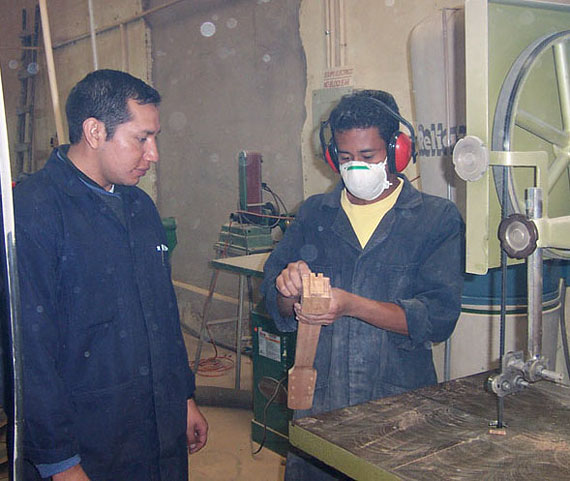
"Wilson roughs out the dovetail neck joint on the bandsaw. Miguel Osorio checks his work . Miguel is an industrial engineer and supervises the whole factory operation; personnel, equipment repairs, tool and material buying, etc."
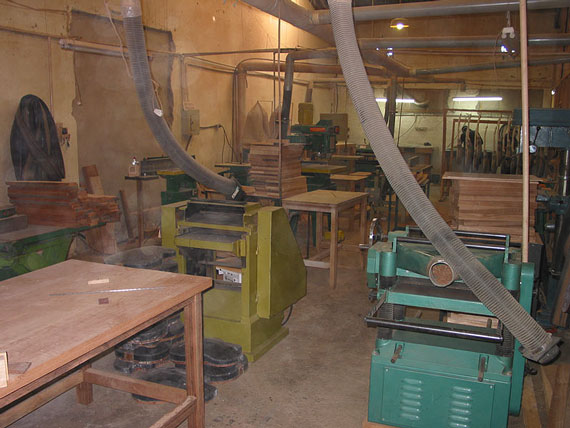
"Here is an overview of the woodshop. Our wood shop uses standard woodworking machinery, and jigs."
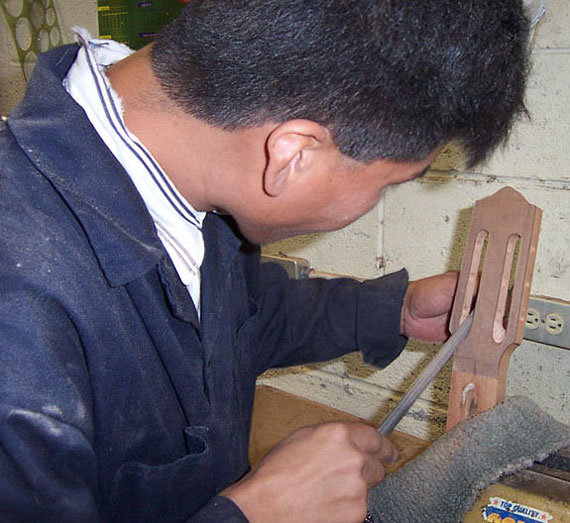
"Jose uses a file to smooth out the holes for the classic tuners. Is there a name for these holes?"
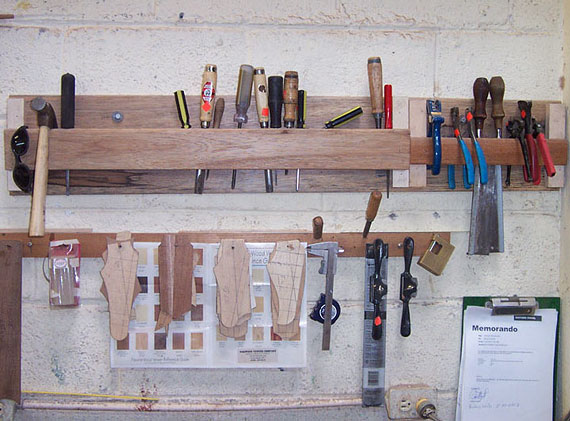
"These guys love their hand tools!
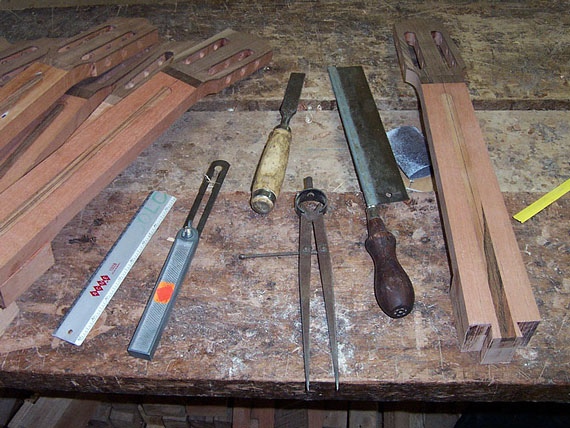
"Someone once said a trip to Ecuador is like walking into a National Geographic magazine. That's true."
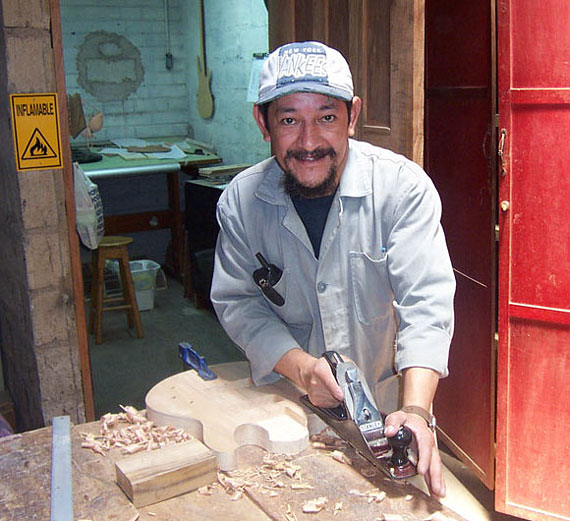
"Hernan works on some 6-string bass bodies with his handy Stanley plane. Hernan is the shop foreman, and has been with me from the beginning, in January 1995."
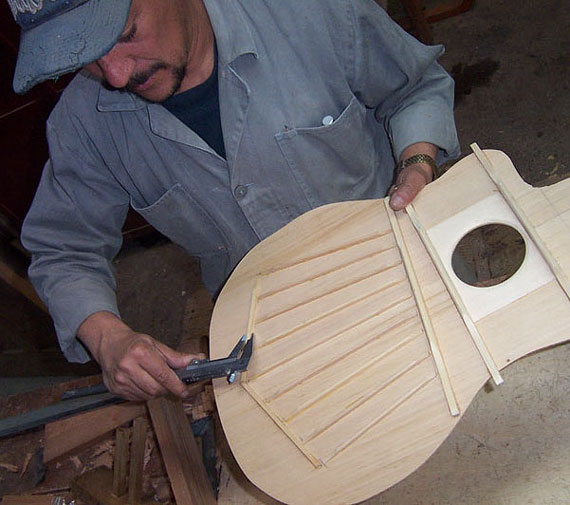
"Hernan checks his work on a new bracing pattern he is trying out. He likes to experiment on new designs, and, unlike the rest of Latin America, always comes to work early."
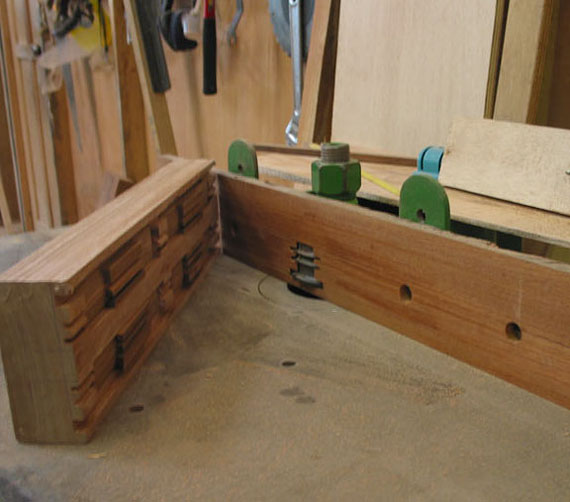
"This is a very simple jig to make classical guitar bridges. The shaper blade cuts the correct slots for the bridge and the string-tying block, and the rest is cut and sanded by hand."
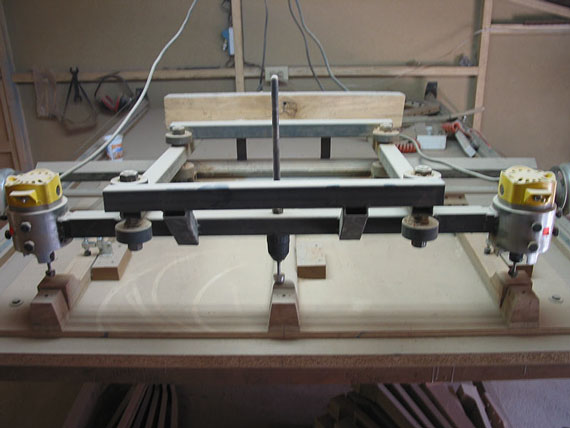
"Our poor man's CNC. It's a small router-copier we use to rough out the heel of the necks on acoustics and classics."
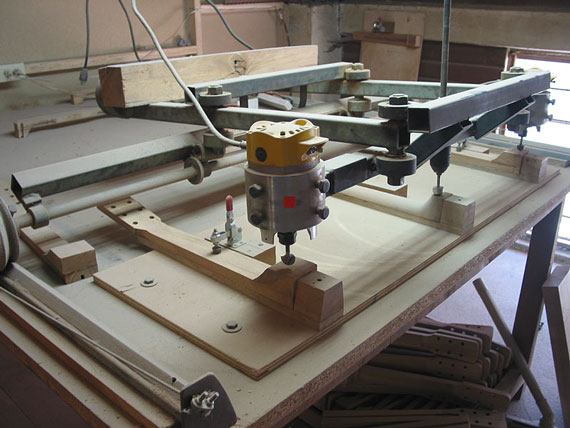
"We don't have a CNC yet, but plan on getting one when finances permit. Labor is cheap compared to the US, so it is harder to capitalize new equipment."
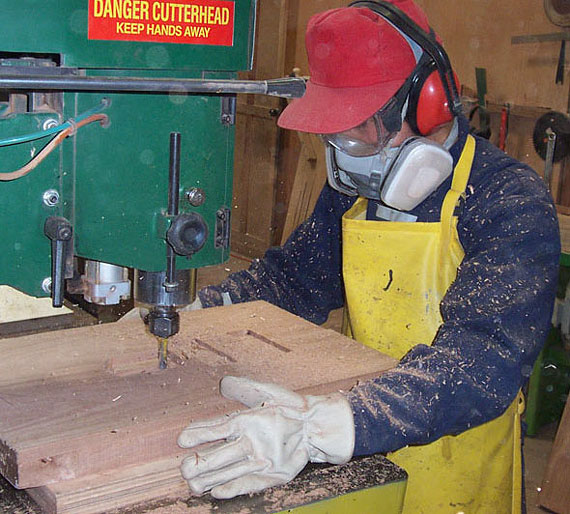
"Here Luis Castillo routs out a guitar or bass on a pin router, our biggest machine. Notice Luis's stylish use of primary colors."
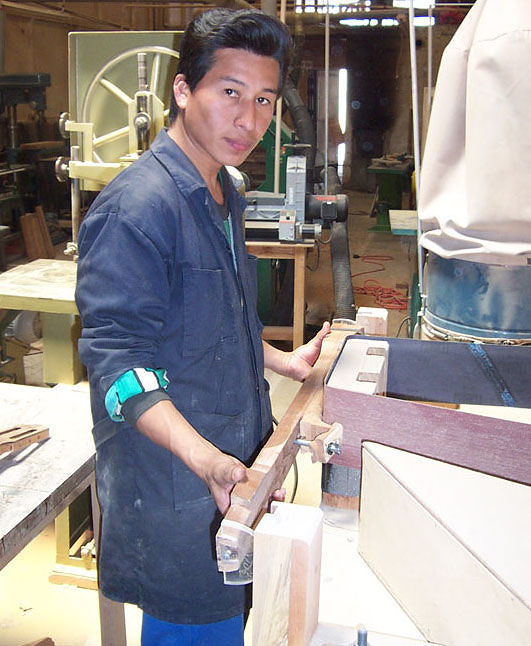
"Making guitars in Ecuador is a very challenging, but rewarding experience. The richness of the personalities involved and the inherent reward of making and selling a product keep it enjoyable. Our market has been exclusively in Ecuador. More information can be found at VogelGuitars.com
"We made a neck sander like the one we saw on FRETS.COM, at the Fox shop. It took us a good while to get the thing to work right. It kept burning up the belts, but since we discovered graphite cloth for the fixed cauls, the thing works great. We have a different cauls for each model, various sizes of belts, and each model has its own round guides for the neck jig which run in slots. We have learned a lot from FRETS.COM, and from visits to Klein, Taylor, and others who have generously opened their doors to a misplaced gringo loco guitar maker."
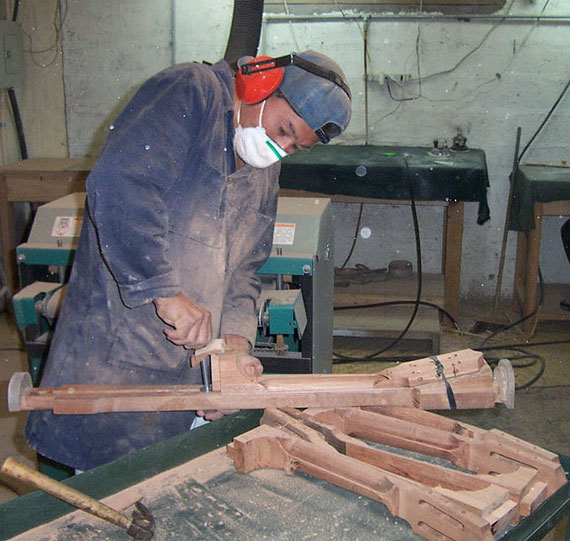
"Jose is attaching the neck to the jig which runs in the channels on the neck sander."
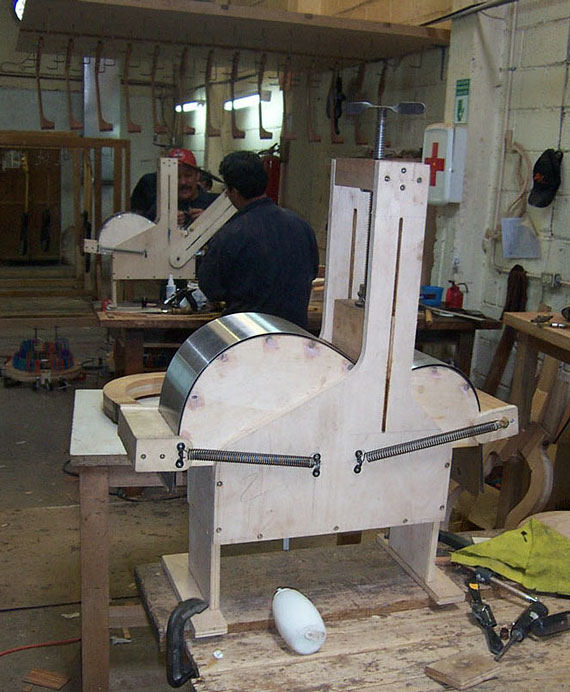
"We use the Fox bender I bought from Luthiers Mercantile Inc. I think we need more heat."
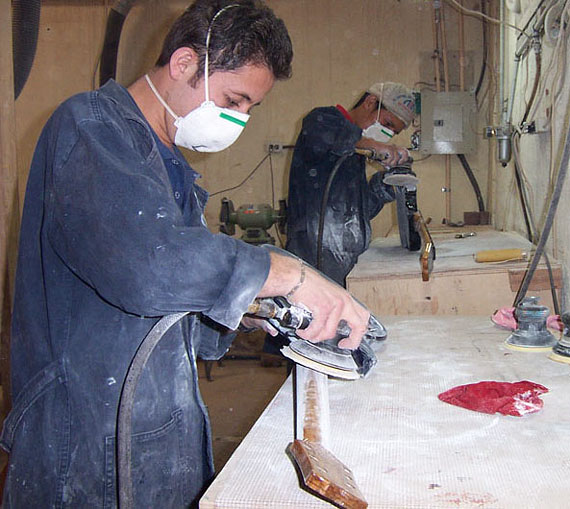
"Kleiner and Manuel sand electric guitars with 5" pneumatic sanders. I built sanding tables, with a perforated top, and an extractor, but they never use the extractor. The table tops are covered with rubber mesh I buy at the 99 cent store in the USA."
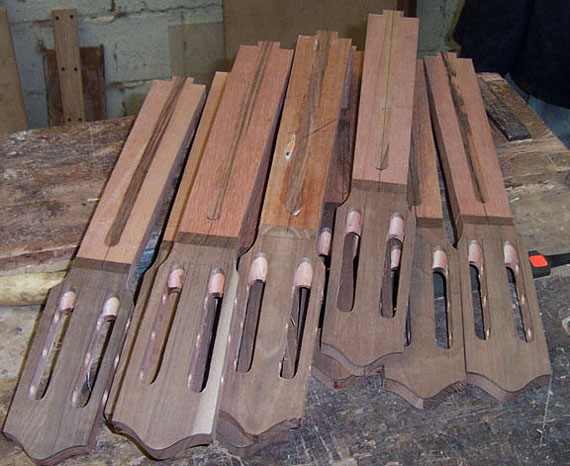
"Notice the inlay on the classic necks. We use a strip of Caoba or Clavellin, both very hard woods, instead of a metal truss rod. The necks are "Cedro" which is also called Spanish Cypress."
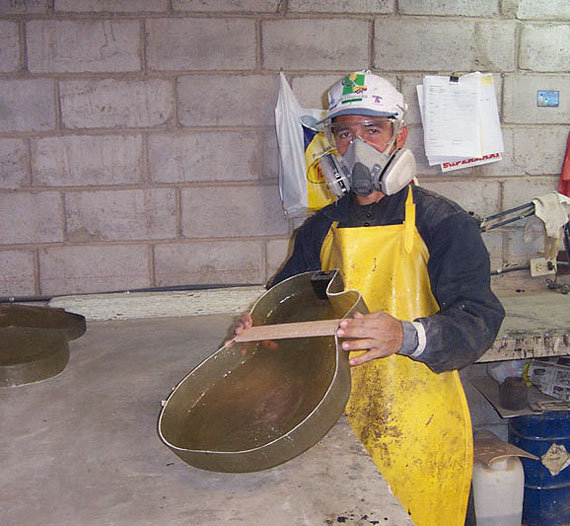
"Luis is showing us one of the fiberglass back shells we use on some of our classics and acoustics. The shells are laid up by hand, using fiberglass, resin and a paint brush, and are very lightweight, as well as being extremely stiff, which we find gives a nice snap the sound of the guitars. We also make all wood guitars."
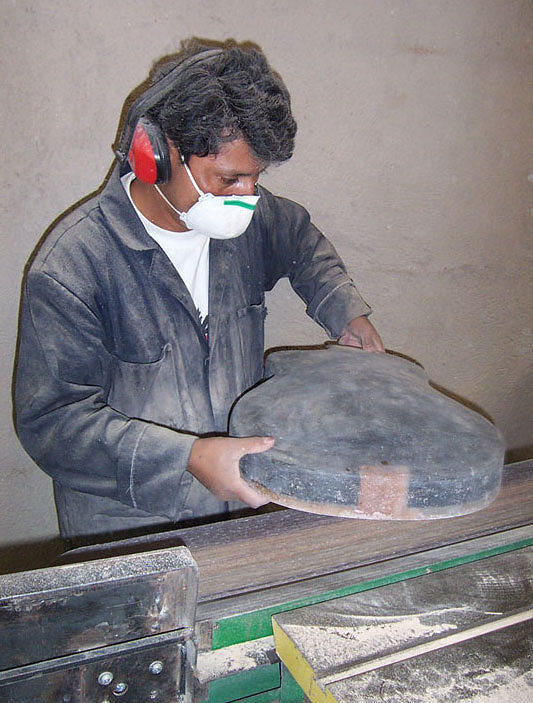
"The 'arillos' or kerfed lining strips are glued with epoxy into the shells, which are then sanded flat."
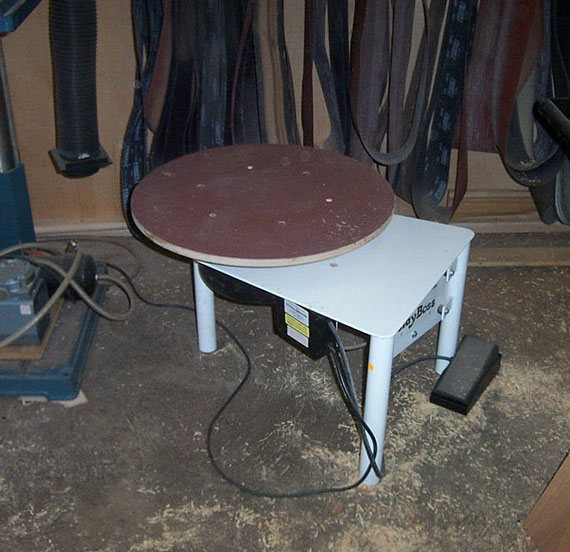
"Clayboss sander. I bought a Clay Boss pottery wheel and we use it to sand the radius on the sides. Again, I saw this on Frets.com!"
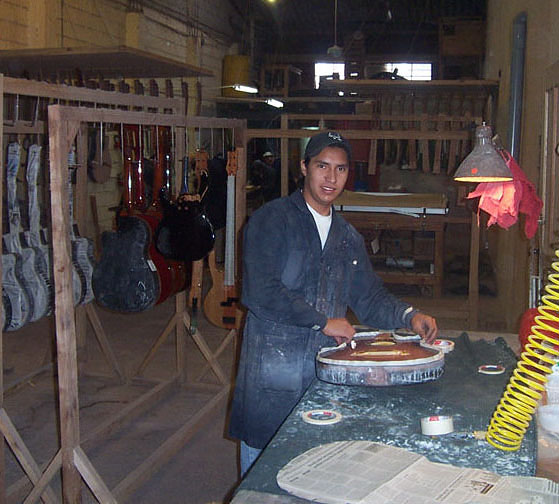
"Cesar Torres masks a guitar top. Tops, backs and necks are all lacquered in different operations, which means three masking operations on each guitar. Behind Cesar is a 48" x 96" vacuum table we use to clamp the braces on the tops. We can do a dozen tops at a time."
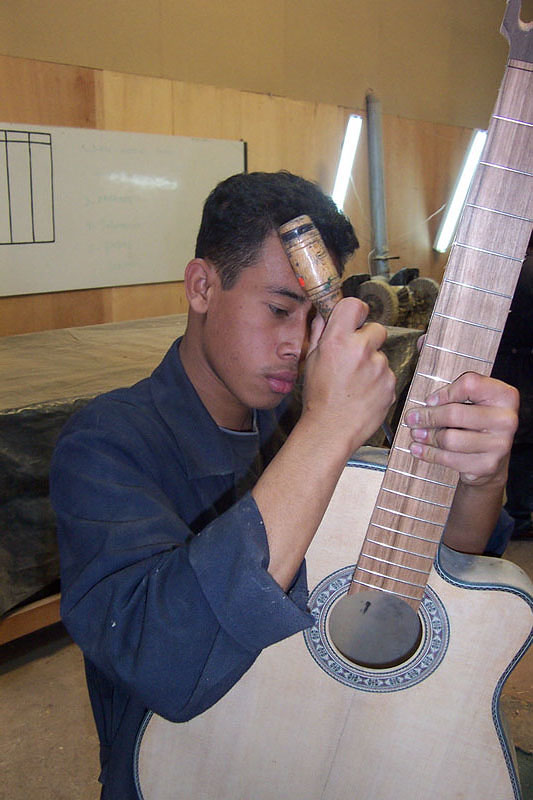
"Wilson cleans up the heel on a neck with his 3/4" chisel. Wilson came to us without any previous guitar making experience, and has progressed rapidly. He went from Aprendiz (apprentice) to Ayudante(helper) and is currently working toward Maestro (team leader). Each Maestro has a team of one or two helpers. The teams make their own parts (necks, braces, bodies, etc.) and work on 30 guitars at a time. We have three carpentry teams and two lacquer teams. The assembly area is a team of two, and the fiberglass area is another team of two. After work the guys play volleyball or soccer until dark."
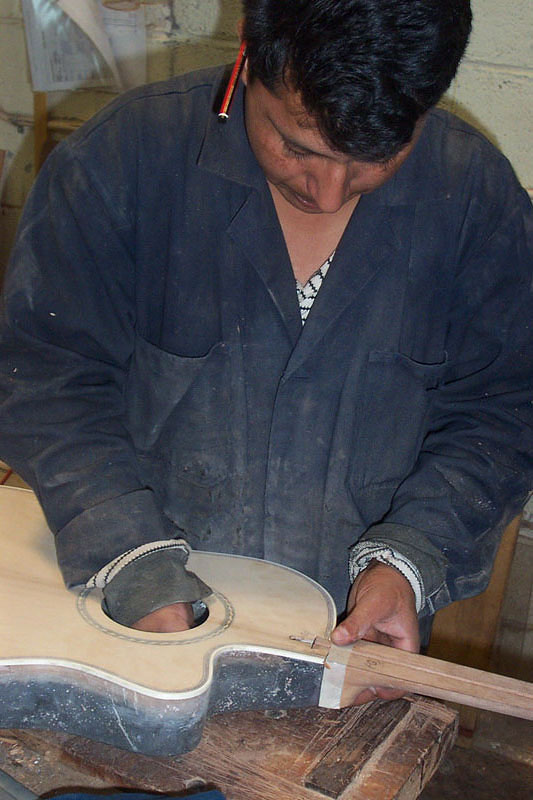
"The neck is fitted to the body and a bolt installed through the neck block into the heel. The fitting operation is done with a chisel and takes a long time. We use a 'colipata' or dovetail joint at the neck to body connection. Then we glue it in with epoxy, and then we put a bolt through the neck block into the heel. I guess that ought to hold it. The carpenter in the photo is named Cergio Bladimir Chuni. Another worker is named Stalin Sanchez Sanchez. I'm not making this up."
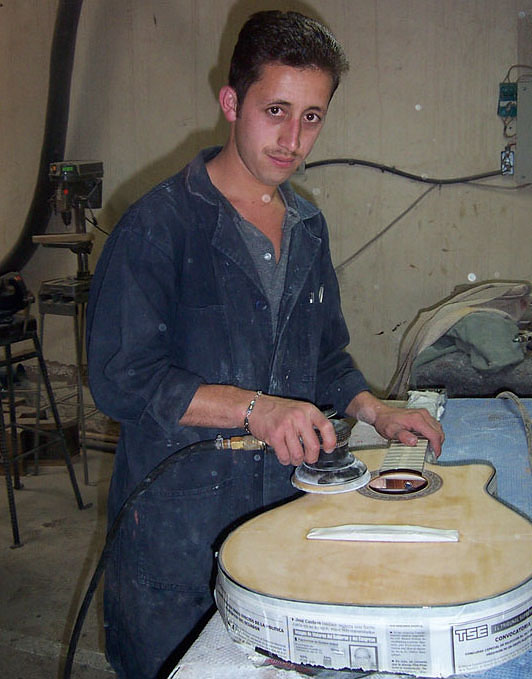
"We use 5" pneumatic disc sanders, except when we sand by hand, which is more often than I'd like to admit."
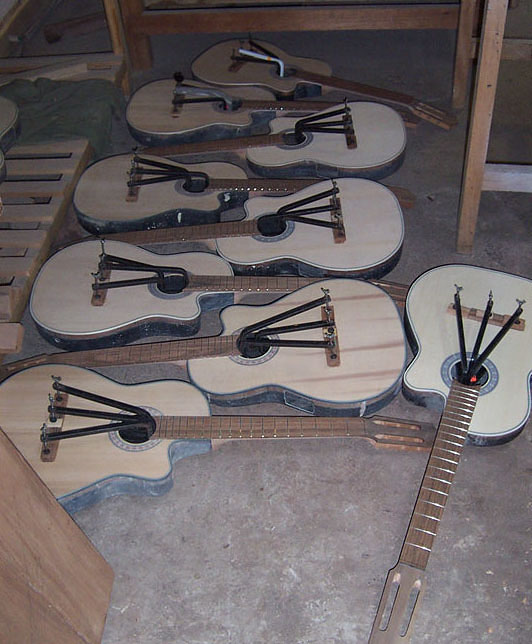
"Gluing the bridge to the top."
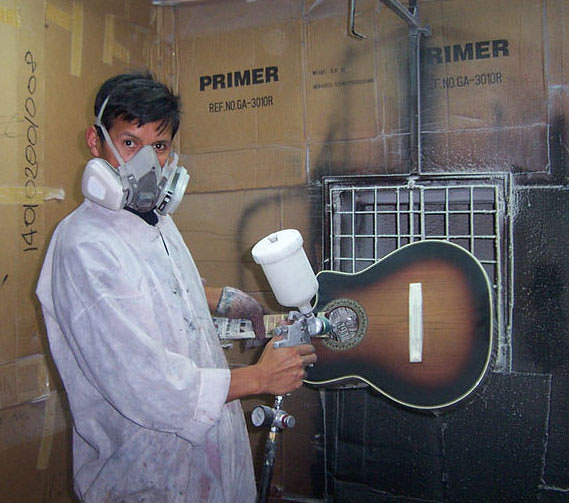
"All spraying is done with HVLP guns. We have 2 spray booths with extractor fans I bought from Graingers. Most other guitar makers in Ecuador simply go outside and lacquer their guitars on the sidewalk. "
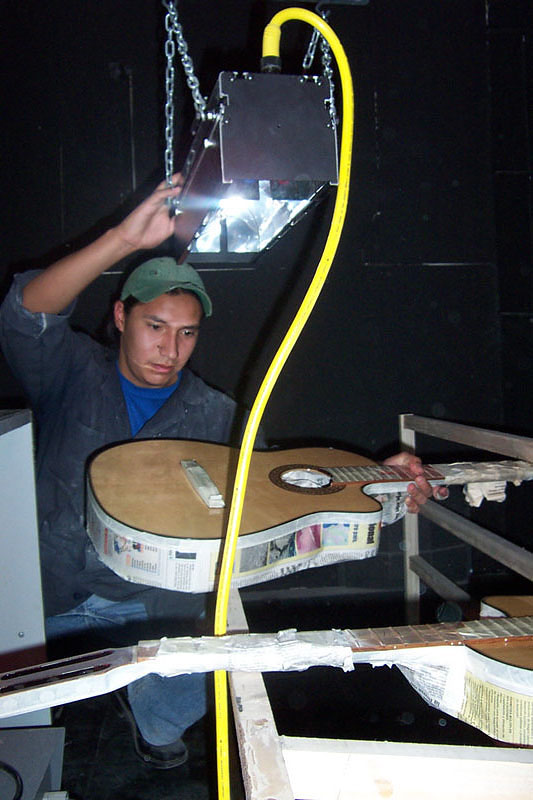
"We wanted to have a UV curing oven like Taylor has, but after much consideration decided to use a UV light on a tripod, paint our curing room black and make the whole thing like a curing oven. Perfect for our cheapo operation. The light is not on in this photo, but the flash makes it appear so."
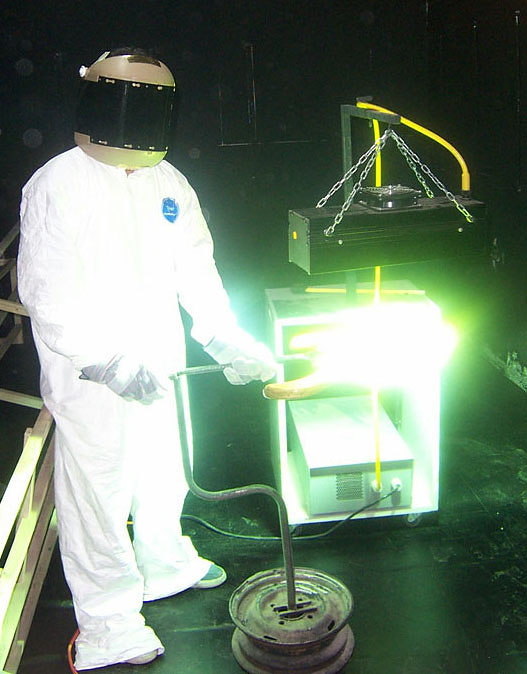
"Here the light is on, and our guy is suited up. The power supply is mounted in an equipment rack with wheels, and the light on a metal arm overhead. The idea is that they lacquer the guitars, lay them on the drying racks, and move the light over them. Presto! Manuel got the nickname 'El Oso' because they think he looks like a polar bear in his white suit. Where they saw a polar bear I have no idea -- it certainly wasn't anywhere near Quito."
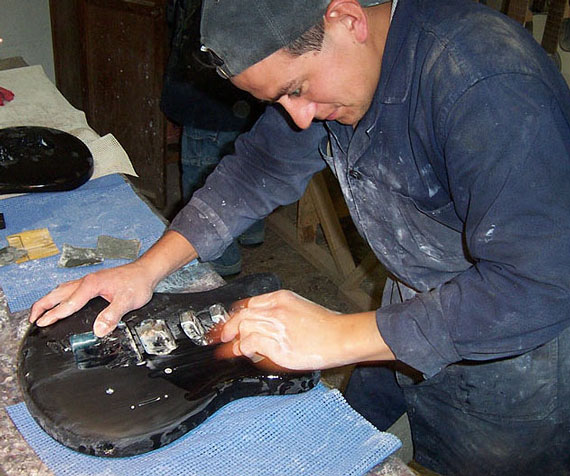
"The final sanding is always done with wet paper, the last step before buffing."
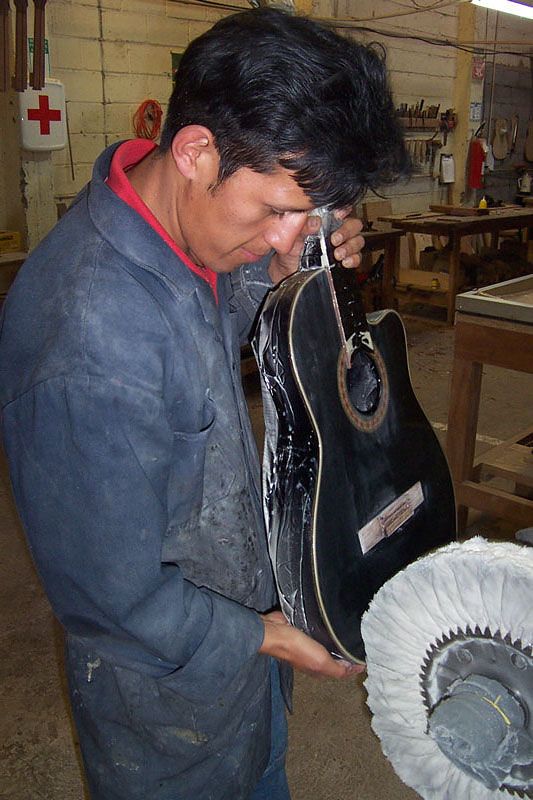
"We use Menzerna wax for final buffing, which is not only expensive, but also heavy, making it even more difficult and expensive to get to South America. We haven't found any other alternative, however, for that glassy finish."
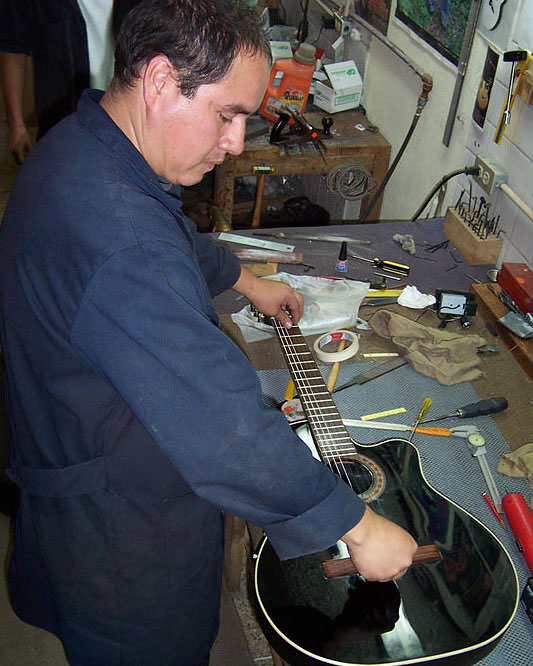
"Gonzalo is good at what he does. He takes time on each guitar to fine tune the fret details, work out string height, install electronic components, and perform a final quality control check."
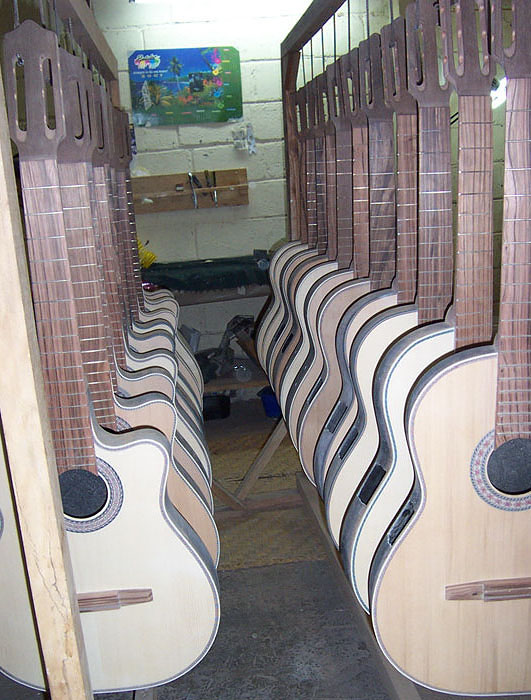
"Here is the indispensable photo of hanging guitars, times three. Our monthly production sometimes reaches 65 guitars."
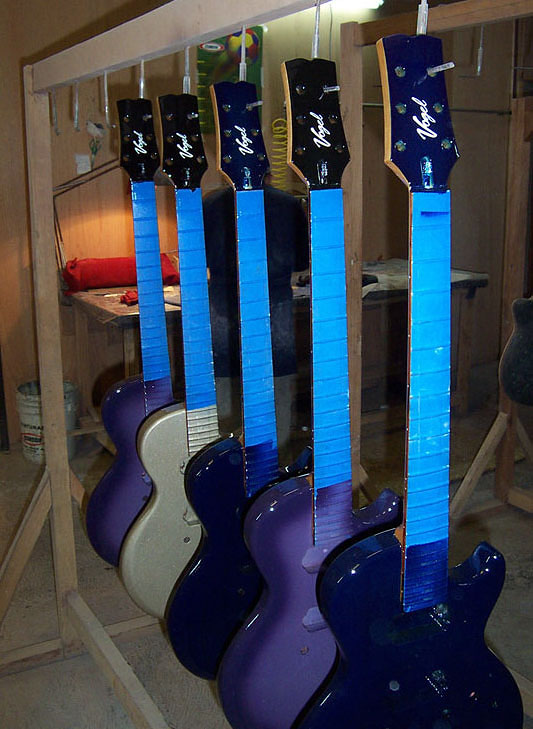
"3M blue low-tack tape is not available in Ecuador, but sure is handy to use on the fingerboards. It doesn't leave any residue. I bring it from the USA."
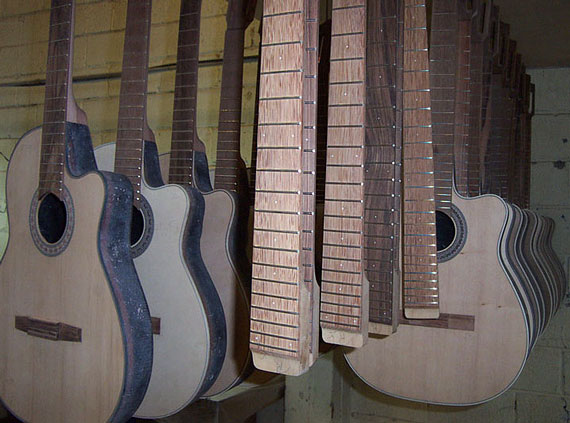
"Bass guitar fingerboards. This light wood is called "Chonta Caspi". We also use a similar dark wood called simply "Chonta" which is actually the bark of a palm tree, and is so hard it dulls the machine tools. Chonta is used for stakes and fence posts because it won't rot, even in the tropical dampness. Any other wood that is used as fence posts either rots, or sprouts. So far we haven't had any trouble with our fret boards sprouting, but you never know."
"I thank God for his help in making Vogel Guitars a reality." -- Bob Vogel, October 12, 2002