
Looking at Frets
Guitars have 'em, banjos have 'em, mandolins have 'em. . .
Yep, all guitars have frets. Without 'em, steel string guitars and mandolins just wouldn't work. The strings just wouldn't ring with any sustain because the vibration would be damped by the player's fingers. Other instruments such as banjos and basses have fretless versions, but the majority use frets to define their notes. In fact, the shape and condition of frets is really important for tone production.
Let's take a look at frets and some of the ways fret problems can be diagnosed.
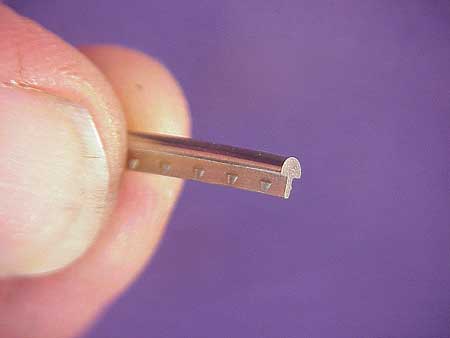
Here's a piece of "fret wire" which is tapped or pressed into slots in the fingerboard:
As you can see, it has little barbs along the portion ("tang') that actually goes into the fingerboard slot. The portion above ("crown") has a "half-round" cross section.
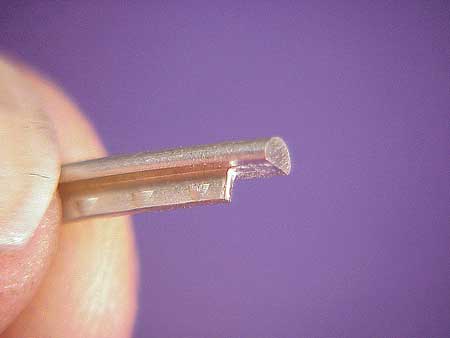
For installation in a fingerboard with binding, the tang portion is usually cut back so the crown can overhang the binding:
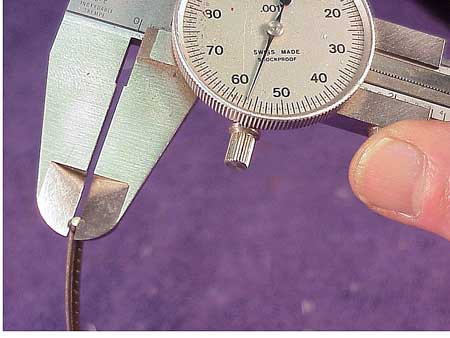
With the tang cut back, it's easy to measure the height of the crown:
Most "regular" guitar frets have a crown height of around .040" - .045" and a width of about .080". You'd find frets of approximately this size on most acoustic steel string guitars, such as those made by Martin, Taylor, Collings, Santa Cruz, and countless others.
If you look at my dial caliper in the photo, you'll see that it reads .057", which is a very tall fret. These frets are popular among some electric players, and are seldom used on acoustic guitars. I chose that size for the photos because the shape showed up a bit better in the close-up views. Frets this tall may allow a really solid contact, but because of their height, they are a bit harder to "control." Frets over .045" high are prone to intonation difficulties as the string is stretched when pressed too hard. Most players also think super high frets feel bumpy, too.
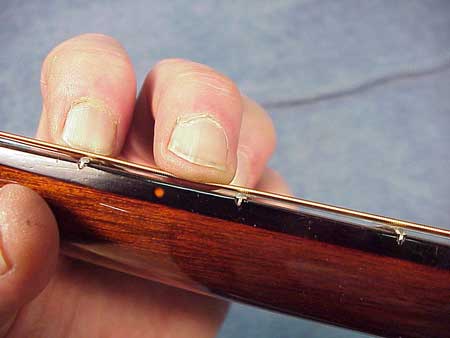
Notice how, when I fret this new guitar,the string makes solid contact with the fret, and my finger isn't actually touching the surface of the fingerboard:
That means I'll have a firm mounting for good intonation and tone. These frets measure .042", by the way.
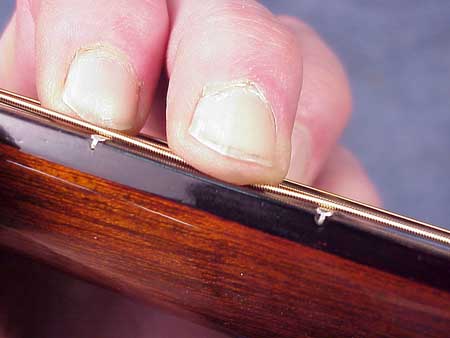
In contrast, the low frets on this guitar allow my finger to touch the fingerboard just as the string is starting to contact the fret:
As a result, I'll have to exert more force to hold the string tight against the fret. If the frets are low enough, I simply won't be able to get a decent note, no matter how hard I press. The frets in this photograph are under .020", on average. Too low, in fact, for me to handle!
Why would the frets on one new guitar be higher than those on another? I have seen some new instruments made with fret wire that was barely .030" high. These have all been imported guitars of modest quality. Mostly, though, new acoustic guitars have abnormally low frets because of poor manufacture. Some factories are notorious for occasionally making up for uneven fingerboards or badly installed frets by grinding off the tops of all the frets so that they are level. A certain amount of leveling is necessary when fretting any guitar, but I've seen plenty of new instruments where the top 1/3 of the frets had been removed in a heavy handed job of leveling all the frets. It's not easy for me to excuse this kind of fret work from a major producer of guitars! (The makers I've mentioned in this article never perform this atrocity, and deliver some of the best fretwork in the industry.)
It's easy to understand how frets become too low. It usually starts with the wear under the unwound strings. In the low positions especially, the first and second strings cut into the frets much faster than the wound strings. That's because they are skinny, to they're somewhat "sharper" as they rub against the frets. And, they're steel, which is much harder than the fret wire. The wound strings have bronze, brass or nickel alloy windings which are much softer than the steel, so they tend to do little damage to the frets.
Virtually all fret wire is made of "18% nickel silver", an alloy of nickel and copper. (Nickel silver is one of those old time euphemisms denoting a stainless silver substitute - it never actually contains real silver.)
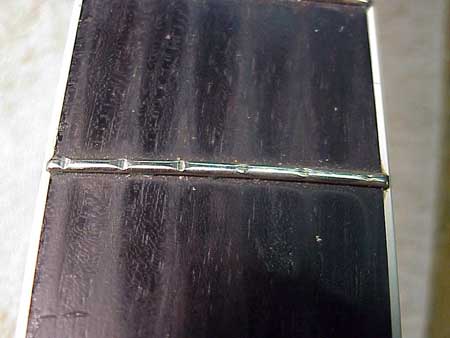
These frets are are worn under all the strings all the way across:
That's because the guitarist was a heavy capo user. Bluegrassers, among others, find themselves using a capo quite often. The capo holds the string down against the fret powerfully, and the string tends to vibrate a lot in the "open capoed" position. Under this circumstance, the fret will wear rather quickly under the wound strings. It's not all that unusual to see more wear under the bass strings than the treble, particularly if the player really "drives" the guitar hard.
As frets become worn, they begin to be uneven in height, and eventually they cause buzzing and other difficulties such as dulling of the tone.
A temptation among both players and luthiers is to save effort and money by leveling worn frets, and many times this procedure works quite well. If, however, the frets are quite worn, leveling them will bring all of them to the height of the lowest worn spot, resulting in low frets. So, it's a bit of a trade. You can level the worn frets, but you might end up with poor playability anyway because they all become too low. Time for a judgment call by an experienced guitar mechanic.
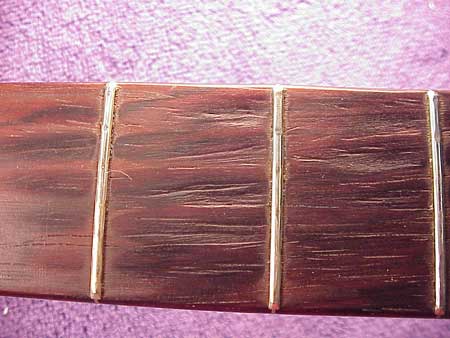
Oh, yes, while I'm on the subject of wear, take a look at this fingerboard:
Very little fret wear here, but lots of fingernail divots in the fretboard. No big deal, though, because fingerboard wear never interferes with playability or longevity. Such wear is purely "cosmetic" and there's no need to anything about it.
Wear isn't the only cause of uneven frets. Sometimes a fret will be too high because it just isn't seated properly, or becomes loose with time, age or fingerboard shrinkage caused by dryness. A fret might be too low because of being tapped too hard during installation, or by being injured when a guitar tips out of its stand and falls against a hard object.
Presuming that the truss rod is correctly adjusted and that the neck of the guitar is reasonably straight, it's not difficult to locate a high or low fret. I gaze down the length of the neck from the peghead to the bridge, lining up the frets in my sight, looking for ones that appear lighter or darker in reflected light. Often, I can spot a light one (sticking up too high) or a dark one (too low).
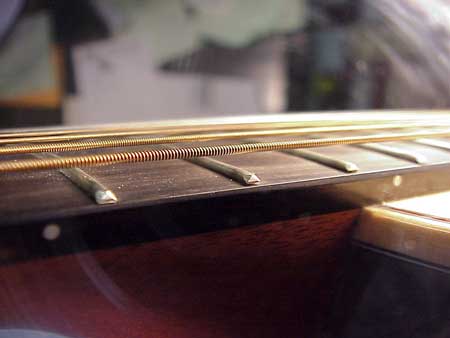
Often, the loose fret end will be visible from the side:
It's not uncommon for loose fret ends to snag the first string if it should slip off the edge of the fingerboard during playing.
A short straightedge will "rock" over a high fret. If the straightedge is just long enough to span only three frets, it's no big trick to find a low or high one by trying to rock the straightedge back and forth. What appears at first to be a too high fret may, in fact, be a fret whose neighbor is too low.
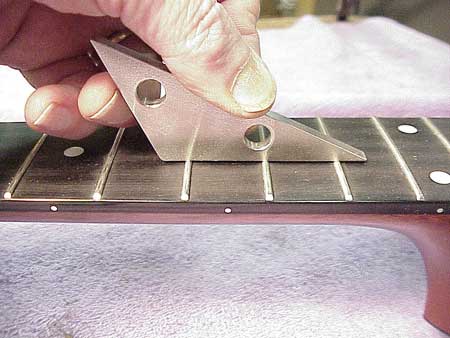
This little precision straightedge is made with three very flat sides so I can span just three frets anywhere on the neck:
With this little tool, I can find that high or low bugger in a hurry!
No question about it, uneven frets can be a nightmare for the picker. If your guitar buzzes terribly in certain fret positions only, uneven frets would be a good first guess. If you'd like lots more information about buzzing and related problems, check out the "Buzz Diagnosis Page" where you'll find two dozen descriptions of what can cause this kind of misery.
High frets can be tapped down, and sometimes glued in position, and low frets can be raised or replaced with taller ones. If there are lots of loose, uneven frets, then it's generally best to refret the instrument, to avoid excessive leveling.
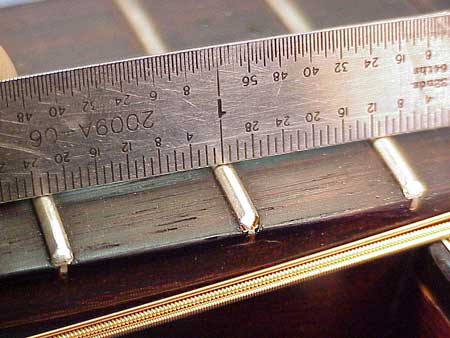
If you look under the straightedge in this photo, you'll see that the fret has a nice, rounded top:
A straightedge really aids in viewing the profile of a fret. It casts shadows that really highlight the rounded shape of the fret crown. This nice, tall, rounded fret will give good contact for the string.
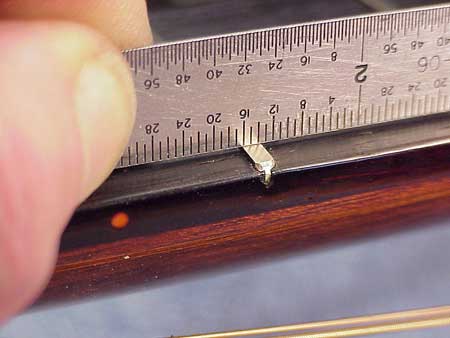
Now, look at this one:
The top of this fret is completely flat from excessive leveling without "re-crowning" or rounding the top afterward. It's no coincidence that flat frets and low frets are often one and the same, because they have the same cause.
The effect of flat frets is that the string can't get a single point contact so it may actually flap against the flat top of the frets, causing a dull or "fuzzy" tone. Add that bit of nastiness to the fact that low frets make fretting difficult, and you have a couple of good reasons for replacing the frets.
Flat frets don't allow the string to make contact in the center of the fret, so intonation is likely to suffer as well. Intonation is another casualty of the low fret syndrome as the player presses so hard that the string stretches sideways a bit from lack of control brought on by all that effort.
Really wide frets (over .100") have been popular among electric players, but lots of acoustic guitarists feel such frets are more likely to contribute to a dulling of tone because the string doesn't have as much of a "point contact" on the top of the rounded fret. Such frets are likely to wear more broadly and become flatter as they wear, too.
As guitars age or as they are subjected to excessive heat or dryness, their fingerboards may shrink a little. As the fingerboard shrinks, the ends of the frets begin to stick out a little. It takes only a few thousandths of an inch for a protruding fret to feel really sharp on the old left hand (or right hand for some).
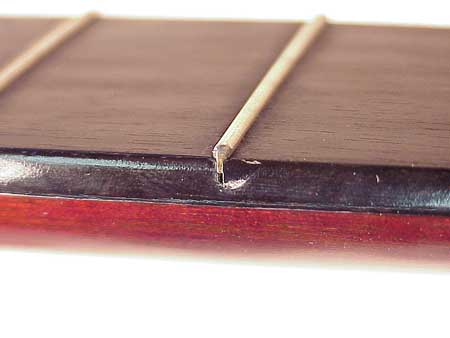
This Martin D-28 is only a few years old, but it spent some time in a hot parked car:
See how that fret actually poked a flake of ebony right off the edge of the fingerboard? Well, that fret and its 19 compatriots feel like so many little knife points when you run your hand along the fingerboard!
As if we needed it, loose and protruding frets make another fine reason to avoid leaving a guitar in a hot parked car. . .