
Mario Martello
I pay a visit to Super Mario! - Mario Martello
Update, 2006. Mario has passed away after battling cancer for some months. Please read his obituary written by Richard Johnston.
Here's my old friend, Mario. He's by far the most productive single instrument repair person in Northern California. For most of the last 40 years, Mario has helped some of the finest instrument shops build and maintain their reputations for elegant repair work. During the important formative years of the 1960s and 1970s he did a majority of the work for Jon Lundberg's shop in Berkeley, and Satterlee and Chapin Music in San Francisco.
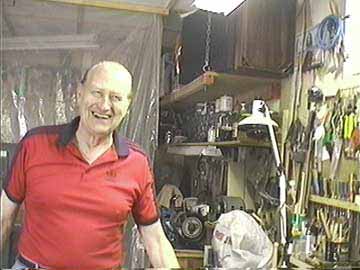
Whenever I see a repair job that's been sitting around my shop for too long, I always ask myself, "What would Mario do?" That's usually all I need to get the push to start the job. . .
Mario was born in Northern Italy, in 1924, and his family moved to Argentina when he was very young.
His father had his own woodworking shop and built cabinets, architectural woodwork and some furniture. Working at his father's side, Mario gained proficiency in the traditional woodworking and finishing techniques.
"My father did mostly carpentry and fine woodwork for the inside of buildings."
At the age of 33, Mario moved to New York City with his wife and son. He landed a job in a furniture factory, making and repairing reproduction period style furniture. A friend suggested that he contact John D'Angelico to see about getting a job making and repairing guitars, but D'Angelico said he didn't need extra help right then. After a year and a half Mario's father died and his wife wanted to return to Argentina.
"But I didn't stay long because I see the situation and I say, 'No I don't want to stay here.'"
A short while later, Mario came back by himself to the United States, eventually deciding that San Francisco was the place for him.
"I didn't like the weather in New York. It was too cold."
By the time he sent for his wife and son to join him, her visa had expired and it would be a year's wait before she could reenter the U.S. In 1960, while Mario worked at sofa manufacturer in San Francisco, a coworker told him he wanted to make a guitar. His friend went to Acoma music on Market Street, and bought some guitar making supplies and wood. He told John Paul, the owner, that his friend, Mario, was going to help him. John Paul said, "If your friend knows about making guitars, why don't you send him over. We need some help here."
"John Paul had traveled a lot in Mexico, and spoke some Spanish, so I we could talk together. He handed me over this big book with instructions about making violins and cellos, and asked me if I understood these things. 'I said, I'm sorry I don't know much about cellos, I do mostly guitars and things like that.' He said he would take me over to see Harmon Satterlee because he needed a helper in his store. He took me there because that's where he took all his jobs - repairs on violins, basses, guitars, everything. He don't do repairs. Acoma was a real nice store. Got a lot of business. Satterlee tried me a couple of Saturdays, and I got the job. I worked on a lot of violins, guitars, harps, all kinds of instruments."
He worked for Satterlee for seven years, doing all kinds of repairs on every sort of stringed instrument.
John Lundberg brought repairs to Satterlee and Mario would do them there. He asked Mario why he didn't just work for himself and pick up repairs. Mario thought about it and quit Satterlee, setting up his shop in his garage. "After all, most of the time I worked for myself when I ran my father's business, so it came natural. Since the days I worked for Satterlee, I've always worked for myself."
"I got so much experience working for Satterlee I could handle any kind of instrument. With experience, you're not afraid to start a job. Once you get started and work careful, then everything goes fine. You can't let the work sit around."
Click here to see Mario's latest guitar, the "San Franciscan"
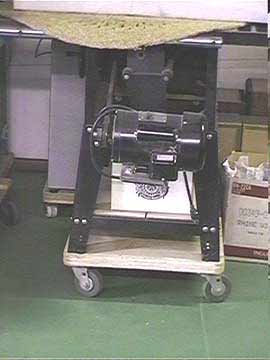
Mario lives in a quiet neighborhood in Martinez, California. His two-car garage shop is always neat and tidy. He keeps his power tools on casters so they can be stored in the corner when not in use:
Notice the green painted floor. It's swept clean so he can find the smallest wood chip or small part that might fall during a repair operation.
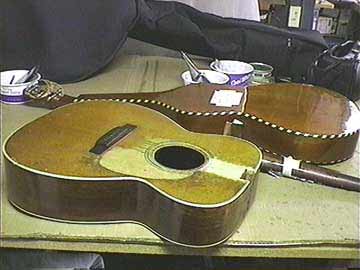
There's a simple table in the center to hold jobs in progress:
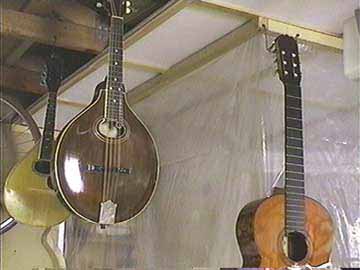
A couple of instruments hang outside the "clean corner" where he does his French polishing and other finish work:
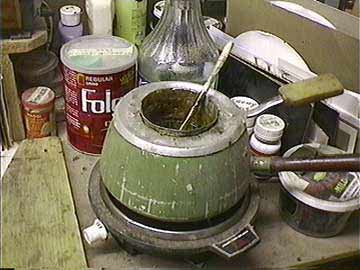
At the end of his workbench is the ever handy glue pot:
Mario uses the classic hide glue for most operations
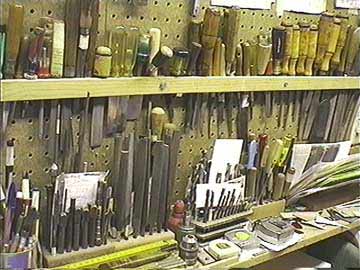
Behind his workbench is a crowded board with all manner of hand tools:
Like many of us, Mario believes that repairing instruments is best done working by hand. A large number of Mario's hand tools are ones he made or modified himself. He describes his experiences working in his father's shop as essentially a nineteenth century style of business.
"If you don't have the tool you need, you make one. If you don't have the parts you need, you make them, too."
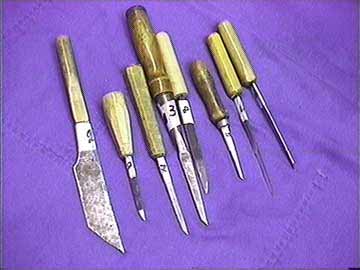
Here's a handful of the tools from his rack:
He has numbers on some of them so he can recognize 'em on the wall.
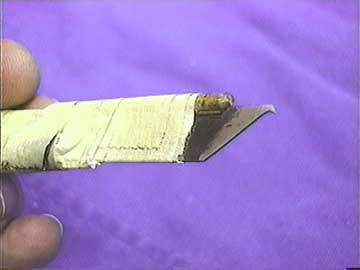
This one is a special hook for cleaning out fret slots:
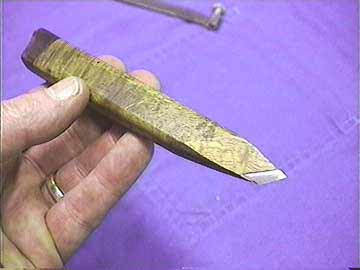
A heavy knife with a comfortable handle made of curly Koa:
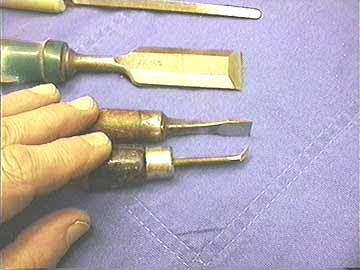
The upper tool is a round nose chisel made from a file:
The lower two are modified chisels for chopping out bits of lining while working through the soundhole of a guitar.
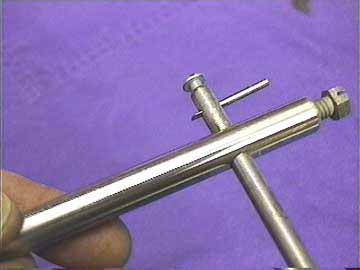
Mario made his own purfling cutter from round stock and a small drill bit:
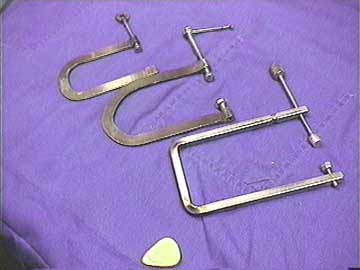
He even makes his own C-clamps:
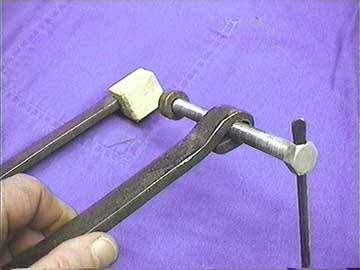
He shrugs and says, "I just heat the steel, fold it over and thread it for a screw:
Simple, eh?
Lots of Mario's clamps have tiny points on the lower jaw to hold small cleats when he places them under the instrument top.
Click here to see Mario's latest guitar, the "San Franciscan"
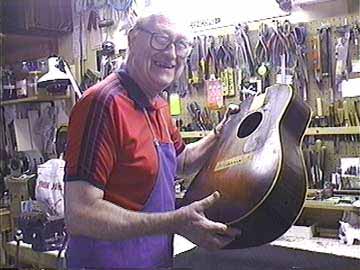
Mario has tried to retire a few times, but he just has too much energy!
"When I'm dead and buried, I'm sure I'll hear someone knocking on my tombstone and yelling, "'Hey, Mario, can you come out and fix these things for us?'"
"I started to build jazz guitars in Argentina. Nobody was making jazz guitars then. I copied Epiphone. Not carved tops - was plywood. I made a mold and then a contra mold to press my own plywood tops and backs. They turned out pretty good. I made about eight or ten. Just like that.
"In those days only one factory (in Argentina) made those jazz guitars. They make in carved wood and everything, but ugly and not so good. This was about 1948. Jazz was real popular in Argentina, and most of the players wanted the Selmers from France like Django Reinhardt's and like that. But for regular jazz guitars there was only one factory but they made guitars that were ugly - ugly in sound and everything, you know.
"I was around jazz groups since I was a kid. I didn't play, I was just a fan. I made friends with those guys. There was one, Ahmed Ratip, and he got one Epiphone guitar. I was impressed by that instrument, you know what I mean. I went to the performers place,the nightclub where he play, and I get a piece of paper and a pencil and I make measurements here and here, and draw the guitar. He say 'What you going to do?' I say 'I'm going to build a guitar.' He says, 'Let me see when is finished.' I go home and I work real hard, I mean, I work until 12:00 or 1:00 in the morning because I was excited.
"Finally I finished, and I make it black and white. Black all over, and sunburst white in the center. It looked real pretty. Anyway, I got no case, so I wrap it up in a piece of paper and tied it up. I went that night to the nightclub and showed it to Ahmed. He was a very good player. I opened up the paper and he looked at it before he started to play. He said 'This sounds better than mine!' I told him, 'No, because this is plywood.' But he really liked it. That meant a lot to me. Then I build a few because evidently he spread the word to some few guys addicted to the jazz and they call me and say, 'Hey, can you make me the guitar?." and I say, 'Yeah.' So I make seven or eight, something like that."
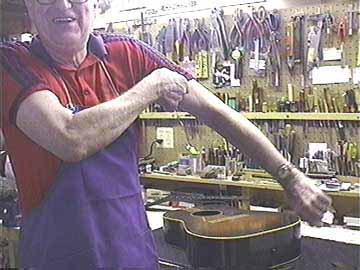
OK, time to get to work:
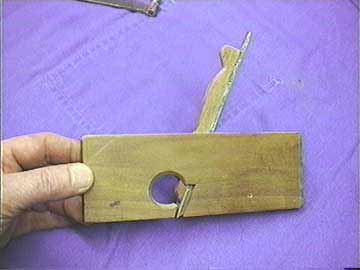
Mario still has a few of the hand tools his dad made:
A very fine rabbet plane.
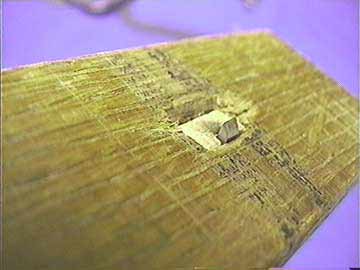
Look at this little scraper plane:
The sole is about 2 inches wide and 6 inches long. The little blade is only 1/4 inch wide. Mario uses this one for making and truing truss rod slots in necks.
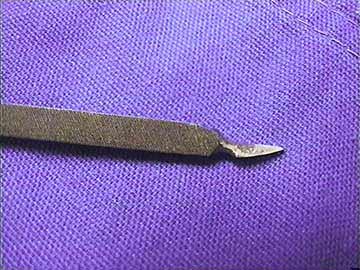
This is a tiny pointing up tool:
A very fine little chisel his dad made from a small triangular file. He used it for finishing the inside corner of delicate carvings.
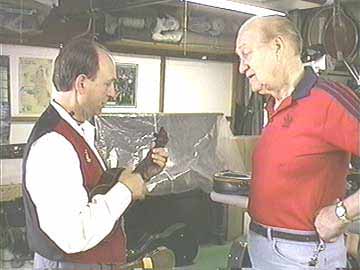
As we were taking, Dave Marty, a local professional banjo player dropped in to pick up a his tenor ukulele:
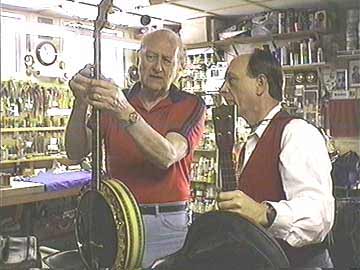
He brought along his custom Vega Vox plectrum banjo:
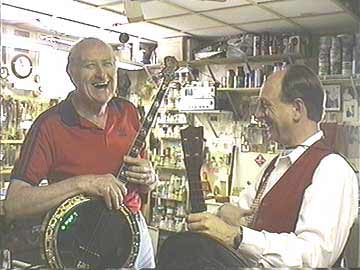
Mario had inlaid and engraved this one for Dave when he worked at Satterlee and Chapin, 30 years ago.
"Who you kiddin' I'm not THAT old!"
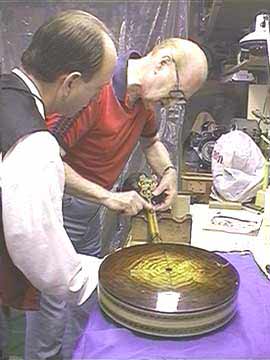
OK, chief, let's look at that loose veneer:
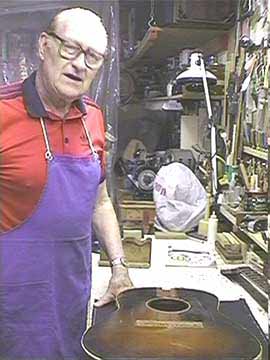
Back to work on the 1946 Gibson J-45:
Hand Mario the job nobody will touch, the "impossible" repair, and you'll hear:
"OK, chief, if that's what you want, I'm gonna do it!"
Click here to see Mario's latest guitar, the "San Franciscan"