
Tapered Friction Pegs
Tuning with Tapered Friction Pegs
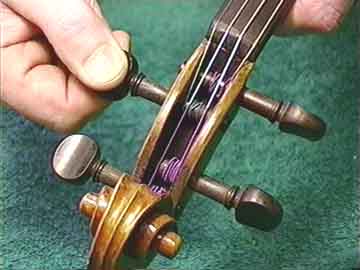
For the last 300 years or so, violinists have tuned their instruments using the most primitive friction device. It's simply a tapered peg that you have to press hard into the peghead as you tune up. The violin's strings are under a reasonably low tension and well fitted pegs turn smoothly and hold well:
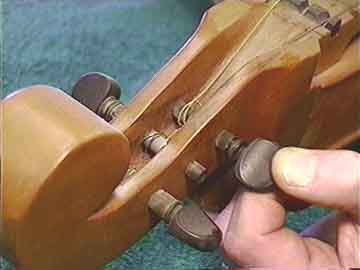
Many ethnic instruments, including dulcimers, have similar pegs fitted into open pegheads with two bearing surfaces for the pegs, just like violins:
Lots of dulcimers and other "ethnic" instruments have friction pegs that are rather rustic and don't work too well. . .
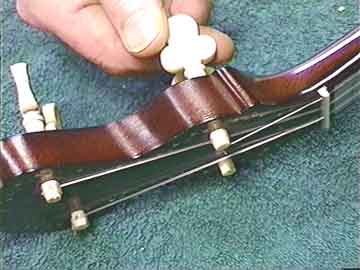
This antique banjo has tapered pegs made of bone:
These pegs are fitted into a soft wood peghead but the bearing surface is very thick so there's plenty of friction to hold them in tune.
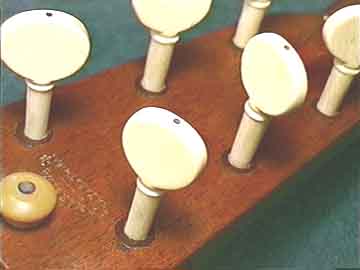
Here's a Martin guitar from 1903. It has a beautiful set of ivory tapered pegs and a thin peghead:
Notice the hardwood bearing bushings inlaid into the peghead. With these hardwood bushings the friction pegs hold tightly and turn smoothly without compressing the wood, even though the neck is made of Spanish cedar which is quite soft.
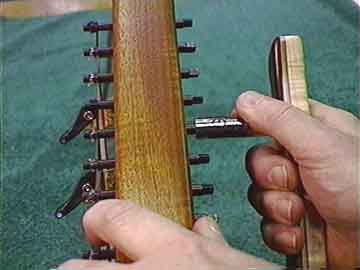
This harp has steel taper pins and a very thick bearing surface:
You have to grab the harp and push hard to make sure the string will stay where you tune it. If the steel peg works loose, you can tap it gently with a hammer to seat it more tightly.
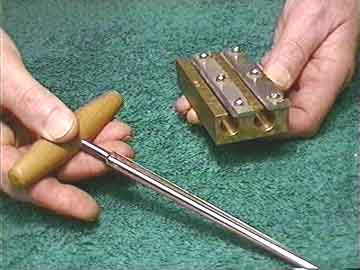
Violin makers use sophisticated reamers and peg shapers to fit the pegs with precision:
Once fitted, the pegs work surprisingly well. If they need to be refitted because of wear, it's not uncommon to replace the pegs to achieve a good fit.
If your pegs slip or bind, you might consider cleaning them up a bit rather than having new ones fitted. First, take the pegs out of the instrument and rub the shaft bearing surfaces gently with a little #0000 steel wool to clean off the "glaze" on the surface.
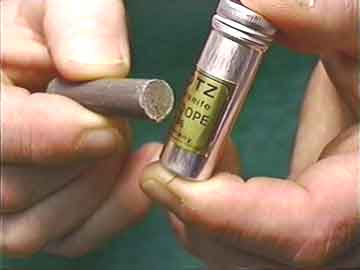
A peg that seems to stick tightly and won't turn easily enough to tune accurately can be smoothed out with a little "peg dope." Sometimes called peg compound, this stuff is sold in violin shops:
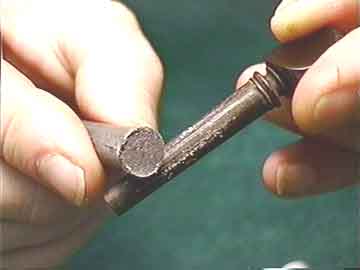
It looks like a wax crayon. To apply the dope, just make a couple of lengthwise marks on the shaft of the peg:
Then insert the peg and begin to tune as usual. It should work smoothly, provided that the mating surfaces on the peg and peghead are in reasonably good shape.
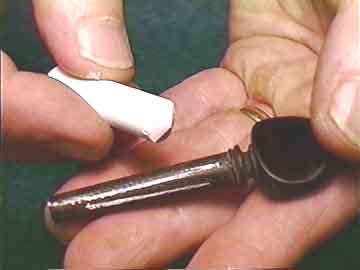
If your peg slips terribly and just won't stay in place even if you jam it in really hard, you can try the old timer's trick. Make a couple of marks with ordinary blackboard chalk:
Chances are, that will make the peg stick in place!
Bear in mind that you have to press inward as you tune, and that friction pegs are not supposed to jam super tightly. They should be just tight enough to hold the string tension. If you need a bit of extra leverage, you can use a standard plastic "string crank" as a wrench. I find that sometimes helps on lutes and guitars.