
The Capo, Now and Then
Reinventing the wheel
The ubiquitous capo!
For generations, it has been the most useful accessory for players of guitar and other fretted instruments.
Simply a device to hold all the strings down at one fret position to raise the pitch of the instrument, the capo comes in a variety of styles from plain and simple to elegant and sophisticated.
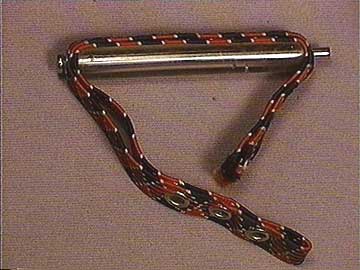
In its simple form, the capo is just a padded bar with an elastic strap to apply the tension:
This kind of capo has been the simple inexpensive mainstay for many decades. If you're prone to losing things, or just getting started playing guitar, it's a logical choice.
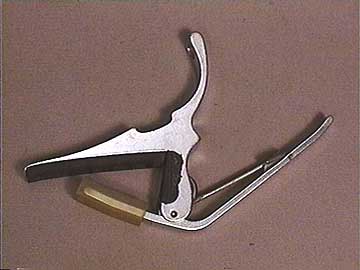
This spring clamp kind has bulky looking handles:
No problem, though, because it's designed so the handles are never in the way!
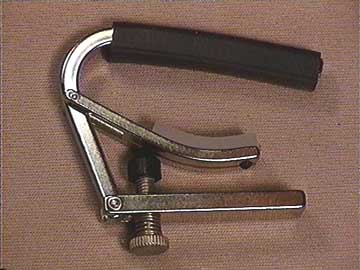
Like the spring clamp, this cam lever capo can be used with one hand:
There are dozens of other capo styles on the market right now, but I won't try to enumerate them all. Capo choice is a matter of personal taste, and most of them will work quite well, if you use them correctly.
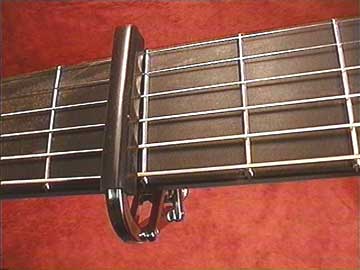
In use, the capo should sit directly behind the fret, as close to the fret as possible:
Ideally, the downward pressure should be just enough to hold the strings against the fret without buzzing or rattling. That way the capo won't press the strings so hard that they stretch out of tune very much.
Any capo is bound to affect intonation because the strings are stretched as they are pressed to the fret. A capo placed way back behind the fret will stretch the string more than one placed close to the fret. Place the capo right on top of the fret, and you'll avoid stretching the string, but you'll lose tonal brightness and clarity.
Most modern capos are available in different "shapes" to accommodate different fingerboards. Short bar capos fit the narrow necks of banjos and mandolins. Curved bar capos are necessary for the radiused fingerboards of steel string guitars, and flat bar capos are the best for the flat fingerboards of classical guitars.
Even the most exotic capo is a relatively inexpensive accessory, so many guitarists buy and try a bunch of different styles to find the one that works best for them.
The capo (nicknamed "cheater") has something of a bad rap as a crutch for poor technique Yes, jazz and other styles of playing require sophisticated technique, and experienced players of these styles don't use capos. But there are lots of styles of playing that require the use of open strings, and to play in various keys, a capo is necessary no matter how skilled the musician.
Next, I present a little gallery of vintage capos, some recent, some quite old. Some of the more recent capos may still be in production, some have been discontinued. These photos are only a small sampling of the staggering array of capo styles that are or have been available.
Recent Vintage Capos
Some of these may still be available. . .
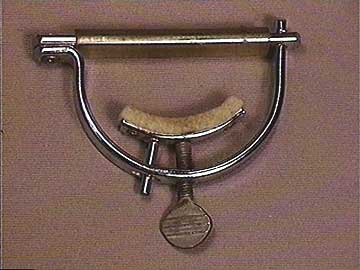
A screw clamp:
At any given time, screw type capos have always been available.
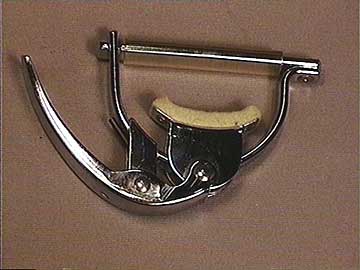
Here's another lever spring capo:
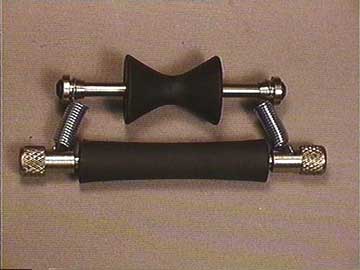
A spring roller capo:
You can mount this one, and simply roll it up the neck to the appropriate fret position. The only difficulty is that you need both hands to install it, and even then you have to be careful, because the springs are strong and there are a lot of sharp-ish metal parts that can scratch finishes.
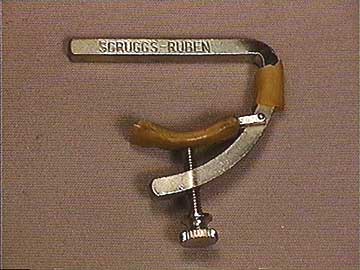
A short flat bar capo for banjo:
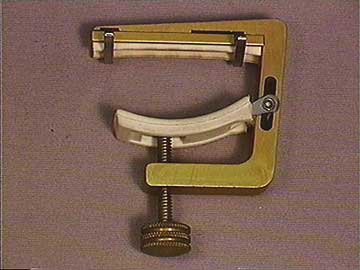
Here's a unique one:
See those little metal "fingers" that stick down under the bar? You'd slide the capo on the fingerboard until the ends of the little fingers touched the fret, then screw down the clamp. If you look closely at the resilient pressure pad on the bar, you'll see that it's a "U-channel." The front edge of the pad would land directly in the middle of the fret to hold the strings perfectly to the fret with absolutely no stretching of the strings, and no shift in intonation. The thing actually worked very well. Keeping it aligned while screwing it tight required a fair bit of dexterity.
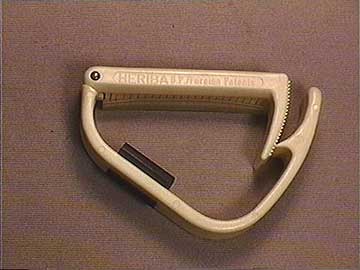
How about a ratchet?
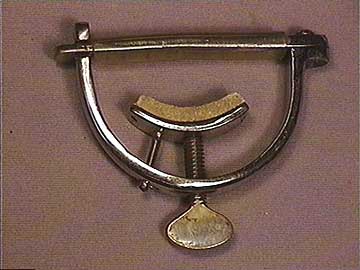
Old Vintage Capos
It's easy enough to scar a guitar neck if you're not careful how you install your capo, but some of these fellows can make the job even more dangerous:
Look familiar?
Seems like the "U-Clamp" capo gets reinvented every few years.
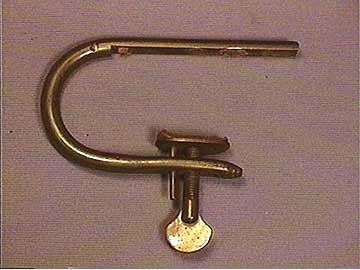
As does the C-Clamp:
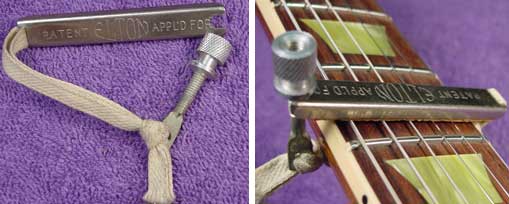
Over the years, Elton made a large variety of capos. Here's one you don't see often:
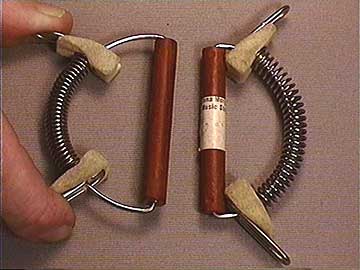
Thank God, these aren't being sold any more:
In fact, the one on the right is "new old stock" and has its original store price sticker still on it. One guitar neck saved, if you ask me.
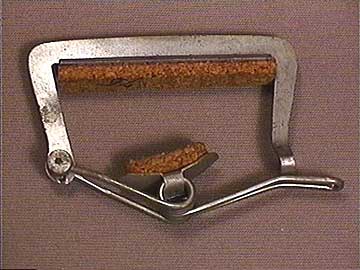
This one is a real classic:
It's the "Lightning" capo. You'll find these in lots of old guitar cases.
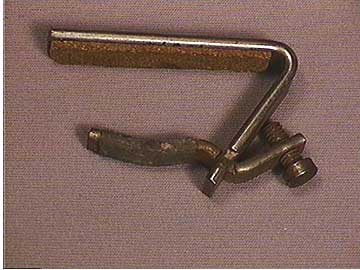
Here's one truly ugly beast:
I saw it listed as the "Cro-Bar" capo in an old accessory catalog. Looks about as friendly as a crowbar, doesn't it?
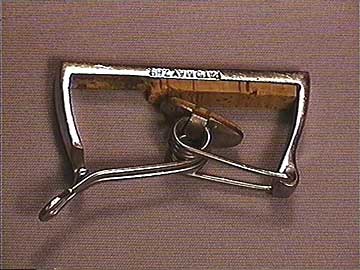
An earlier cast brass version of the Lightning, patented May 2, 1889:
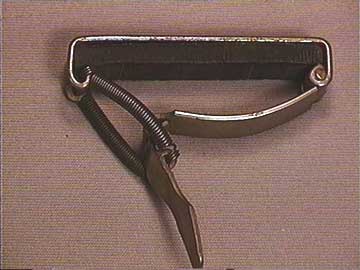
Just the sight of this one scares me:
I don't know what it was called, but I suspect it's spelled "t-r-o-u-b-l-e."
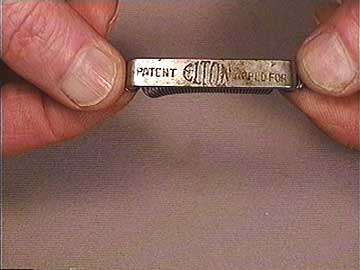
Ah, but look at this little fellow:
From the top it's not too harmless, but watch out!
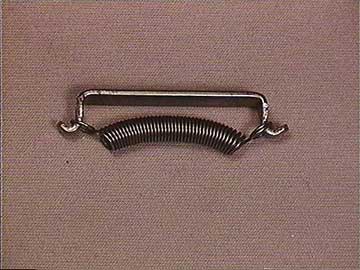
There's literally no way to use this capo without damage:
And it was a very popular model, if the number of old instruments with deep spring tracks down the neck is any indicator. Elton was one of the most prolific and successful manufacturers of instrument parts and accessories.
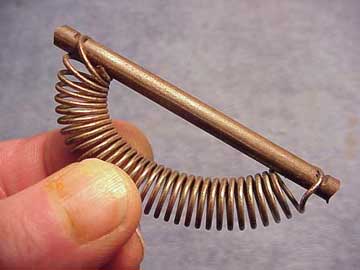
And, here it is, a capo that's even more dangerous than that little Elton:
This is one beefy spring!