
Using Hide Glue
Please read the glue data sheet
My Method for Using Hide Glue
Hide glue is reasonably easy to work with, but it takes practice to get comfortable with it. It's nowhere as convenient to handle as bottled glues, but it doesn't take all that much effort, if you develop a routine.
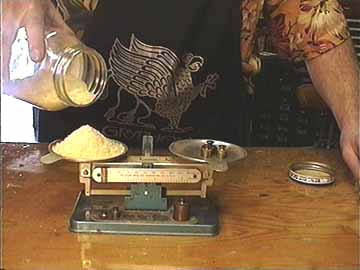
Here's mine:
I always weigh the glue and water so I get a consistent viscosity. It takes almost no time at all because I always make the same amounts:
I'm weighing out 40 grams of glue for these photos. Usually, I weigh out 100 grams of dry glue; I use a ratio of 100 grams of glue to 180 grams of water. Every batch of hide glue has a different ideal mixing ratio and that's why I bought a fifty pound bag of the stuff so I'd never have to figure it out again!
I can't use volume measure because the granulated glue will be finer and have a greater density as I get to the bottom of my jar.
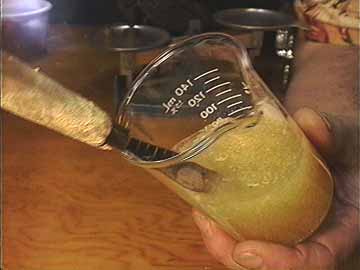
Stirring the water and glue together, I see the granules begin to swell:
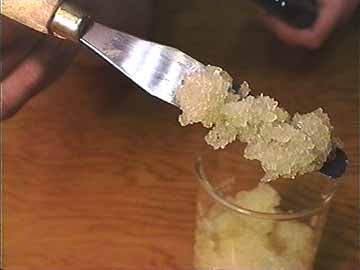
A few hours later, the glue has absorbed all the water. Because of the size of the granules, the glue has taken on the exact consistency of the flying fish roe I get on my sushi:
OK, if you don't eat bait, then just think of it as little jelly granules.
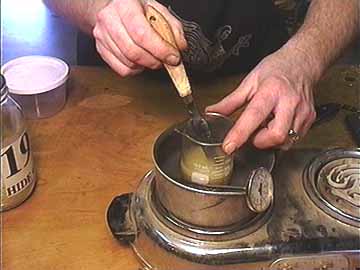
Now I'll "cook" the glue:
I'm just heating the glue in a pot of water. I have a thermometer stuck in the water so I can keep the temperature to no more than 140 degrees Fahrenheit. I just stir the glue until it all melts.
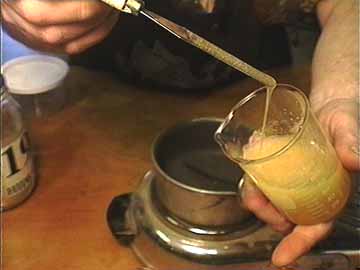
Once the glue is all melted, it becomes nearly transparent:
The glue is ready to use now, but I'm told that if it sits around a day or so, it develops a slightly more complex molecular structure, and becomes stronger. Regardless, I'm not ready to use it all now anyway.
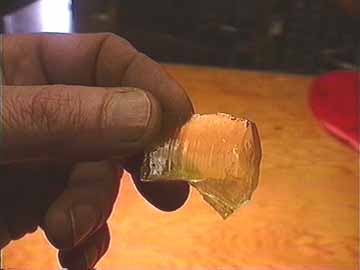
I'll pour my glue into a paper cup and put it in the refrigerator to gel. It then has the consistency of concentrated gelatin, which is, after all exactly what it is. I'll take the glue out of the cup and cut it up into little chunks for easy handling:
Look at this clear and transparent this 1/2" thick chunk of glue. It has not even the slightest tendency to stain the wood. Hide glue can be anywhere from dark brown to clear like this and there is no difference in the strength. It's just a matter of how much micro-filtration is used in the manufacturing process.
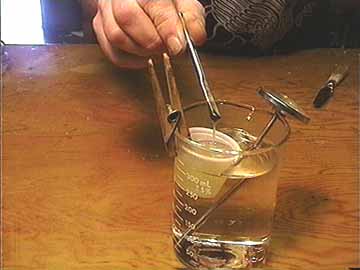
I keep a big jar of these little chunks in the refrigerator, about enough for 3 weeks' work. When it's time to use some hide glue, I fill my beaker from the hot water tap and stick it in the microwave for about 40 seconds, until it reaches 160 degrees. Then I pop open the refrigerator jar, stick a brick in a hot sauce cup, clip the cup to the side of my beaker and go to the workbench:
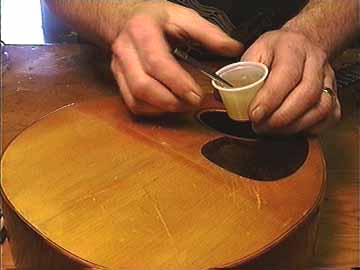
By the time I get my clamps set up, my glue has melted, the whole business has only cooled to about 145 degrees, and I can use my glue:
I can even just take the little cup out and have it right where I need it on the instrument, so I don't lose any time or make drips getting the glue where I want it:
After my glue job, the plastic cup and disposable brush hit the trash, and my cleanup is done!
Some time later I'll have more to say about gluing procedure, but for now, don't forget to read my hide glue data sheet.