
A Banjo 5th String "Spike"
Less obtrusive or intrusive than a 5th capo
They're these little L-shaped pins that hold the fifth string down at one or more frets higher up the neck, so you can capo the other four strings to play in higher keys without retuning. The most common position is at the seventh fret for the key of A. Usually a second spike at 9 or 10 will allow retuning to reach the other Bluegrass keys of B, Bb, and C.
Is a fifth string spike better than a fifth string capo? NO. It is a matter of personal choice. In particular, the Shubb Fifth String Capo works better than the spikes, and it will hold the strings down neatly at any fret. However, some players say it gets in the way of their thumb as they slide up the neck. Bluegrass players are more likely to use a fifth capo because they play in so many keys to accommodate the singer's range. Old time clawhammer players are more likely to insist on the spikes because they don't need to capo as many positions, and they dislike the look of a capo on a vintage style instrument.
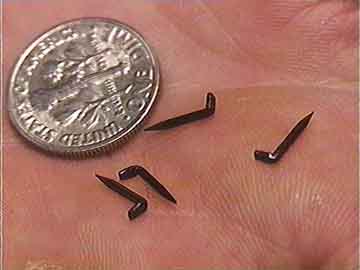
These things really ARE spikes, H-O model railroad spikes, to be precise. It seems that the model railroaders like to nail down their tracks with teeny replicas of the real thing:
I'd call that teeny, wouldn't you?
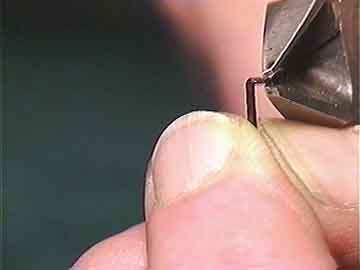
Sometimes the short leg of the spike is a little longer than I'd like, so I clip it off:
And then round and smooth the clipped end so it won't catch on a finger.
Before installing these little fellows, it's really important to check out and fix up the fifth string nut, as follows.
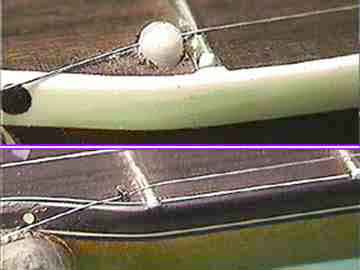
More traditional banjos, like the Gibson at the top of the photo, have fifth nuts that must be lowered so that the string bears cleanly on the fifth fret:
Deering banjos, and others like the one in the lower half of the photo, have a railroad spike in place of the fifth nut and need no further attention.
If the string does not bear on the 5th fret, then it will play sharp up the neck, especially when slipped under your new spike.
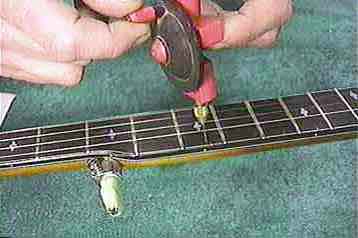
First, I drill a small hole, about 3/8 inch behind the fret, right under the fifth string:
I find that a spike closer to the fret will hold very well, but is more likely to be out of tune, and is definitely more difficult to use.
It's necessary to experiment with each "batch" of new spikes I buy from the hobby shop because they're not consistent in diameter, so I can use the right drill for my pilot hole.
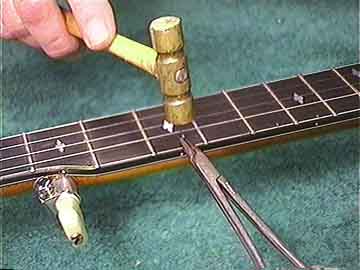
Here, I'm holding the spike with a hemostat to keep it from rotating or bending as I tap it in the hole:
It's not unusual for me to bend one and have to start with a new one! They're cheap, so it's just part of the game.
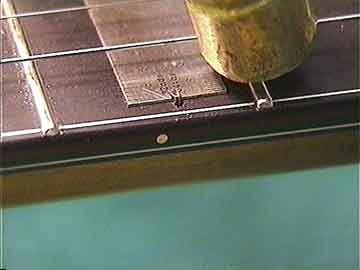
As I get close to tapping it all the way in, I find it helpful to slip my thinnest steel rule under the spike so that I won't curl the end over as I tap:
This way, I protect the fingerboard from any stray hammer blows as well.
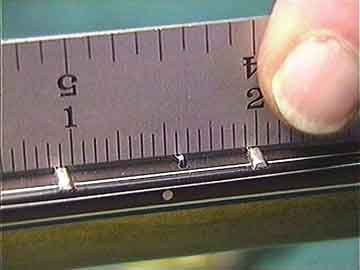
I make sure the spike is no higher than the frets, so it won't interfere with fretting the fifth string:
Believe it or not, you can fret the string on the seventh fret even if there's a spike there, because you still can hold it down against the fret. It does feel a little funny, though.
That's the job, except to mention that some players like to slip the under the spike from the "outside," and some from the "inside" so it's a matter of personal choice which way the spike faces.
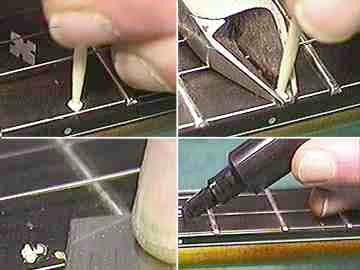
I call the spikes less intrusive than a fifth capo because they're so easy to remove.
All you have to do is to jam a round toothpick into the hole with some glue, and snip it off:
Then, shave it cleanly to the fingerboard surface with a razor blade, being careful not to nick the fingerboard. A quick block sanding with the grain, using 320, 400, or 600 grit sandpaper will make the fill perfectly level. Then a dot of black stain from a "magic marker" will make the fill virtually invisible!
Of course, if it's a rosewood fingerboard, you have to go looking for a brown magic marker. They do exist.