
What's Down in Brian's Basement?
What's Down in Brian's Basement?
Brian Burns is an old friend and neighbor of mine. He lives a block away from me and builds flamenco guitars in his basement shop. He's a real master of machine woodworking and tool design and is in demand as a tool and idea man for local luthiers, me included. I've found that if I'm needing information about a product, machine, process or material I'd better ask Brian first so I don't waste time wandering down blind alleys.
Last night (3/5/98) I took my camera down into Brian's basement shop. He'd just finished setting up another wild machine. This time it's a neck carving rig which guides along a template and reproduces the neck shape using the table saw setup on his Shposmith Mark V. This thing runs automatically and is remarkably stable and accurate.
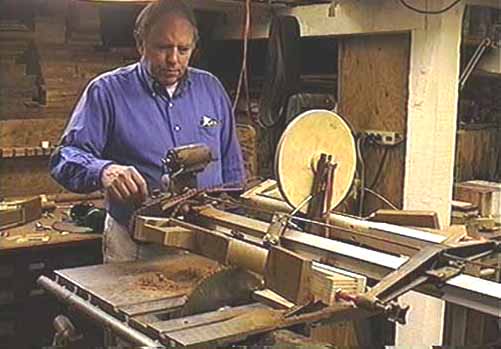
Here's a view of the machine (and Brian) in action:
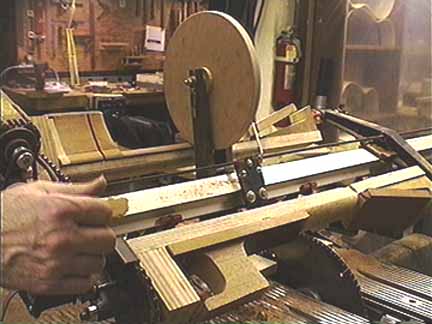
The "stylus" (that 10" wood wheel) remains fixed in position opposite the table saw blade while the neck and template rotate and pivot on rocker arms as they are fed along the central bar.
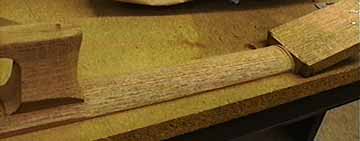
This is the result, a neck profiled within about .010" of the final shape:
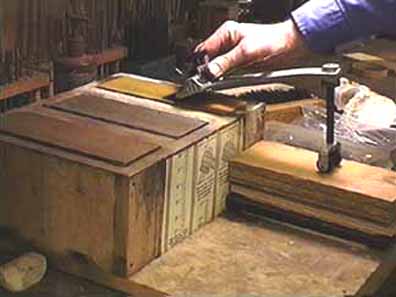
Some years ago Brian described how he sharpens plane irons and chisels. As he told me about I thought it sounded cumbersome and slow, so I really didn't pay much attention. Some time later he demonstrated his technique at a meeting of the Northern California Association of Luthiers. I saw him take a plane iron that had a big chip from hitting a nail and sharpen it to a mirror finish. He trued and ground it, sharpened and honed it perfectly by hand in under 5 minutes! That was the last time I underestimated Brian's, methods. He sells a small pamphlet describing his (locally, at least) famous double-bevel method of sharpening, along with plans to build the setup. It's really quite simple, and looks like this:
With this rig, you can "dial-in" your cutting angle with real precision.
More details here.
Later, I hope to get Brian to write some articles for FRETS.COM about the testing and selection of tonewoods. He's spent a lot of energy in scientific evaluation and prediction of the tonal output of various guitar woods.
Meanwhile, here are some more shots of his basement shop.
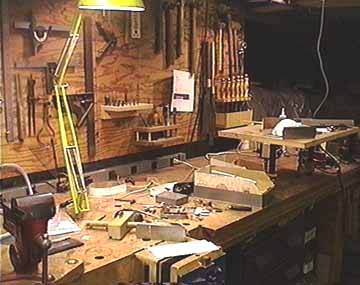
His bench is as busy as mine:
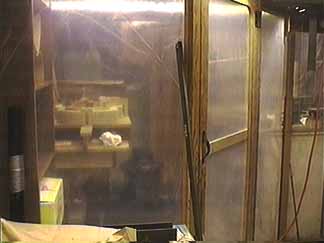
The humidity control room for stabilizing parts and assembly
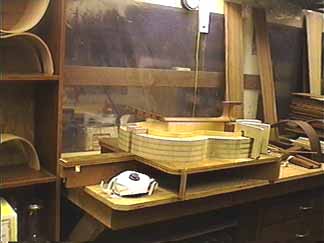
It's a simple enclosure with 10 mil polyethylene sheeting for walls and a dehumidifier, vacuum clamping setup, workbenches and storage racks. The plastic makes a great moisture barrier and lets light through, so the room doesn't feel cramped:
I'll be back for more photos later. . .