
The Way We Were
Let us not judge the past by present knowledge. . .
Fretted instrument repair has come a long way in our generation. Thirty years ago when I first started repairing guitars the general state of the art was just coming out of the Dark Ages. Not surprisingly, the average quality of repair work has matured and improved along with the average value of the instruments being repaired.
When we're examining a repair job that was done many years ago, it's important for us to remember that the instrument may have been of little actual cash value at the time. So, in a way, it's understandable that some pretty poor quality work was performed on instruments that are now taken as precious. When we are horrified to see a 1940 Martin D-28 with varnish brushed all over it, we must also be glad it the guitar wasn't simply thrown away and replaced because it was "ugly" at the time.
The same thing goes for customization. Some old instruments were converted for other use, some for electric amplification and some for "beautification."
Let's look at a few of the more common repairs and customization of the past.
Add a Tailpiece
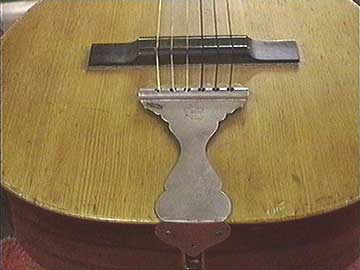
If you just can't seem to get the bridge to stay glued down, you can always add a tailpiece:
This Washburn guitar was made around 1910, and originally had a pin bridge. From the damage underneath, it's obvious that it had been reglued several times. Musical supply houses used to sell these cheap tin tailpieces for quick repairs, and we often see the scars left by their application to elegant instruments.
Neck Resetting by "Slipping the Back"
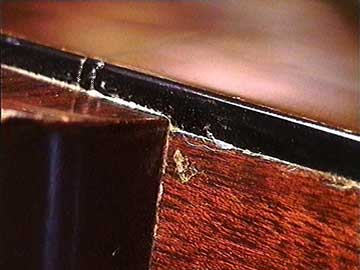
When I first started working on guitars I was told it was "too difficult and messy" to remove the neck for resetting to the correct angle. Our standard method of resetting Martin necks was to loosen the back of the instrument from the neck block and the linings, and push the neck backward, allowing the back to overhang at the heel. That technique allowed for really good control in adjusting the neck angle, but presented a host of other problems.
The back was easily cracked in the effort to loosen it from the neck block. The binding and purfling had to be removed, the back trimmed to fit, the binding channel recut and the binding reglued in place. Then there was all that finish touch up, if it was done at all.
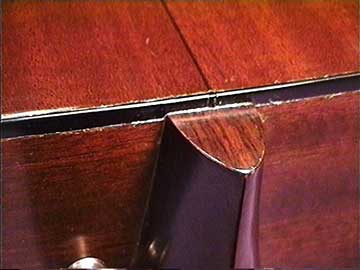
In the best case, this is the result:
You can see the little piece of binding that had to be inserted in the gap at the joint behind the heel.
There are signs of the binding having been removed and reglued, and the finish touched up:
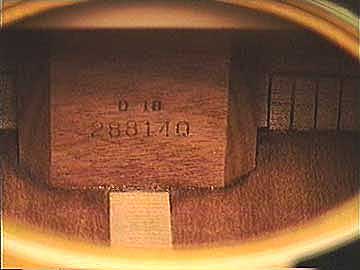
Inside at the neck block, you can see the results of the loosening and regluing.
Now, this one is a good example. I've seen lots of damage caused by this kind of reset work, including massive cracking and splintering of the back over the neck block, and damage to sensitive wood purfling.
After doing a few resets in this manner, I started to work on a technique for removing the neck intact, even though I was told it was too difficult. It turns out to be MUCH easier than doing the reset by loosening the back, but then who knew?
Cut Through the Fourteenth Fret
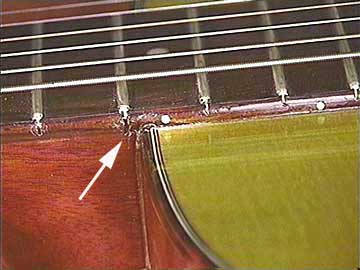
Early on, I was told that in order to get access to the neck joint it was necessary to cut the fingerboard through at the fret slot right at the body:
Then, after removing the end of the fingerboard from the top, the idea was to pour hot water into the joint to soften the glue. One serious problem with this system is that the fingerboard is no longer intact to provide support to the neck joint. That leaves the neck vulnerable to a sideways force (say if the guitar is dropped while it's in the case) which can cause the neck block to crack.
Thankfully, it wasn't too long before I (and lots of others, too) developed techniques for steaming the neck joint apart without cutting the fingerboard.
Teeny Dowels
Dowels are used to reinforce wood joints, right?
Here's a classic example of a good idea in the wrong application.
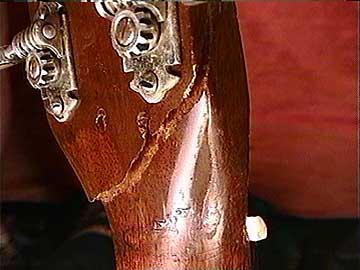
This 1940 D-18 had a broken headstock, which was reglued and "reinforced" with dowels:
As you can see, the dowels were really small, and because of the location of the crack, the were also really short. So, they didn't hold at all. They did look ugly, though. The neck broke again because the guitar was dropped, and the dowels pulled neatly through.
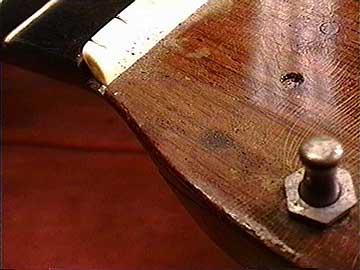
You can see the results from the top, too:
This is an example of a misguided effort to improve a simple glue joint. The dowels were visible from both the front and back, and only served to reduce the gluing surface by a small amount. I've seen much bigger diameter dowels make a much bigger mess, by the way.
Add a Pickup
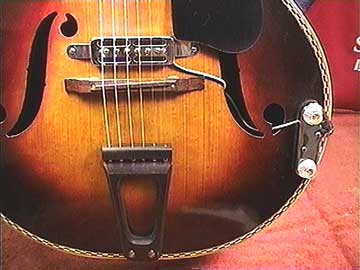
This isn't a particularly valuable guitar today, but it serves as an example of two interesting techniques.
The first is the application of a pickup system. Here, it's simply screwed into the face, so when it becomes obsolete, it leaves behind a bunch of little holes:
Nowadays, we're more sensitive to the application of pickups, because we've seen generations of electronics go into obsolescence.
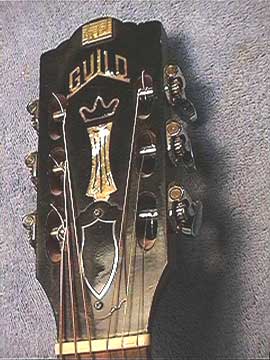
Gear Conversion
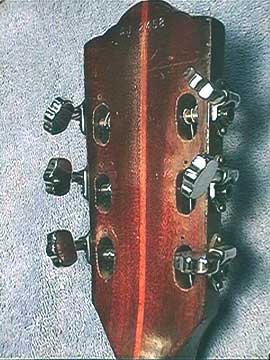
Well, this one is really quite horrible. I don't know when it was done, but it certainly was no earlier than the mid 1970s, because that's when the guitar was made. It takes a bit of doing to remember that we really have no way of knowing the motivation or reason for the work. It's still important to recognize that we don't know why, and since we can't go back, we must forgive it.
We often decry the loss of "originality" when replacing tuning machines, but such replacement usually at least results in an instrument that works better.
This one, with the increased downward pressure on the nut, actually doesn't work well at all:
I find this modification somewhat less forgivable than those coversions we see which were made during the "dark ages" of low guitar popularity. Grover Rotomatic or Schaller tuners could be had for less than 25 bucks, would have worked well, and would have been easy to install.
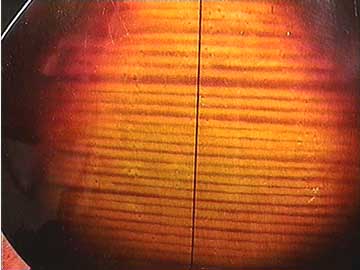
Faux Wood Grain
I have to show you two more pictures of this fine old archtop guitar. It's really quite a piece of work. The top and back are made of fine solid birdseye maple. But check out the wonderful finish:
Here the back is spray painted to simulate curly fiddle back maple grain. It's not a bad job for a production guitar; it's just a shame that they didn't simply let the birdseyes carry the show!
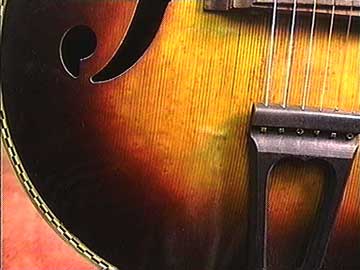
The top is even more amazing. Same tightly figured birdseye maple here, but this time they've painted it to look like spruce:
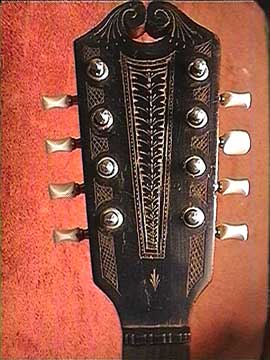
Gibson Mandolin Beautification Project
This is a classic Gibson style A mandolin from about 1915:
And, it has been richly incised to create a European flavor. Unfortunately, it's not the sort of work that can be easily undone.
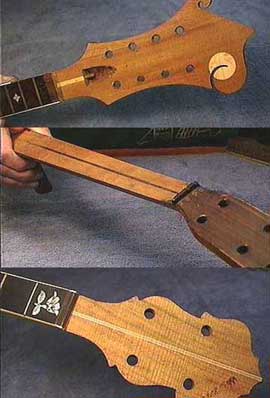
Here are three skeletons from my closet:
At the top, it's a neck from a 1930s Gibson F-7. More than twenty years ago I was asked to convert this instrument from the F-7 short neck to the F-5 long neck style. Most everyone would agree that the conversion successfully upgraded the instrument to a much more playable and better sounding mandolin. These days, however, we all agree that the collector value is greater than the "musical value" so it's not a wise thing to do.
The middle neck was one I removed from a Martin OM-18P, a plectrum 4-string guitar. I reshaped and transplanted a 1940s vintage D-18 neck onto that instrument, converting it to a regular six-string guitar.
Both of these jobs were done a long time ago and represented the current state of the art thinking at the time, so I feel I have nothing to apologize for. These necks do serve as a reminder of days past.
The bottom neck is a tenor banjo neck from which I salvaged the peghead overlay in order to make a five string replica neck. I acquired the neck, broken off at the heel, without the rest of the banjo. In 1974, I bandsawed off the peghead veneer as I had on other occasions to lend a bit of "authenticity" to my replica neck. That was at the time considered the proper thing to do, both to save effort in inlay work, and to capture a bit of originality. Most of the necks we salvaged in this way in the 1960s were not damaged, they were just four string necks, and not considered valuable at the time. These days, it's considered more appropriate to reproduce the peghead inlay, and keep the tenor neck intact. It seems obvious now, but it didn't then.
If you'd like to see the results of the five string conversion, click here for some photos of the Washburn banjo, which I still have after 25 years.
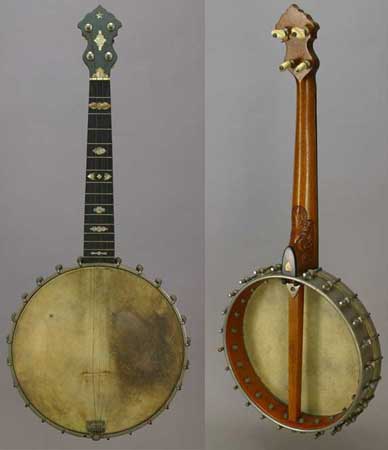
And, here's another old Washburn banjo. This one dates from about 1900, and appears to be a short neck tenor, with an inlay at an unusual position, namely the second fret:
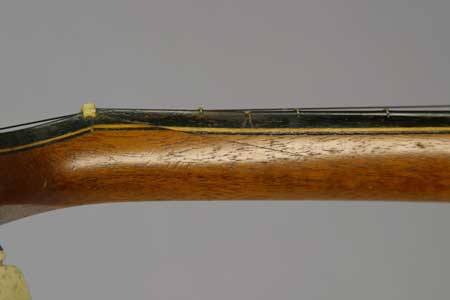
A closer examination reveals that it was originally an elegant open back five string banjo that was skillfully cut down to make it into a short 15-fret tenor at a time (probably the 1920s) when the short neck tenor was a popular melody instrument.
No trace of the original fifth peg remains, and that second fret inlay was originally at the seventh fret. The only thing I know for sure is we have no place asking, "What were they thinking?" or "How could they have done that?" That was then, this is now. . .
Anything to Avoid Resetting That Neck
30 years ago it was commonplace to see complex repairs done in the effort to avoid resetting necks. Removing the neck seemed nearly impossible to many repairers, so they devised "workarounds" and other methods of achieving low action on guitars whose neck angle had changed. I actually heard of a violin maker who removed guitar tops and shaved the sides to achieve a taper toward the end block, and replaced the top, in effect, lowering the bridge by dropping the entire top lower in that region.
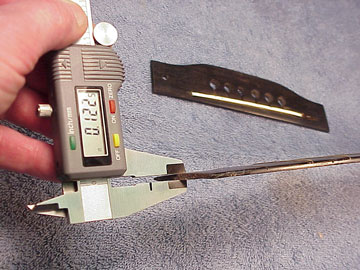
Here's a fingerboard I removed from a 1947 D-28:I have my caliper set to the maximum thickness at the nut. You can see that the fingerboard had been planed down to less than 1/8" which is half its original thickness. At the 14th fret the fingerboard was left at full thickness, tapering back toward the peghead in a effort to avoid resetting the neck.
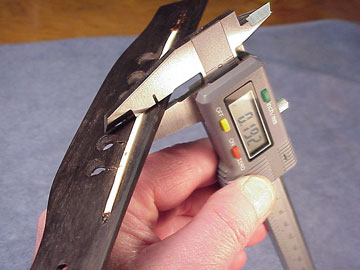
It must have worked for a while at least, but now look at the bridge:
It, too, has been cut drastically lower. See, it's barely over 3/16" INCLUDING the height of the saddle!
BUT, after a few more years, the action was high again, and there was neither bridge nor fingerboard left to cut lower.
After resetting the neck and replacing the fingerboard and bridge with ones of stock dimension, the guitar once again played well. The best part of the job was the "test drive" because the sound was utterly transformed. With the bridge height restored, the trebles and midrange came out dramatically stronger. This guitar went from 98-lb. weakling to Superman in one week!
Can you make my neck wider?
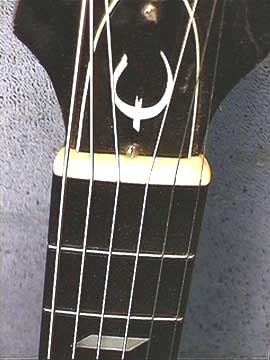
Here's one that had me a bit worried. This fellow brought in his 1960s Epiphone Texan, which was made by Gibson during the period they were into pathologically skinny necks. You know, the ones that are only 1-5/8" at the nut.
He wanted to have a new fingerboard made so his neck would be 1-3/4" wide at the nut, and I told him it wasn't possible. The problem would be that the profile of the neck would come out really strange and the edge of the fingerboard would of necessity have to be quite sharp.
Well, he prevailed and I made him the new fingerboard, almost cantilevered out in space. Just take a look at the nut profile on this guitar:
I figured he'd be instantly unhappy with the feel of the neck, and would want to have it made narrow again.
Wrong!
He's been playing this guitar happily since 1975 when I did the work.
So, here's a case where doing the "wrong" thing worked out right! Neither he nor I have any regrets about "violating" this instrument. At the time, of course, there was never a discussion of the value of "originality" I was just worried he would be dissatisfied with the work and might have blamed me for a custom job that was his idea. In fact, I doubt you could find a better custodian for this guitar or more loving home for it. In his hands the guitar is doing exactly what it was made to do -- making lots of music.