
Jeff Traugott's Way
Building guitars Jeff Traugott's Way
I hope you enjoy this pictorial tour of Jeff Traugott's guitar building style. Like so many of today's best luthiers, Jeff is ready and eager to share his methods and small discoveries. I asked him for some special tricks, and he said, "Well, I don't know if I have any. I mostly build by hand." True enough, Jeff is a traditional craftsman, relying on his skill as a woodworker and judge of materials, rather than computer aided gear, tricky fixtures and high tech tooling.
Jeff's is a one-man shop, and he designs all his processes for himself. I suppose for the individual luthier, the real tools are more a matter of hand and eye combined with enough experience so that things seem to fall into place intuitively.
There are some operations Jeff does only about once a year, like cutting fret slots or making linings and brace stock, so it isn't really possible for me to include every operation in the construction sequence. Rather than trying to make this a "how-to" article, I'm attempting to give an overall impression of how a traditional luthier works.
Here are some links for further info and photos:
1998 Field Trip to Jeff's Shop
A Traugott Baritone Guitar
The Traugott "Millennium"
Jeff Traugott's Web Site
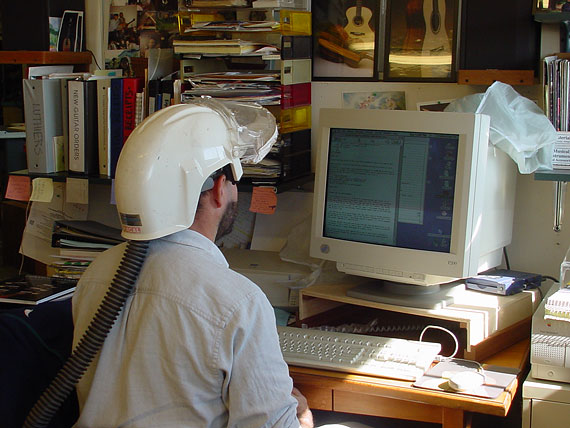
Jeff's office is a corner of his "setup" room, where he does all the final work on his guitars, and where he keeps his business organized. Here, he's looking over an order for a new custom guitar. Like most luthiers, Jeff grabs a little office time during the day as he's actually building the instruments. He's wearing his respirator because he's been doing some power sanding.
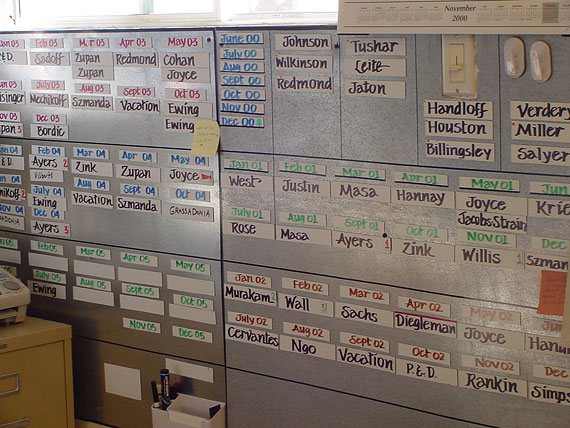
On the wall, he has a neat magnetic chart with the next four years' guitars all planned out. An individual luthier isn't just an "arteest" but is also a business owner. As with any business, organization is a key to success.
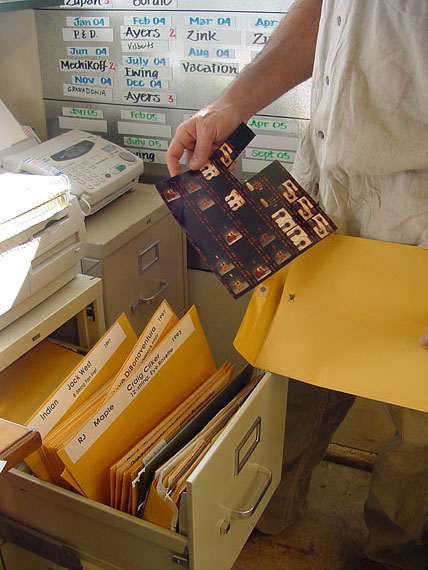
Right at hand, Jeff has a file drawer with specifications and photos of all the instruments he's made over the years. He says he never knows when a prospective client will want to see some detail of his past work.
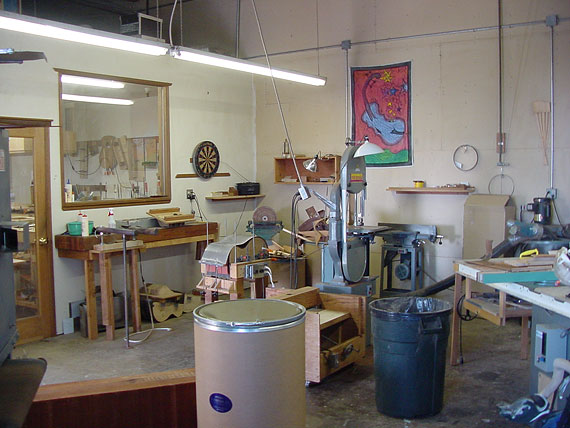
Jeff's shop is divided into several rooms. There's a large room with machine tools, where all the rough work gets done. Through the window, you can see into his humidity controlled room where he stores the wood for the next few years' guitars. Also, this his where he does all gluing, fine sanding, and all body assembly.
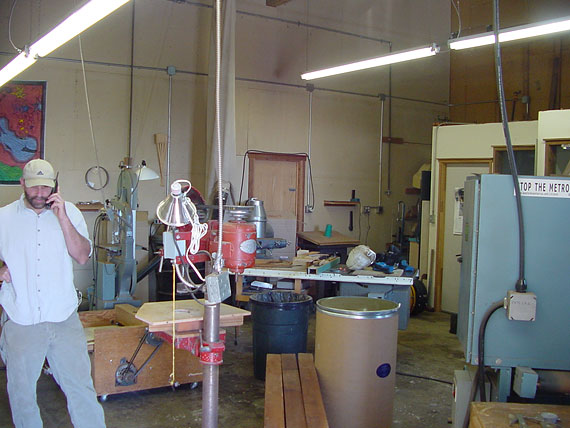
Jeff, like most of us, contends with the interruptions of phone calls. At the right rear, there is a small finish drying and buffing room, which abuts his large spray booth.
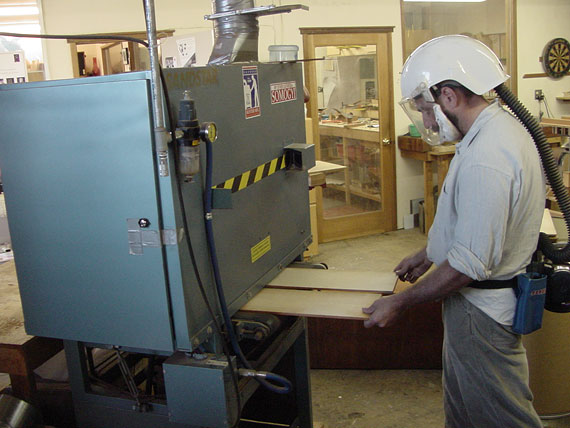
Body construction starts with a trip through the wide belt sander. Tops, backs and sides must be sanded to precise uniform thickness. But first, they get a quick trip through to make them uniform and a bit over thickness in preparation for joining the book matched backs and tops.
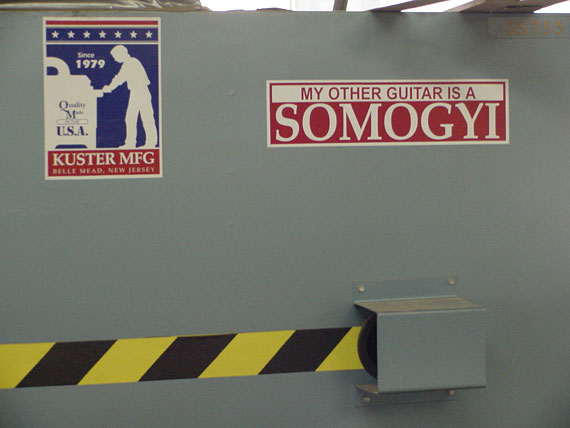
If there's one thing a luthier needs in addition to a wide belt sander, it's a sense of humor!
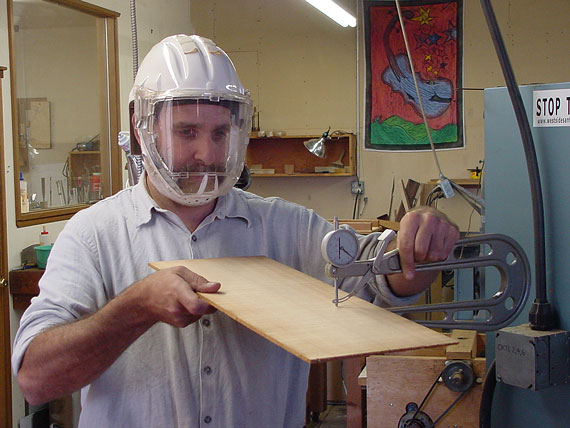
He's checking the thickness with a dial caliper made just for luthiers. It has a very deep throat so it can measure into the center of a guitar top.
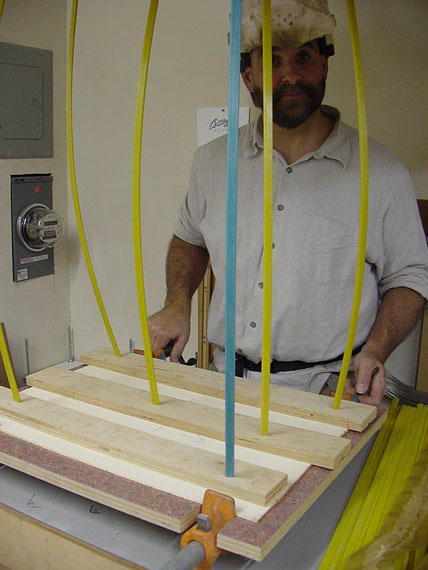
Jeff has a simple fixture for clamping the two halves of the top and back together. It's a pair of bar clamps which are mounted under a work board. Those vertical rods are "go-bars" which hold the top down and keep it from buckling upward as lateral pressure is applied. If you don't know about "go-bars" you will after you read on.
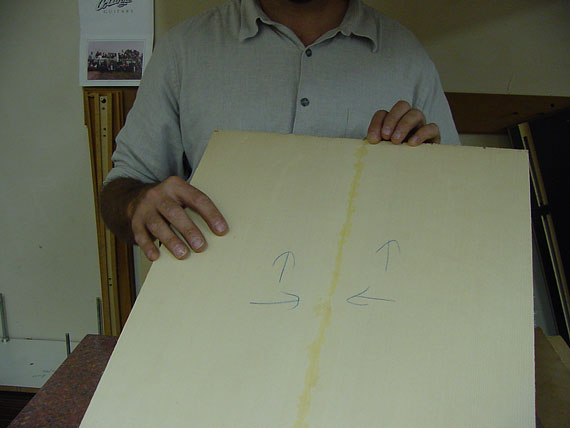
After the glue dries, the top is ready to go back through the wide belt sander to be reduced to its final thickness.
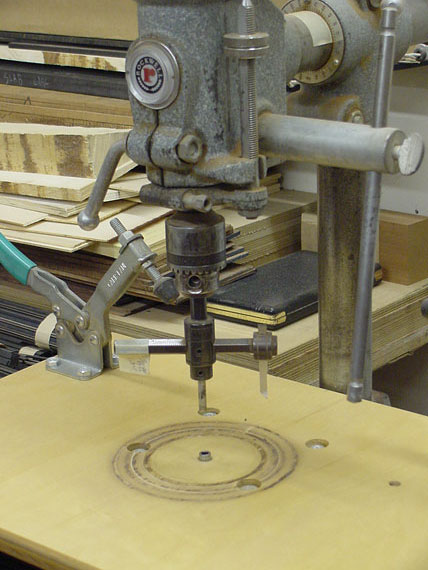
Also in the humidity controlled room, there's a little drill press dedicated to making the grooves for soundhole rings.
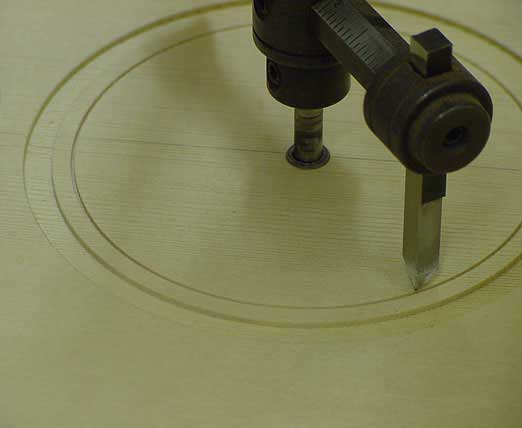
In fact, Jeff makes a large number of unique instruments, so he's always making test cuts as he lays out a special pattern. That's why he prefers to use a regular circle cutter, rather than to make a special tool for a specific ring pattern
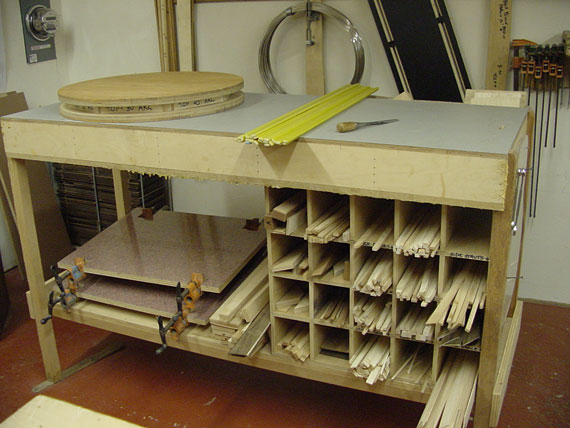
OK, back to the go-bars. This is Jeff's go-bar deck. It's platform or work table, with a low "ceiling" above it. Under the table top, you can see bins containing spruce stock he has milled to the appropriate sizes for all the various braces he uses on the guitar tops and backs.
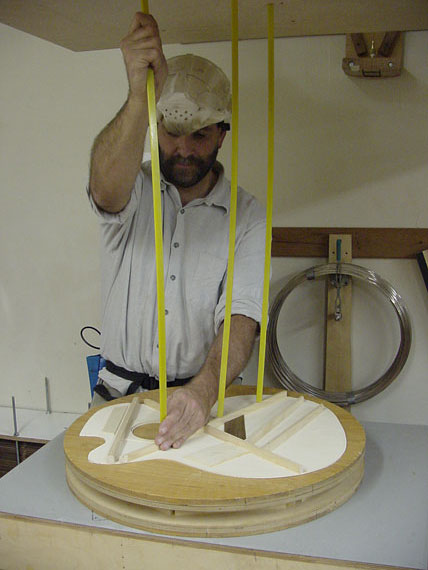
To clamp the braces, he simply takes one of these little fiberglass rods, and springs it into position Because the rod is almost nearly straight when it is in place, it exerts plenty of clamping pressure.
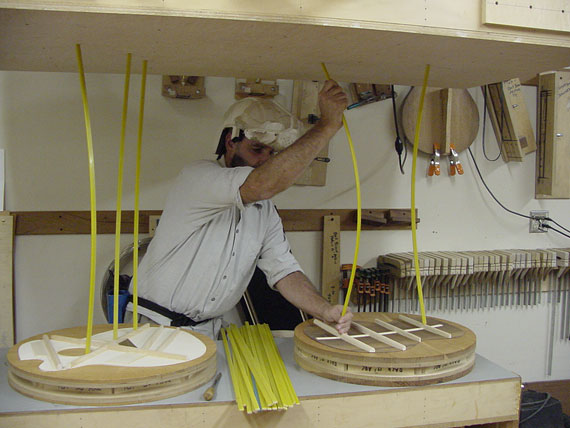
Both the top and back are braced by clamping into these round "dished" forms, which provide the proper radius curvature appropriate for the finished guitar.
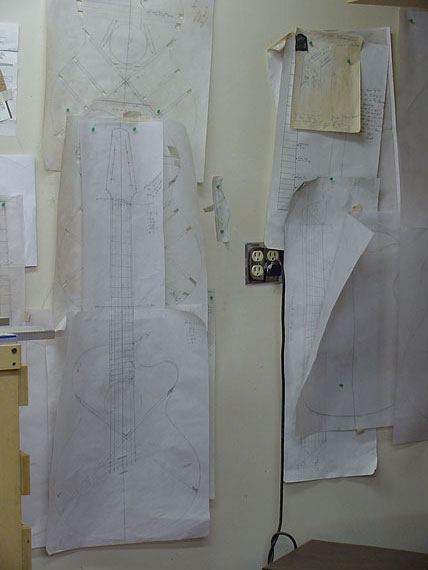
Over on the wall, there's more evidence of custom design work, both past and in progress. . .
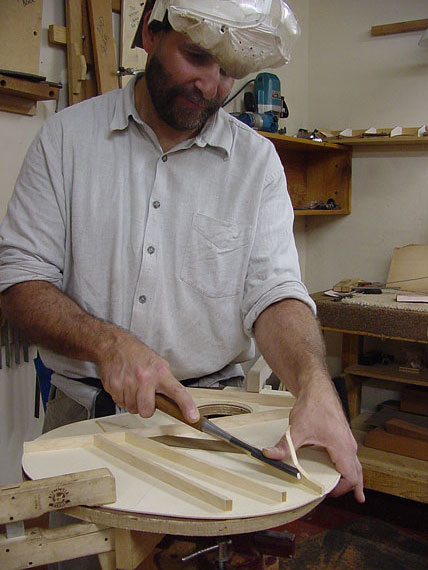
After the tops and backs are ready, Jeff hand carves the contours of both the top and back braces. If the braces were shaped before gluing, Jeff would need lots of special clamping fixtures in addition to the traditional go-bar deck.
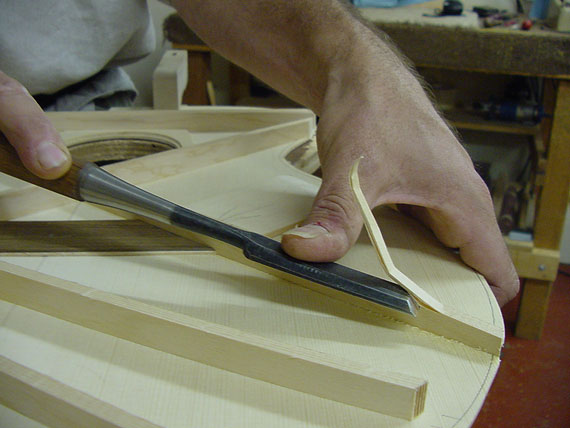
Many individual luthiers prefer to shape the braces by hand because it gives an opportunity to use discretion to modify the thickness and contour for optimum performance.
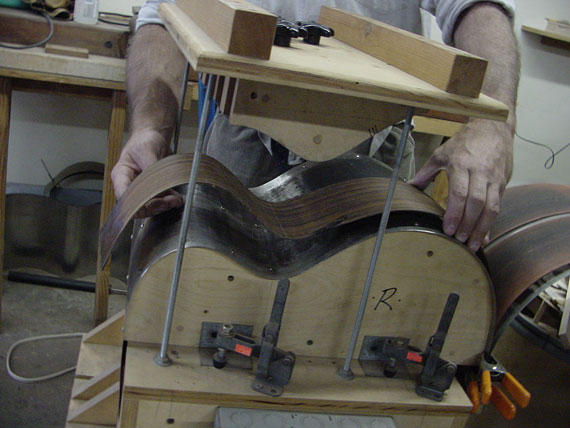
Jeff bends his sides by placing them on this heated form, with a mating piece that clamps downward at the "waist." Curled off to the far right, you can see the flexible electric heating elements.
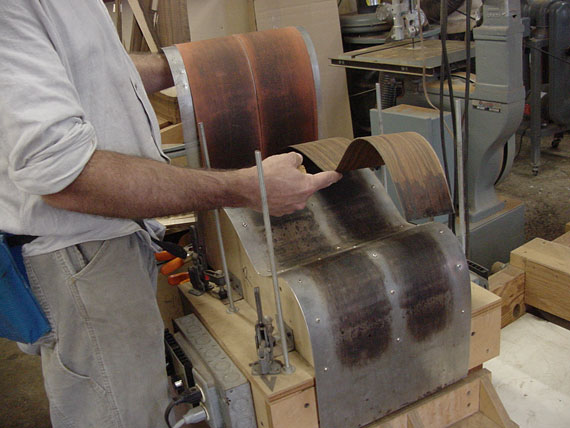
After they come off the bending form, the sides are approximately the right shape.
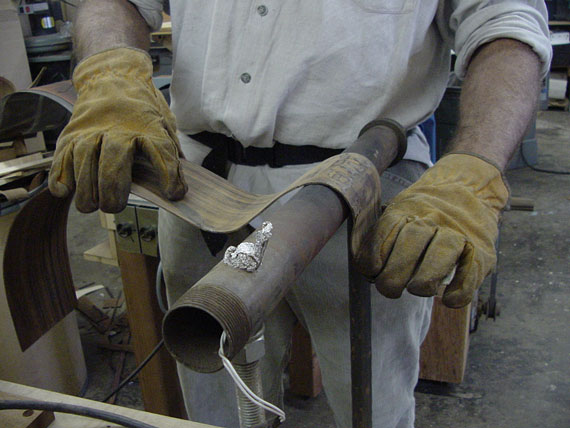
Jeff adds the bend for the cutaway, working strictly by hand over a heated pipe. He also uses the hot pipe to make unique body shapes.
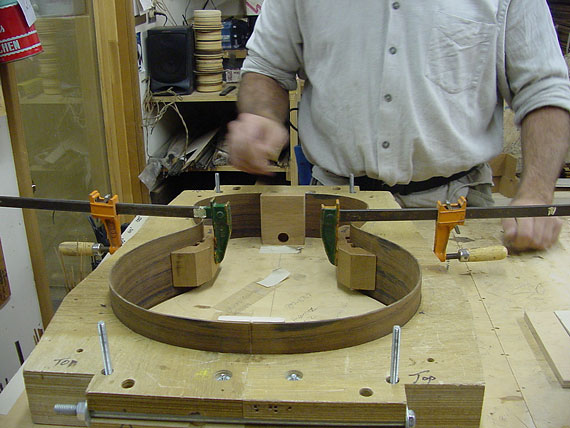
The sides are clamped in a heavy mold to maintain their shape as the body building progresses.
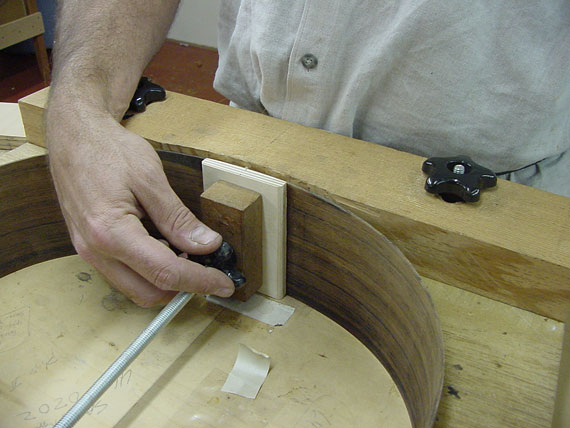
Most of Jeff's tools are deceptively simple. This is an expanding clamp which presses the neck and end block into position as they are glued.
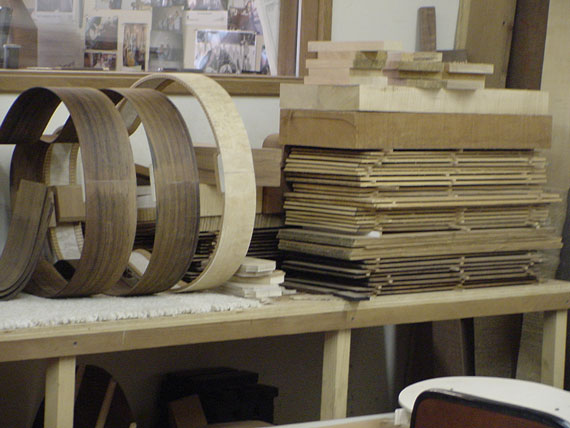
All around the humidity controlled room, there are guitar parts in progress, and stacks of wood for future guitars.
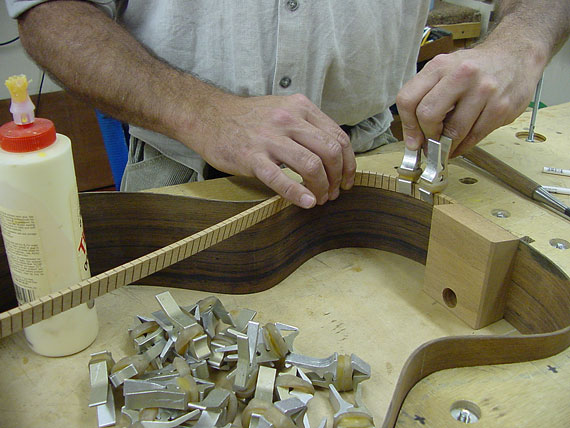
While the sides are still in the mold, Jeff glues in the linings.
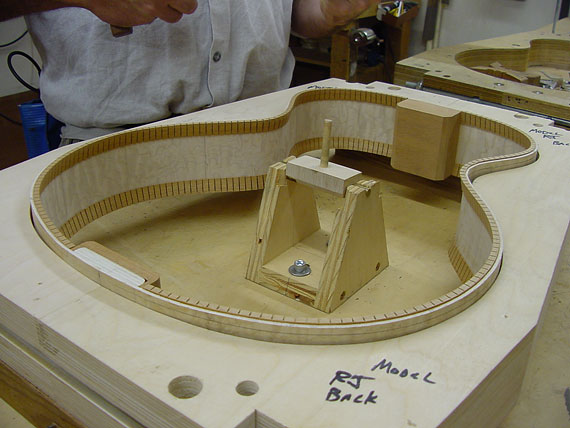
The heavy mold is bolted to the bench, and Jeff has a special little pivot screwed right in the center.
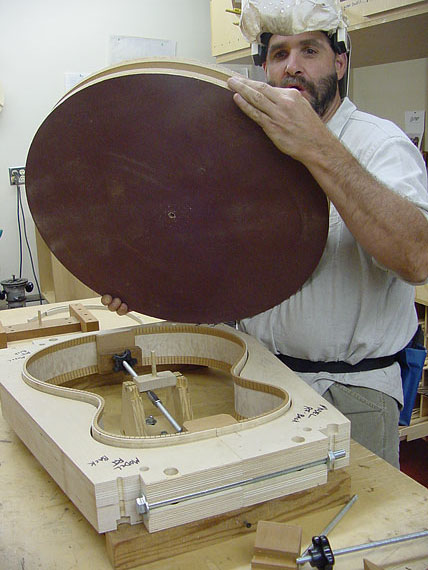
He takes his big "dish," a wood form with sandpaper glued to its concave surface, and places it on the pivot dowel pin.
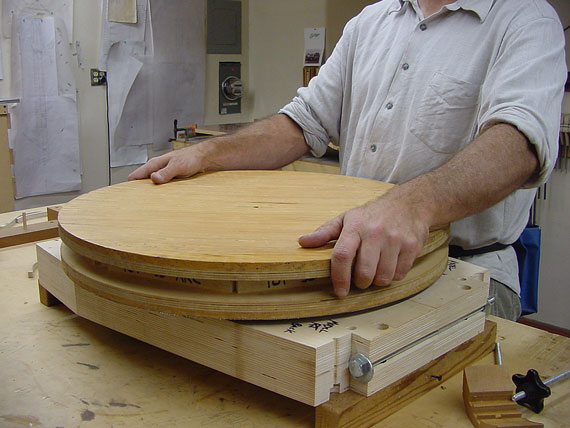
Then, all he has to do is spin the disc around and around to give the end block, neck block, sides, and lining the exact radius to which the top and back were clamped in the go-bar deck.
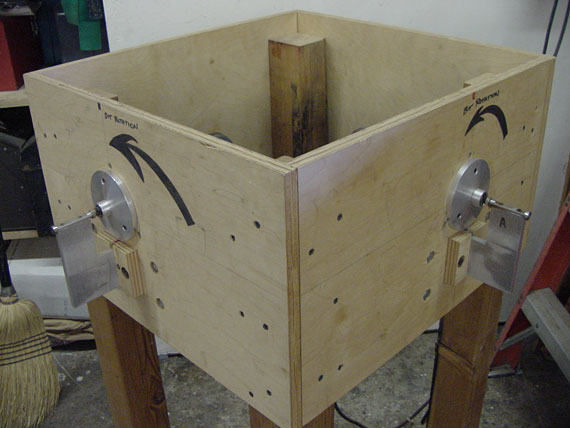
Unfortunately, Jeff was not ready to bind any guitars as I took these photographs, so I'll have to settle for just showing his setup instead. Here it is, a pair of routers mounted horizontally.
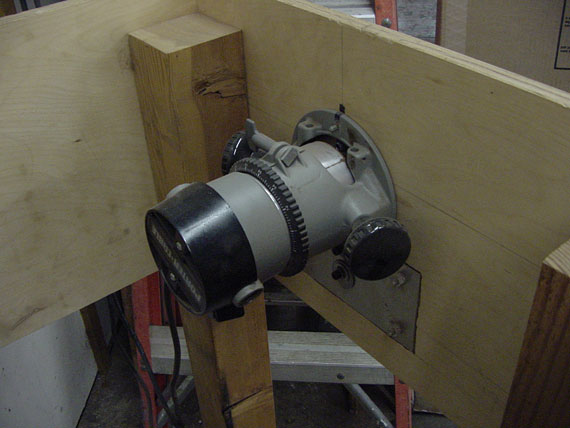
They are regular routers and just hang inside this movable box affair.
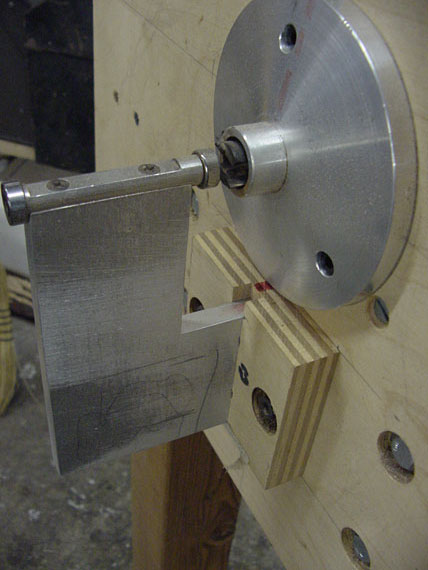
Outside, the router bit is centered in a convex aluminum guide, outboard of which is mounted a "finger" with two ball bearing guides. Jeff guides the guitar around, holding the sides tightly against these two bearings.
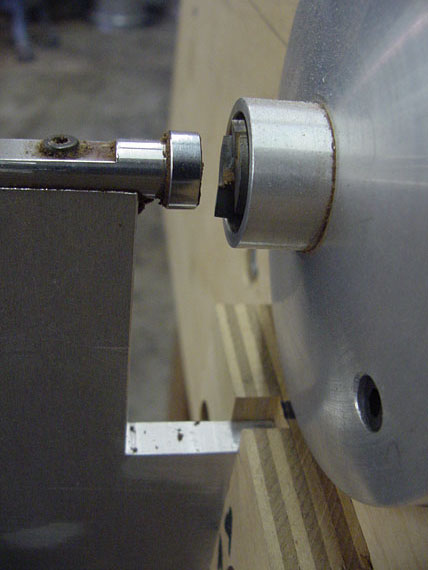
The result is a neat channel all around the top and back, ready to receive the binding. Once the binding is installed, the body is completely formed, and finishing begins.
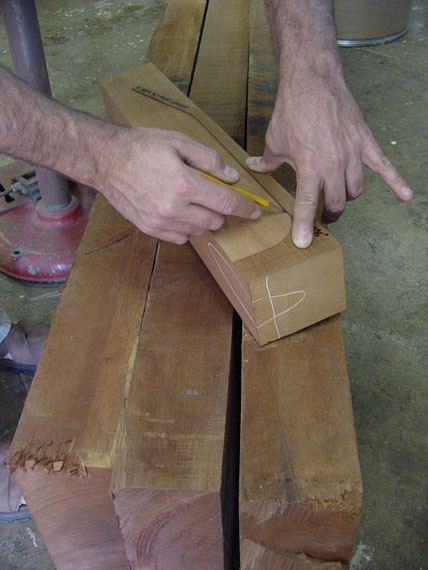
Look at these big mahogany planks. Jeff buys mahogany in big boards, a full four inches thick. That way, make all his necks from single pieces of mahogany, orienting the grain in the most favorable direction.
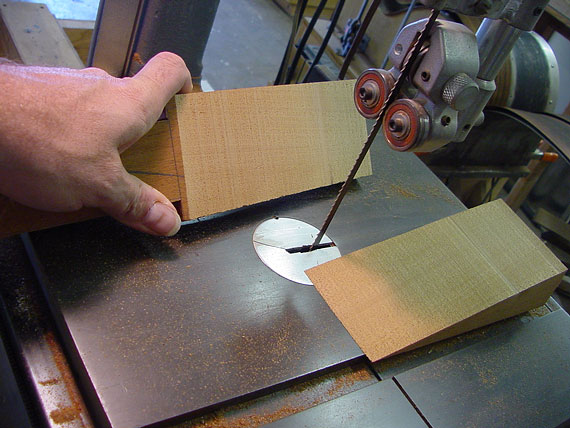
He cuts the neck's lateral profile on the bandsaw.
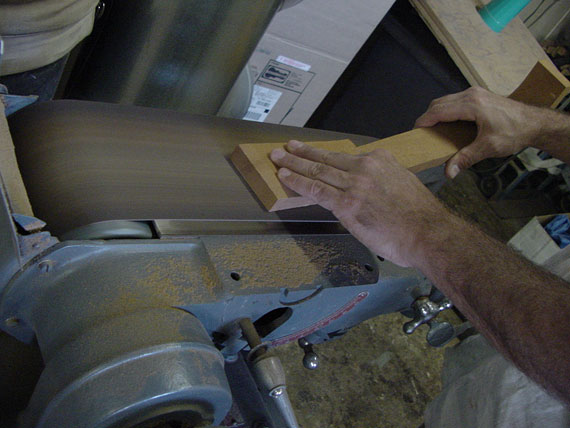
And surfaces the face of the peghead on a belt sander.
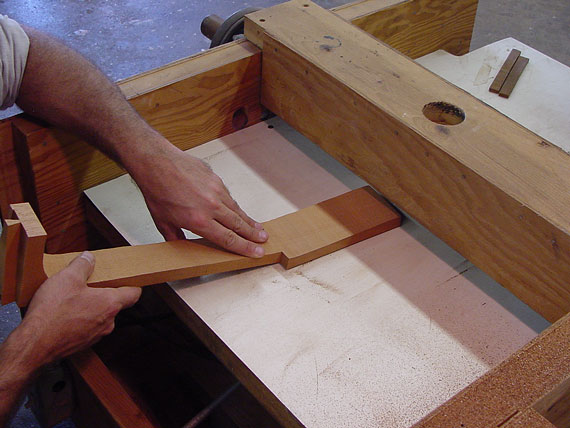
This is his old shop-built thickness sander, in semi-retirement, being used to even out the peghead thickness and sand the back side.
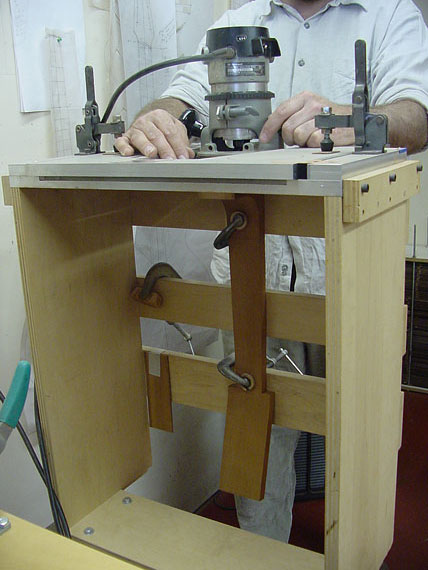
Cutting the dovetail is an operation best performed with a router. Jeff's fixture holds the neck at the correct angle as he guides the router. He can clamp the body inside this form to cut the mating portion in the neck block.
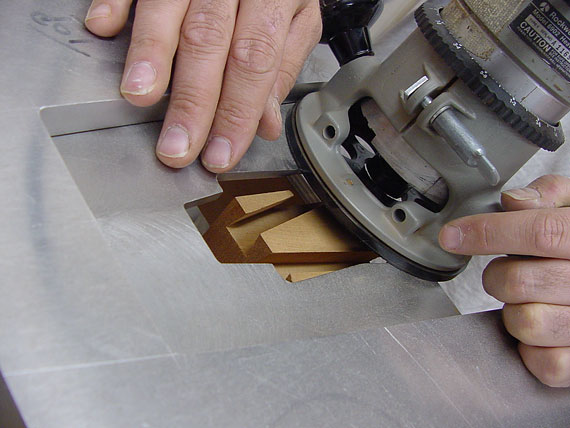
This heavy aluminum template assures him of consistent results with no slipping.
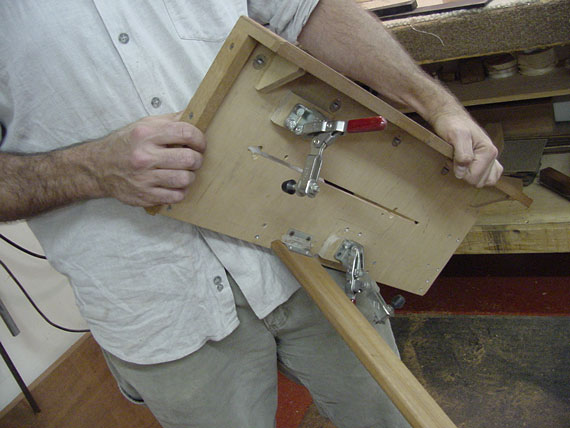
Here's a clever little router fixture. It's a sort of table that Jeff clamps into a vise mounted on a free standing pedestal.
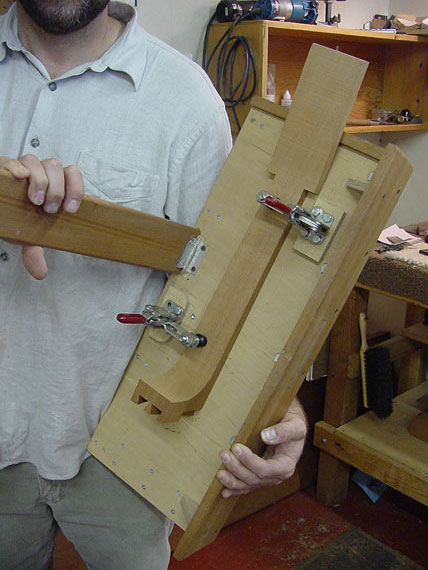
Underneath, he has the neck clamped in place.
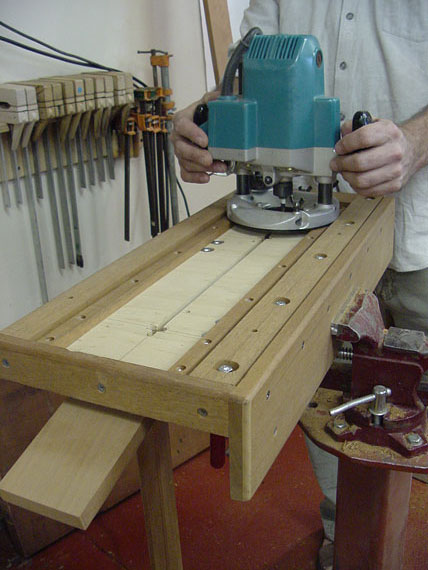
And, with the fixture clamped in the vise, it's ready to go. He uses two different routers with this rig. The big one, here, is for making the groove into which the truss rod will be inserted.
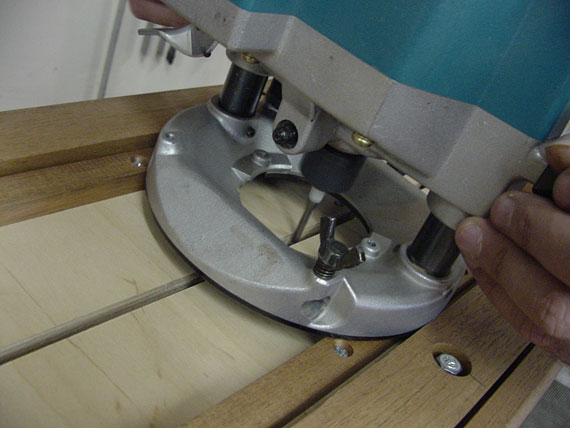
A pair of rails on the edge keep the router right on track.
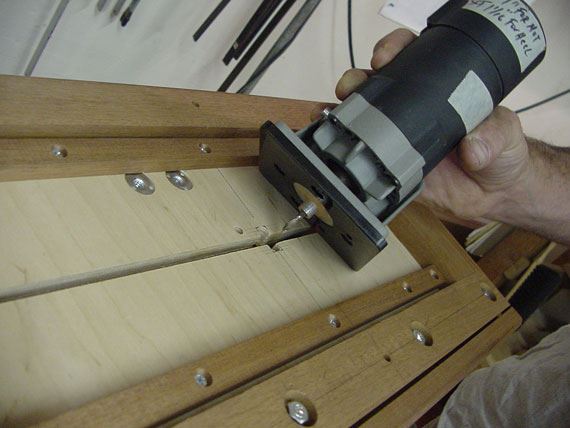
This smaller router rides in the space between the lower rails, and the bit runs in the same groove as the big router. By shifting the neck underneath the table, Jeff can cut a pair of extra grooves alongside the main truss rod groove.
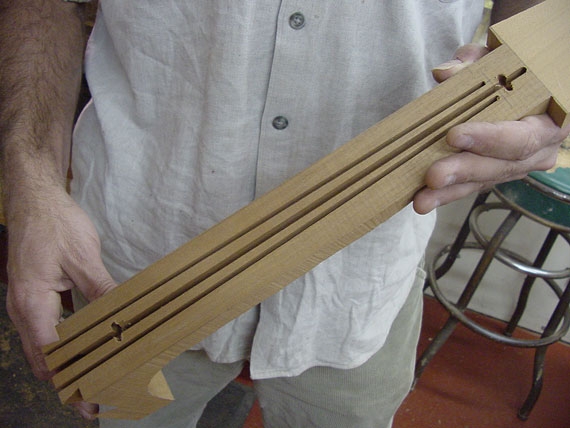
Notice that the grooves are not exactly parallel, but run in approximately the same taper as the edges of the neck.
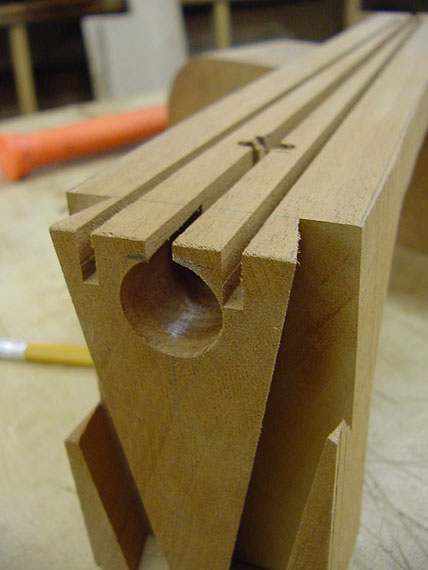
From the end you can see the truss rod adjusting pocket, and the depth of the two outer grooves.
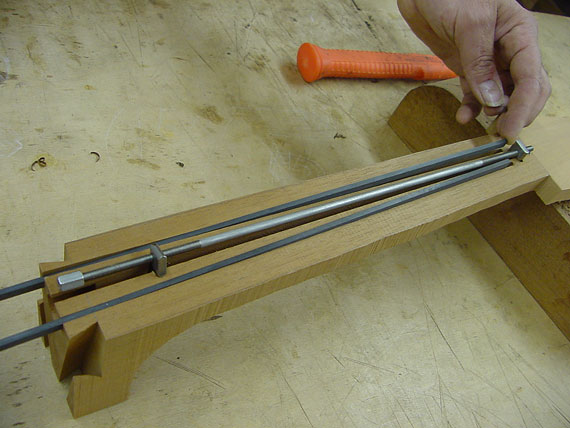
Jeff uses two stiffening rods of carbon fiber composite in addition to the adjustable truss rod, for greater neck stability.
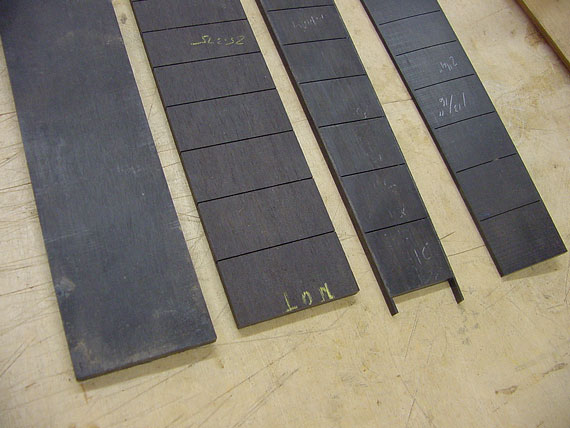
Here are the various stages of fingerboard preparation., from left to right:
the blank board, fret slots cut; binding glued on, and completed.
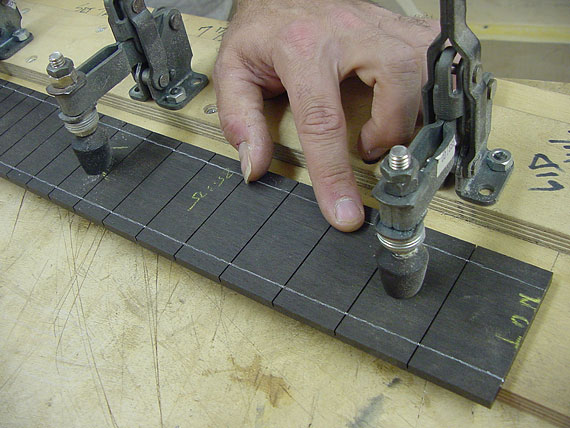
After cutting the fret slots on his table saw, Jeff carefully marks the fingerboard profile with a thin white pencil line. I asked him why he didn't just make up a bunch all the same, and he told me it was because he's called on to make so many different custom styles.
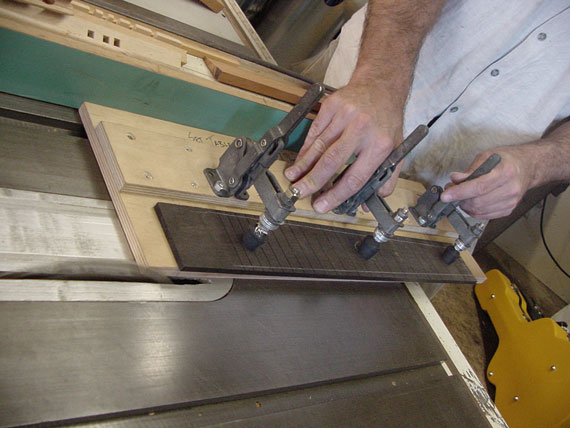
A quick stock removal on the table saw.
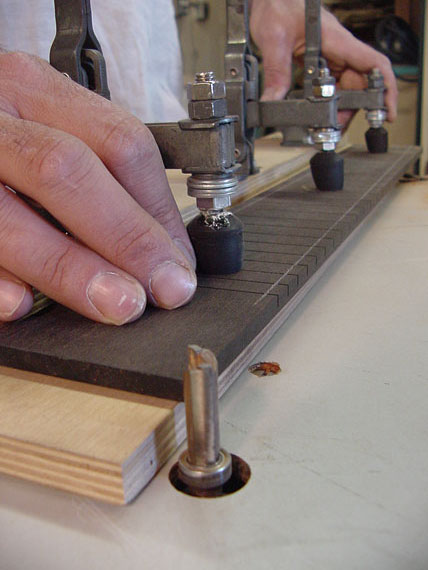
And, final shaping on the router/shaper. This vertical router is set up for pattern duplicating, with a bearing collar to guide along the various templates Jeff uses for cutting out parts.
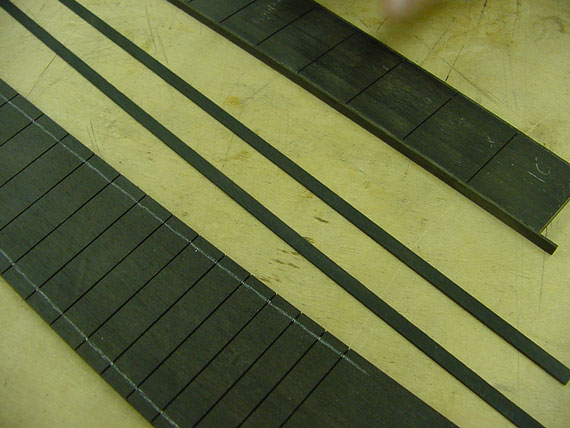
All of his fingerboards get binding. In fact, most of them are ebony boards with ebony binding. Jeff prefers the trim appearance of a bound fingerboard, so the ends of the frets and fret slots are not visible from the edge.
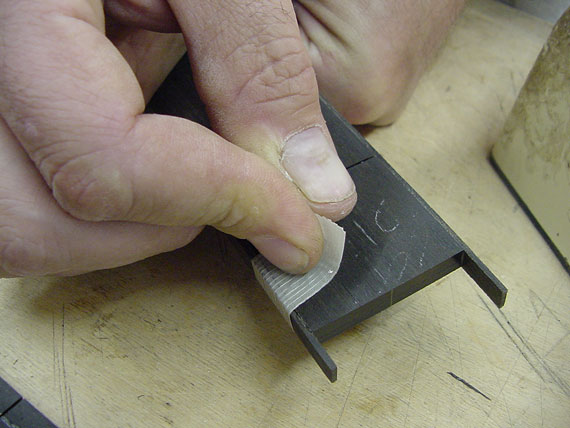
He makes all of his own wooden binding and glues it in place, using tape to hold it while the glue dries.
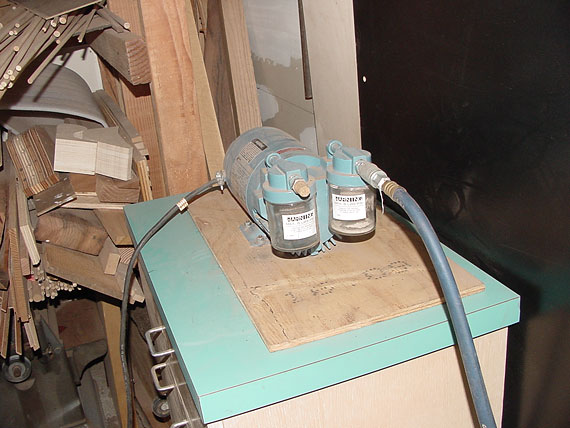
These days, many luthiers use vacuum clamping for fixturing as well as gluing. Jeff has a small vacuum pump way over in the corner, which he uses for holding delicate parts onto various shaper templates.
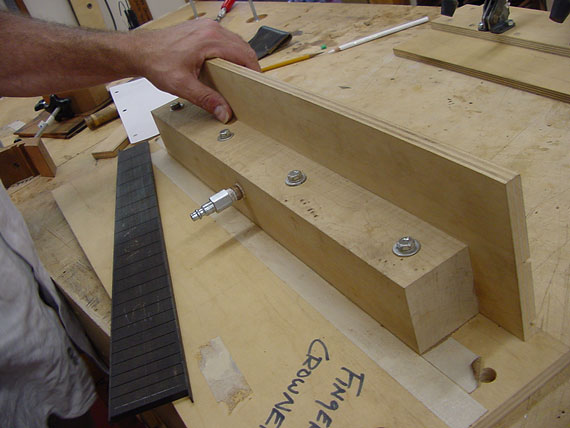
This is the back side of his fingerboard profiler.
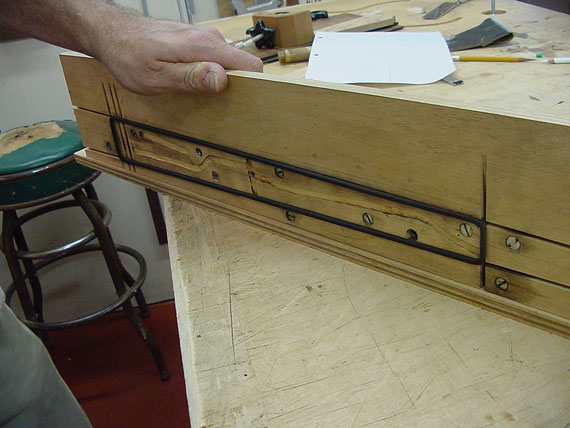
From the front, it's just a rubber gasket forming a vacuum chamber.
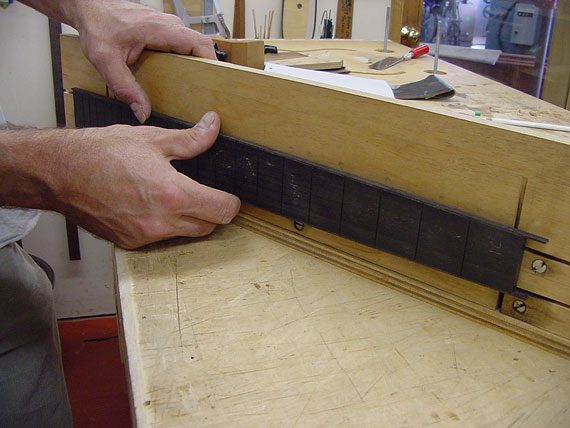
He aligns the fingerboard by careful measurement, again preferring the hand-and-eye method over jigging because he makes so many different styles.
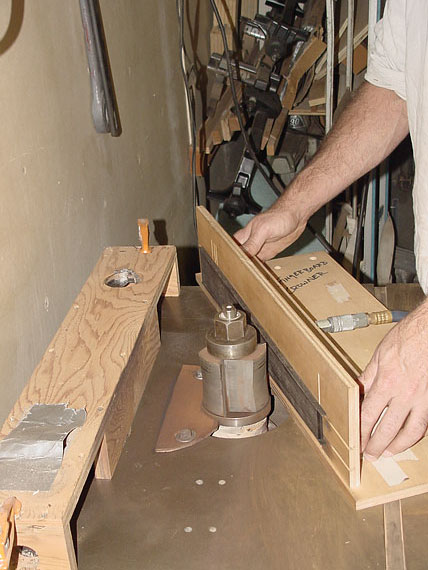
With the vacuum drawn, the fingerboard can stand up to this big custom cutter head!
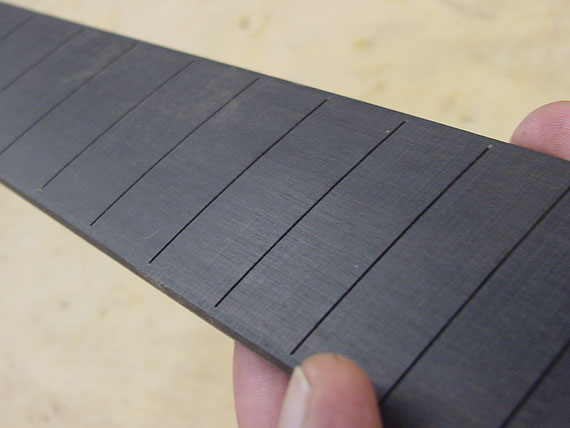
And, it comes off clean as a whistle.
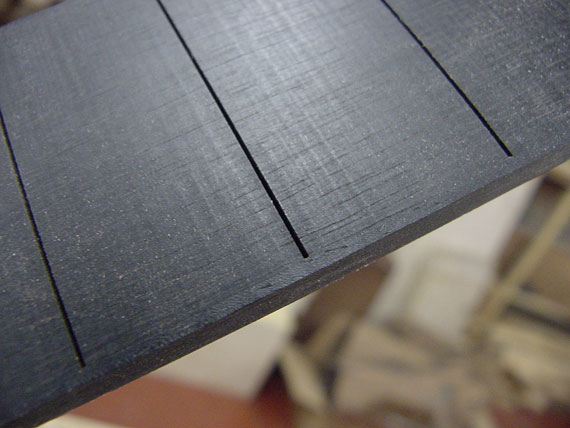
In fact, that's a fine finished surface.
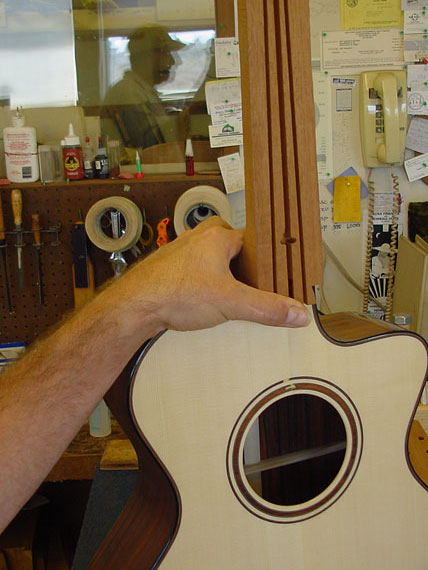
Back in the setup room, the neck gets its first dovetail fitting'
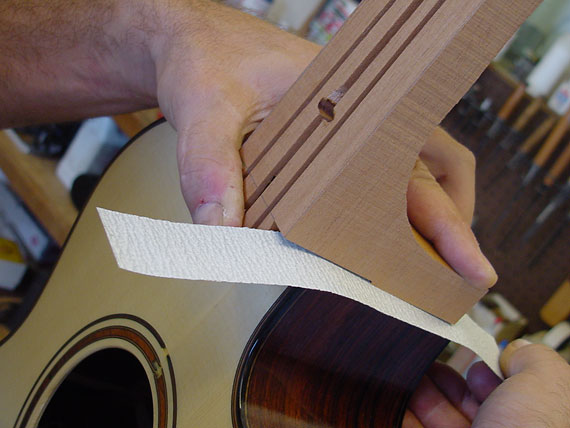
Even in this rough state, Jeff makes sure the neck fit is just about perfect.
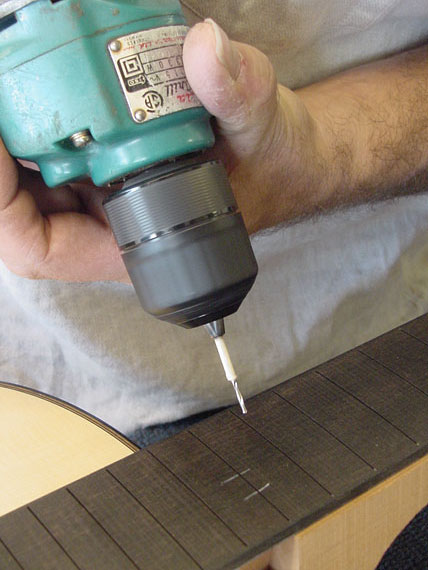
With the neck mounted on the body, he positions the fingerboard on the neck, and drills a pair of tiny holes for locator pins, so he can glue it right where he wants it.
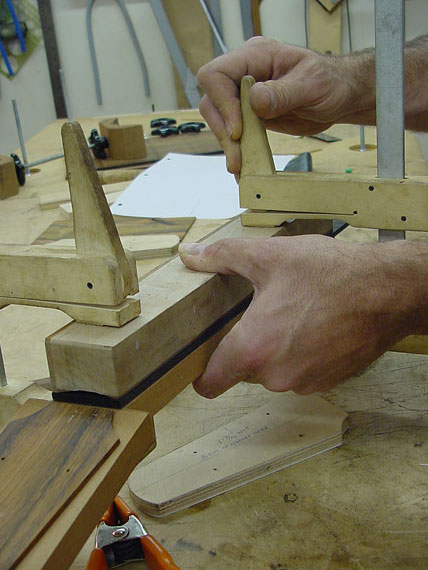
With the neck back off the body, he glues the fingerboard in perfect alignment, thanks to those two little removable steel pins. Now, you may notice that this neck has a peghead overlay on. Depending on the instrument, he may laminate and shape the peghead before or after gluing the fingerboard.
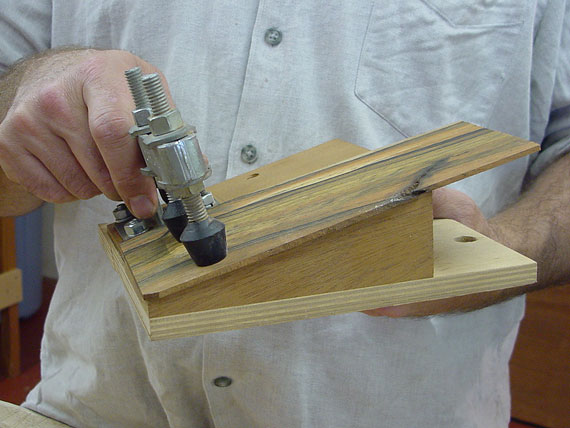
To facilitate fitting the nut, Jeff likes to cut the end of the peghead veneer at precisely the correct angle before gluing it on. This little tapered fixture works with his router table to produce that bevel cut at the nut end of the veneer.
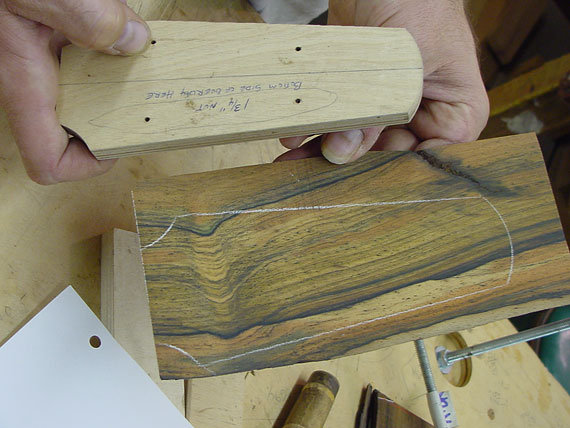
Then, he places a peghead shape template on the veneer, drills some locating pin holes where the tuner posts will be, and pins the veneer to the template with some skinny dowels.
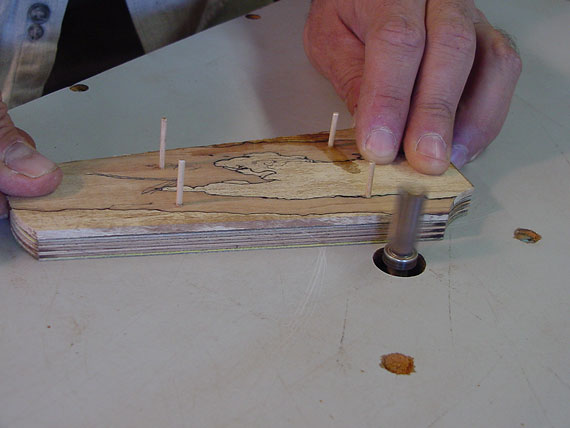
The template rides up to the pattern copy bit on the shaper table, and the peghead veneer is shaped to match the template.
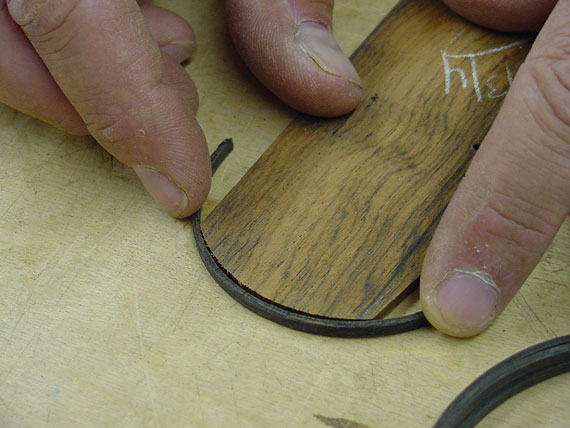
Staking the veneer out on the work table, Jeff cuts, bends, miters, and glues the binding on the veneer.
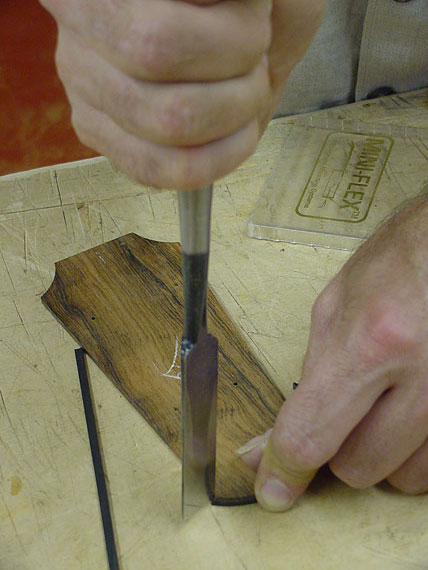
Not all pegheads get binding. This Brazilian rosewood one is being fitted with ebony binding.
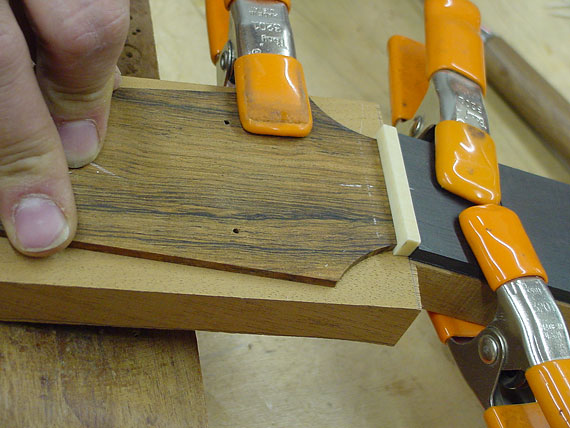
After the pehgead veneer is cut and prepared, Jeff clips it in place after inserting a nut blank. That way, he's assured that the nut will fit just right.
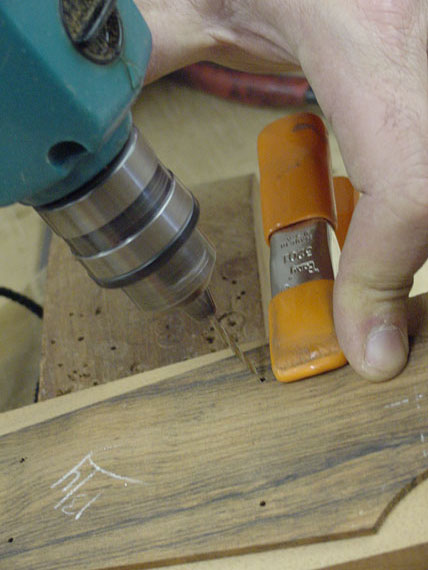
More locating pins, this time through the same holes he used on the shaper template.
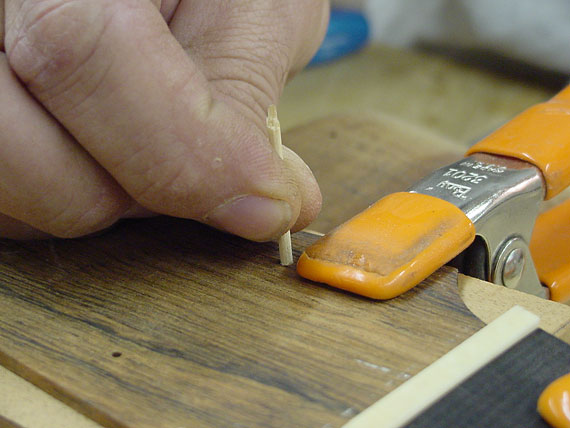
These are also small wood dowels, and he breaks them off flush with the surface after applying glue.
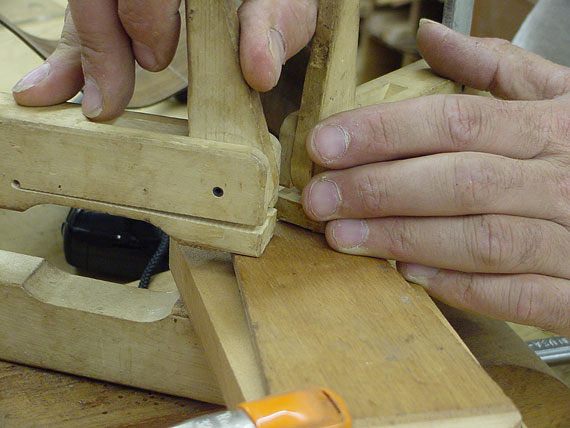
The locating pins will disappear when the tuner holes are drilled. By breaking them off, he doesn't have to make a special clamping caul for gluing the peghead veneer.
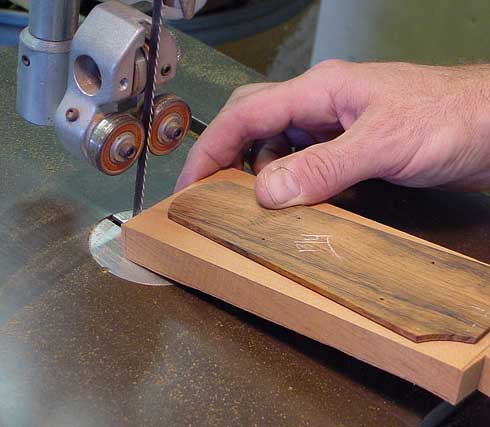
If there's a lot of outboard waste, Jeff trims it roughly on the bandsaw. Notice the saw isn't running. We're just photographing, no cutting. He assured me that he keeps his fingers away from those teeth.
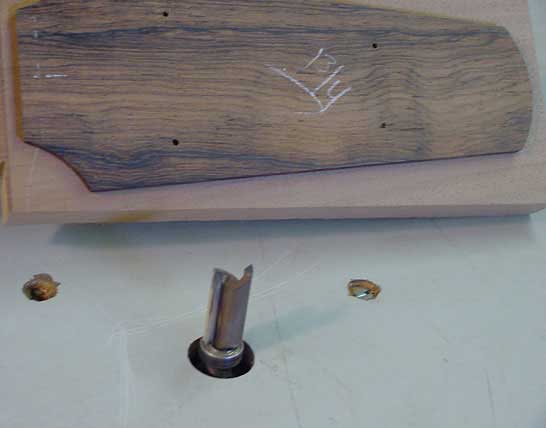
Now, the peghead veneer itself becomes the template, and rides along that bearing as the cutter trims the neck to match.
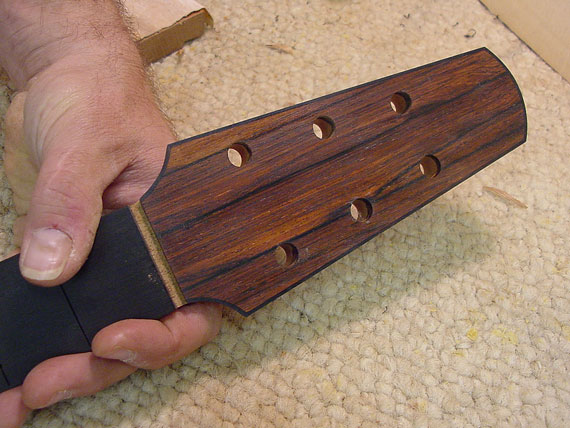
After the holes are drilled, the neck finally has that Traugott signature look.
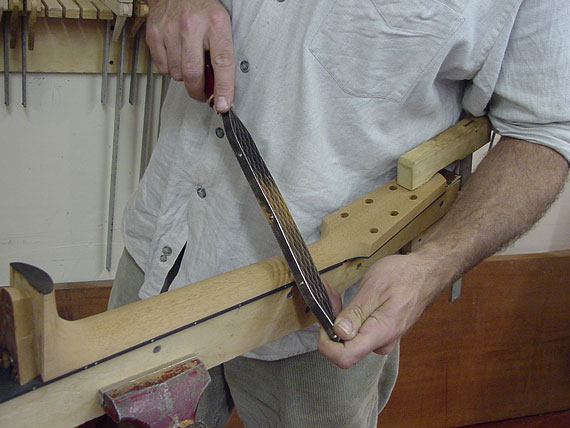
OK, we staged these next few shots, but it's better than nothing, I think. Jeff uses this heavy saw-rasp thingy to carve his necks.
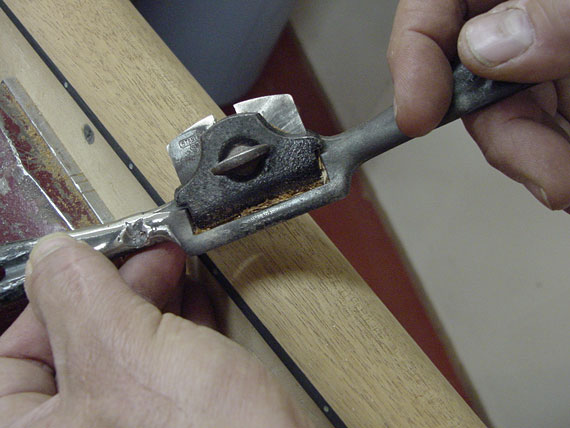
Also, he likes this small spokeshave. For a custom builder, hand carving the necks allows for infinite variability. Jeff could set up some shaper templates, but he tells me he likes to carve them by hand. There is a therapeutic nature to this kind of hand woodwork, don't you think?
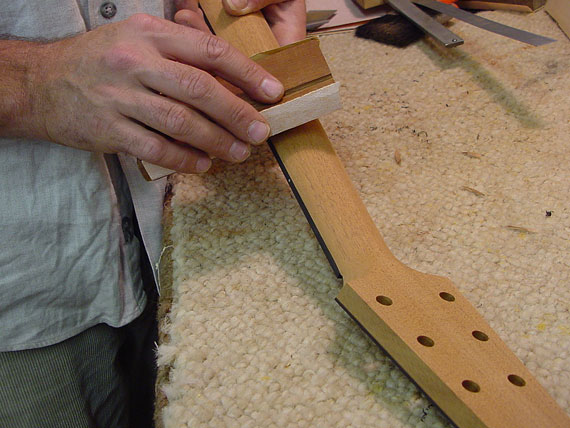
Block sanding helps him keep his profiles smooth and straight.
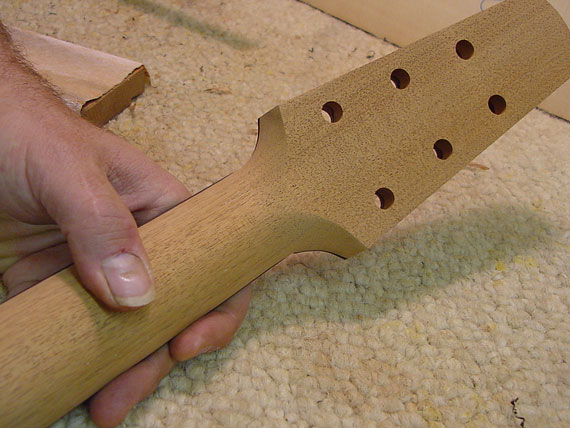
This neck is now all but finished.
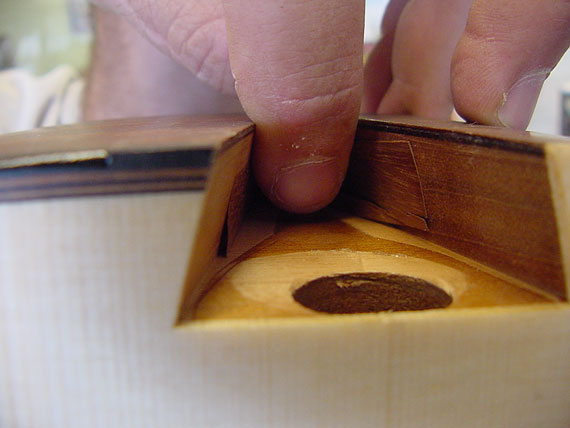
Time to go back to the body for a final fitting. Jeff inserts some paper thin shims at the bottom of the dovetail pocket,
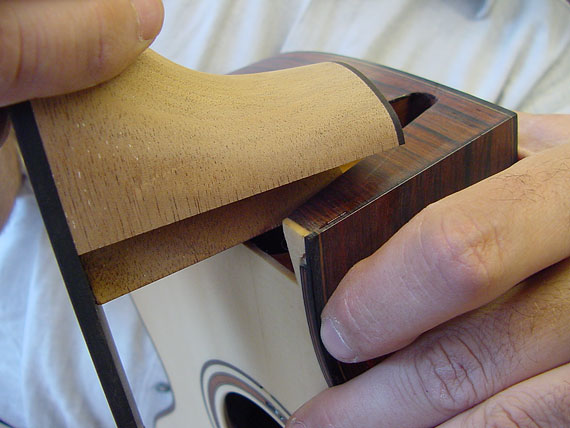
slips the neck in place,
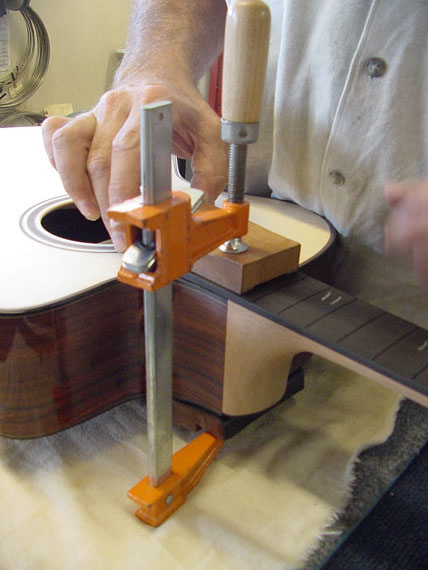
And clamps it up tightly. In fact, it's so well fitted that it doesn't need glue to hold it in place. Before taking the clamps off, Jeff has a quick little special trick.
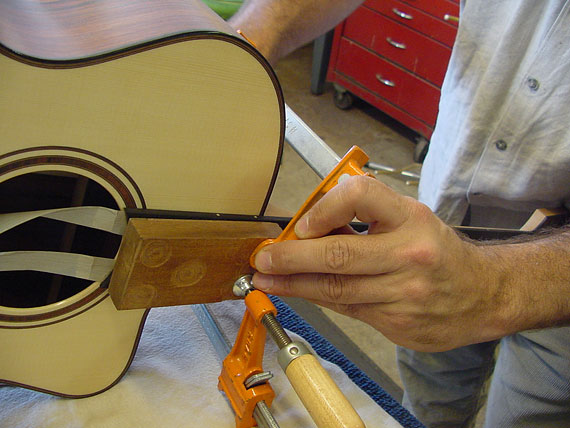
See those two strips of tape? They are fastened to the underside of the fingerboard, and will hold the end down to the body when he presses them up tightly inside.
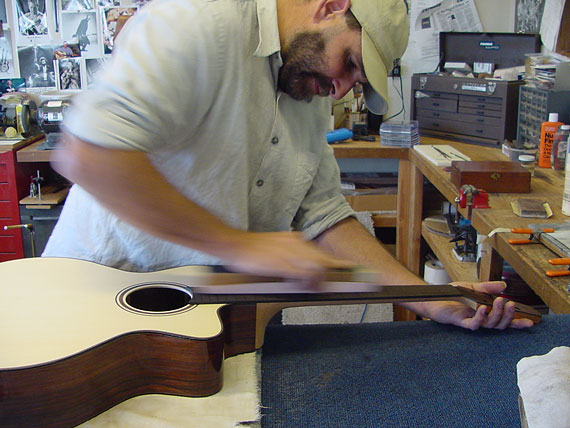
Now, with the clamps off, Jeff "shoots" the fingerboard perfectly straight by sanding with a long block. He said the thickness of the tapes under the end raises the fingerboard just enough to create the perfect "drop-off" over the body. Clever, eh?
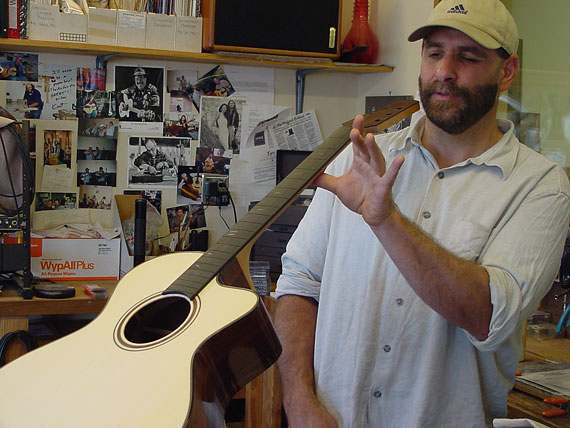
Once he's pleased with the straightness of the neck, he can begin fretting.
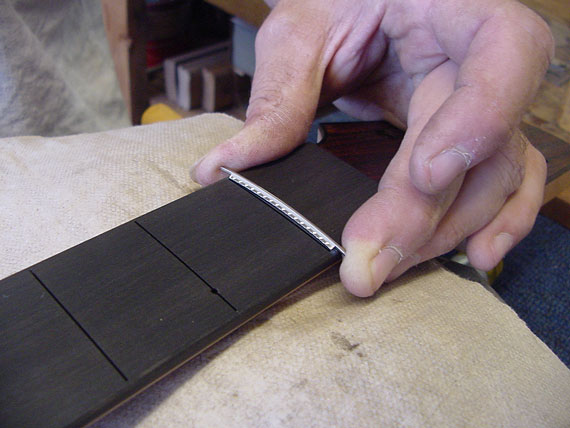
Each fret gets trimmed to fit, overhanging the binding.
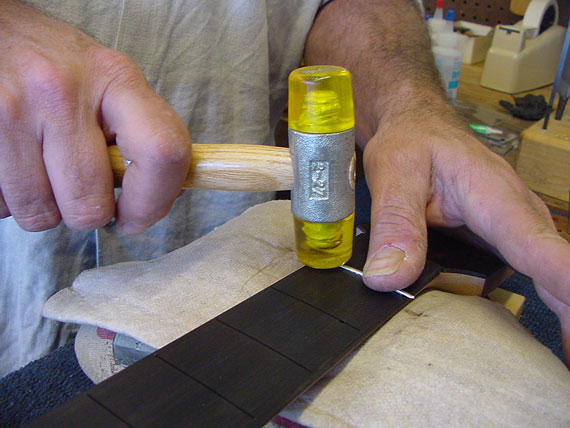
Jeff uses a plastic hammer to avoid injury to the top of the fret crown.
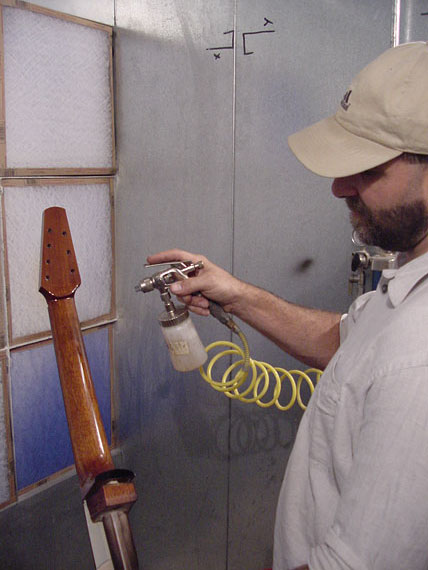
After frets are installed, it's into the spray booth for some lacquer. All of Jeff's instruments are finished with high gloss nitrocellulose lacquer.
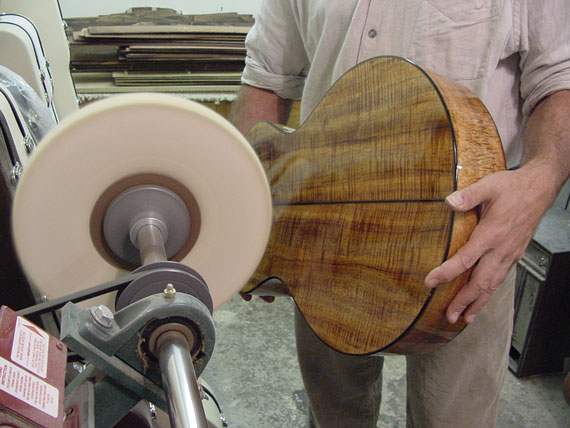
After weeks of spraying, sanding, spraying and drying, a final buffing gives the body and and neck a high class look. While you're at it, look at that koa back. That's what I call "mother-of-curl!"
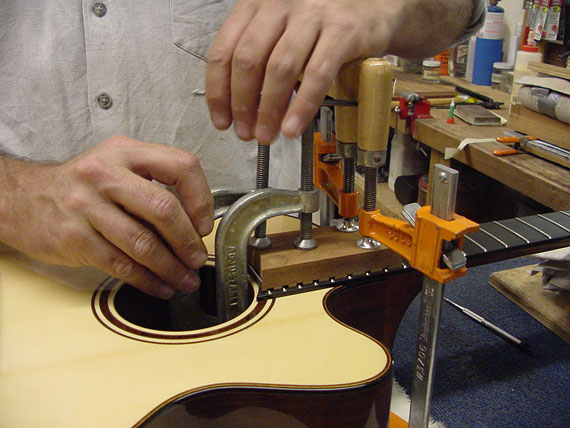
Back in the setup room, the neck gets fitted back on and glued in place.
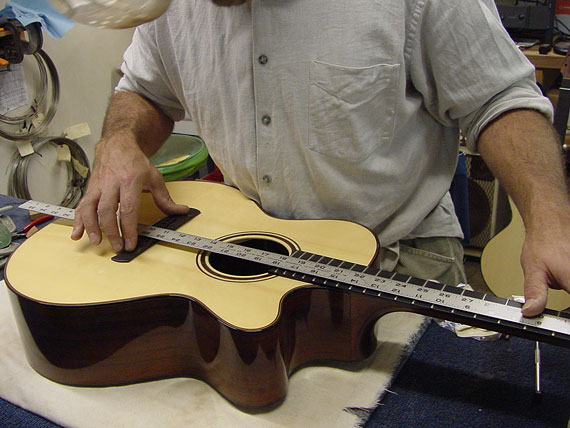
Jeff makes each bridge himself, and locates it for optimum intonation by careful measurement.
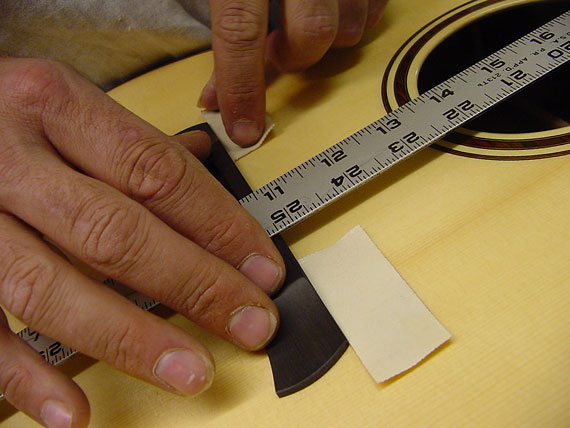
Here again, he works by measurement rather than with standardized templates because he gets involved in so many different scale lengths, unusual tunings and stringing, not to mention the infamous "fan fret" models.
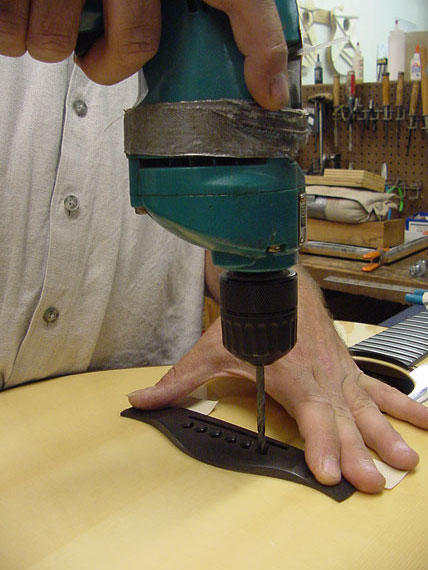
Held in place against the temporary strips of masking tape, Jeff drills the first and sixth bridge pin holes to locate the bridge precisely.
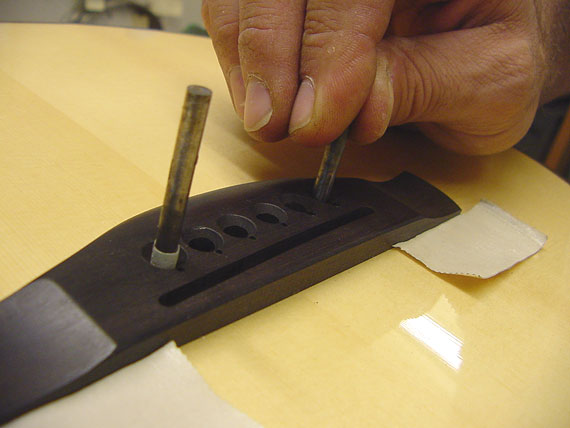
These are two steel locating pins, machined to fit very tightly so there won't be any shifting when the bridge is clamped in place.
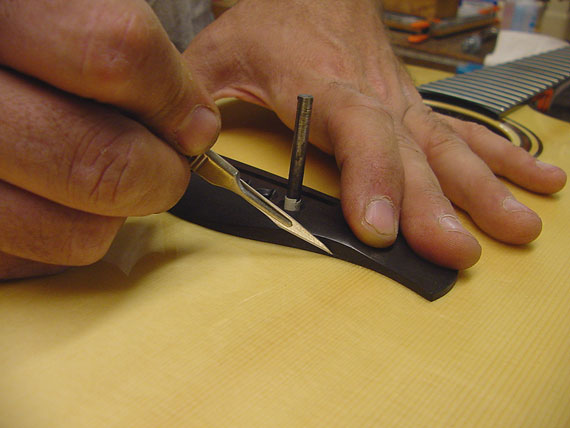
The sharpest scalpel makes a clean scribe line right into the precious new finish. Jeff takes pains to scrape off every bit of finish under the bridge to get the best possible glue joint.
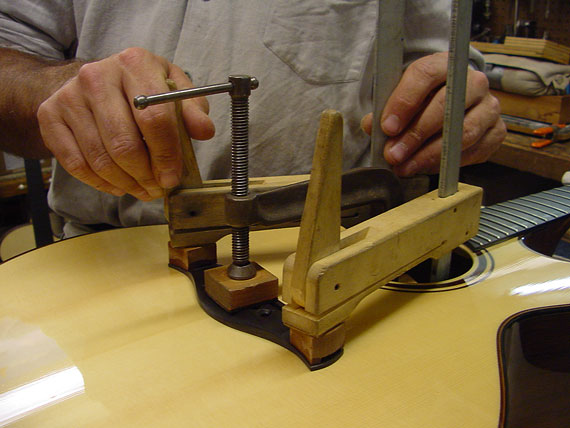
The last gluing operation is the bridge.
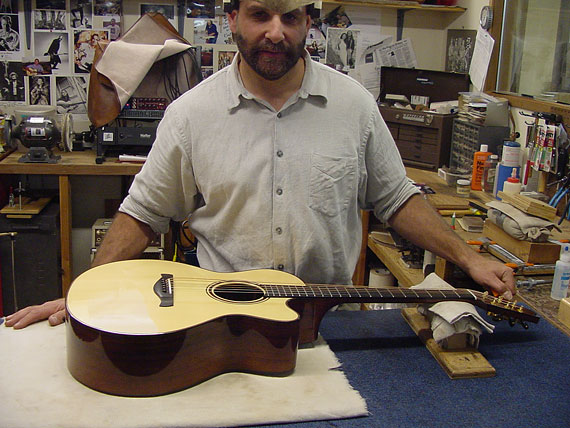
Finally, time to set up, make a saddle and nut, install tuners and string it.
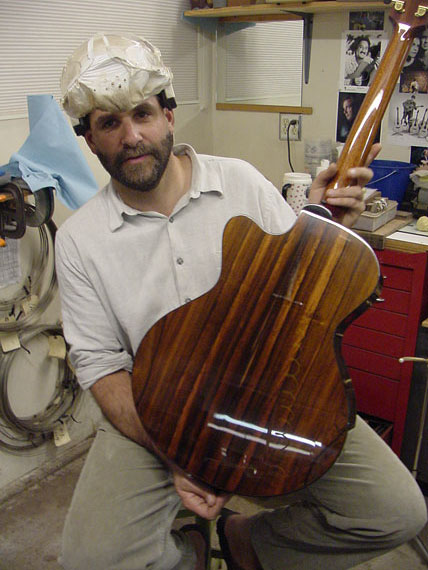
Here's Jeff with his latest creation. It's a Brazilian rosewood fingerstyle cutaway, and it looks great.
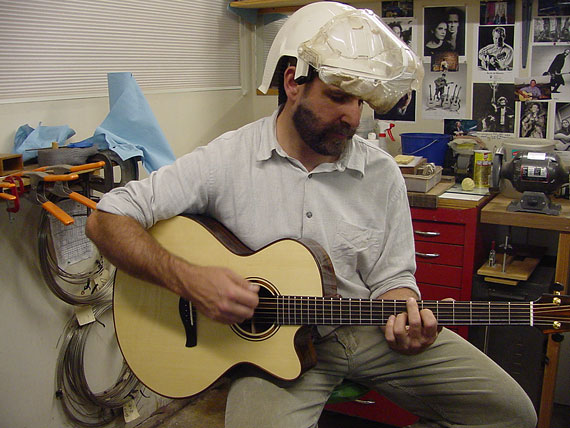
Here's the moment. . .