
Looking at Cracks
Does it go all the way through the wood?
Fine stringed instruments are usually made of solid, but thin woods. In fact, the wood is so thin that it can break rather easily when hit, or when it is subjected to extremes of humidity and temperature. To confuse the issue, the finish can crack with temperature and humidity changes, too. Sometimes it's difficult to tell the difference between a structural crack in the wood and a crack in just the finish.
Musicians are aware that cracks are never a good thing, and that most of the time they should be repaired and/or reinforced. But the first question is, "Do you think it goes all the way through?" The presumption is that if the crack is only in the finish, then it never needs to be repaired to maintain structural integrity.
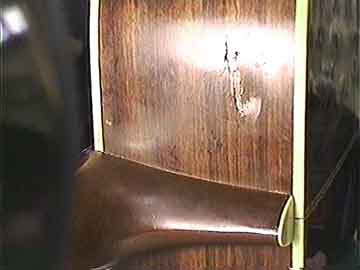
I've taken some pictures of instrument cracks to illustrate some of the "classic" structural cracks, to give you some idea of what I look for when I examine an instrument.
Let's start with the most obvious kind.
No question what happened here. The side got hit, and hard! In fact, the side is punctured. There is finish damage indicating that it was a hard object, and the wood fibers are smashed inward.
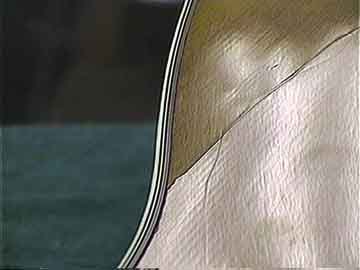
Here's an obvious crack in a spruce top.
You can tell that it goes all the way through the wood because the crack appears "open" and the wood is "puckered" upward.
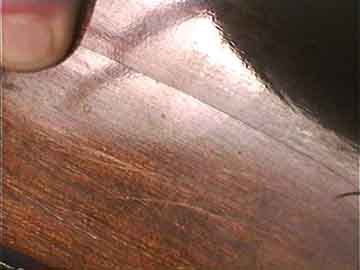
This crack is open in the opposite direction. You can be sure that it goes all the way through because even though it's perfectly tight, it "folds" inward.
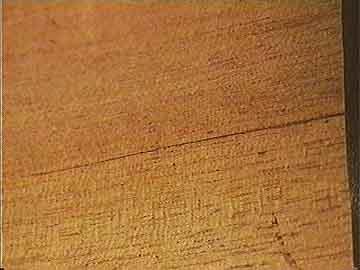
Whenever you see this kind of crack on the outside, you can bet it looks like this inside, where the crack bends wide open:
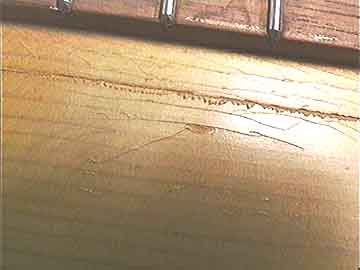
This Martin 0-16 has a crack near the fingerboard.
There is a series of finish cracks that have no structural significance, and there is also a tight, flat crack in the spruce. It's easy to see which crack is the structural one because the finish is shattered along its edges where the lacquer was broken, probably as the two edges moved up and down against each other. Not all lacquer checks with shattered edges are structural cracks, but when it's the only one of dozens that has shattered edges, chances are it's a structural crack in a field of finish cracks.
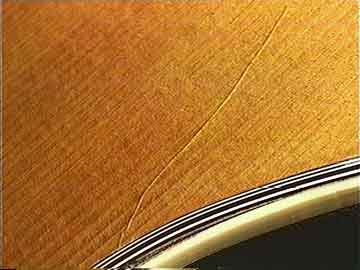
This is a classic finish crack.
You can't miss it because it doesn't even come close to running along the grain line in the spruce top. A structural crack will virtually always follow the grain along the weaker light grain line between two hard, dark ridges of grain.
Finish has no grain structure, so it can crack in any direction. Finish cracks or "checks" may follow the grain in a "general" way, because the wood may have expanded or shrunk across the grain and strained the finish. Usually, though, such finish cracks will stray away from following the grain exactly. Sometimes a structural crack will proceed for a while, and at its end a finish crack will continue. This pattern can get a bit confusing.
So far we've looked at the thin sections only. If you see several cracks at the heel of the neck, or behind the nut where the peghead might be broken, chances are you're looking at finish cracks.
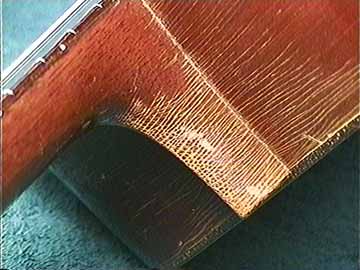
Here's a really gross example.
These cracks are obviously in the finish, even though they follow the grain of the neck and side. Structural cracks don't generally occur in multiples, and never like this!
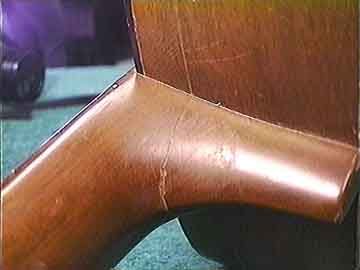
This one is obvious, too.
The heel is cracked, and the same crack appears to continue along the sides, emanating from both sides of the neck. There's only one crack, so we can be reasonably certain.
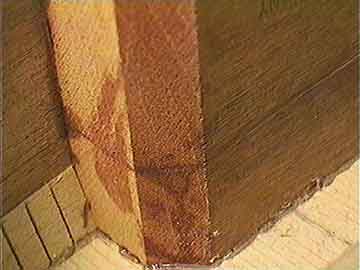
The crack continues to the body, so we can be sure that the crack goes right through the neck block and looks just like this inside.
This is a big structural crack that must be repaired for the instrument to survive.
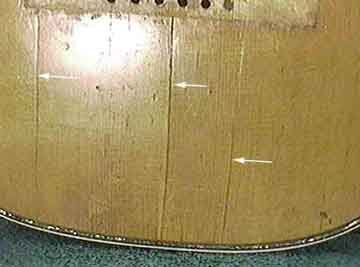
Three top cracks in this 1887 Martin guitar extend from the bridge all the way to the end of the body.
They are structural cracks, but will not affect the longevity of the guitar even if they are left wide open and not repaired at all. Spruce has very little strength across the grain, and the pull of the strings is never in that direction. So, lengthwise cracks have little effect on strength in this area, where the only force is with the grain. The wide bridge (now off the guitar) distributes the load across six inches of the spruce, so it's able to handle the tension very well.