
Refretting the 1931 Martin 000-45
The Infamous Bar Frets
Refretting the 1931 Martin 000-45

This 000-45 (Lefty) was the subject of my article on neck resetting. I've reset the neck now, and I'm ready to replace the frets and deal with a badly abused fingerboard. This one has been treated roughly during repairs, probably at a time when its actual cash value was not so much. I can now afford to take my time to correct past abuses!
I invite you to read my article on refretting a D-35 to fill in any of the gaps in this discussion. Bar frets are much more involved, and I'll gloss over some of the details and processes that both jobs have in common.
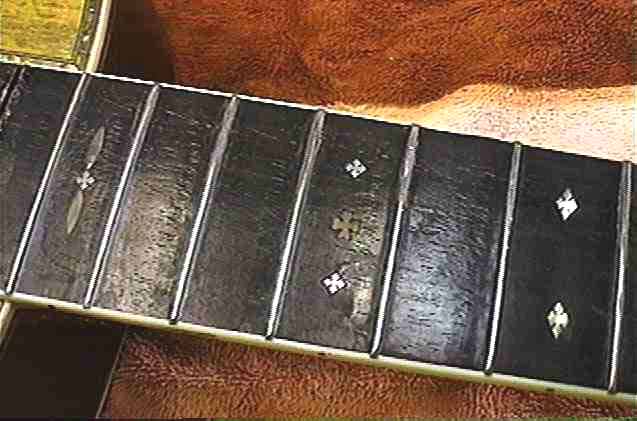
The fingerboard shows reglued and loose chips at almost every fret, and severe scarring from fretwork between all the frets:
One of the previous repairs consisted of raising the frets by pulling out all the frets and slipping mahogany slivers underneath, then returning the frets to their original slots. In the process, many of the overhanging fret ends were simply cut off.
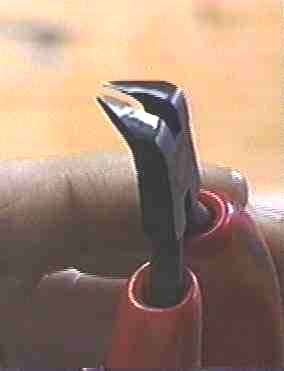
First order of business is to remove the frets. I'll use a special pair of bent flush cutters I found while rummaging around in the local SNAP-ON truck:
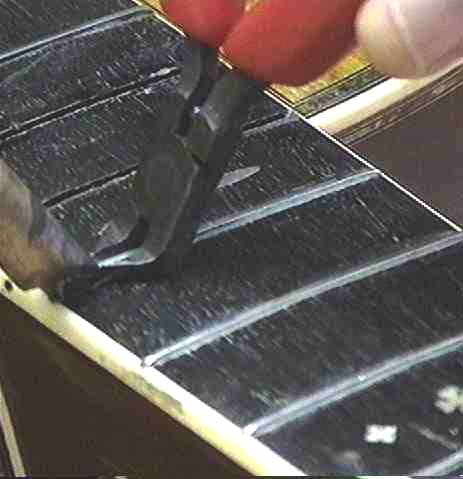
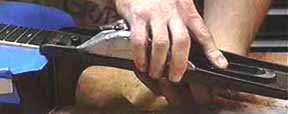
These cutters are made for fine electronic work, and they work just perfectly to raise bar frets. I can "bite" the fret gently, and rock the cutters backward, allowing the jaws to pivot where they contact the fret. I'll heat the fret as usual with my soldering iron:
Here I'm just starting to raise the fret right where I'm heating it. I want to go very slowly and the leverage of this rocking action allows me to do that easily. The high heat will allow me to avoid pulling chips from the fingerboard. I'll still have to deal with all those previous chips, though!
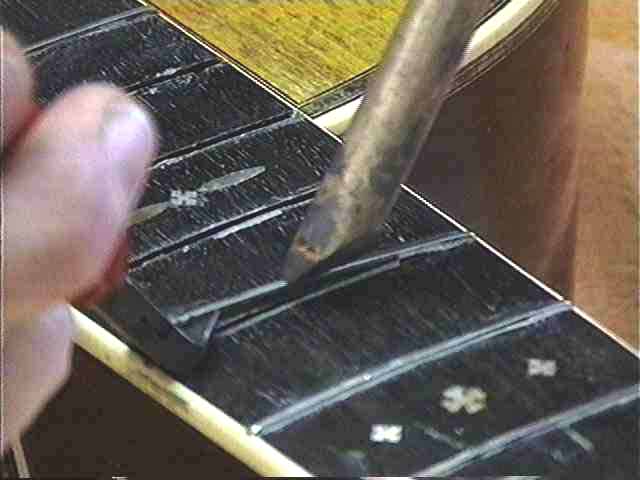
I have the fret started and have switched hands, pulling from the end and heating from the middle, working very slowly. The long white flakes at the edges of the fret slots and along this fret are remnants of previous glue.
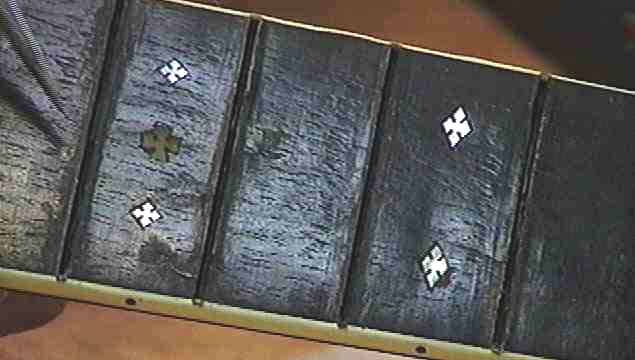
Now that all the frets are out, I can see which of those old chips are really loose. Notice the "blister" in the fingerboard just below the lower square inlay. This one is typical, unfortunately.
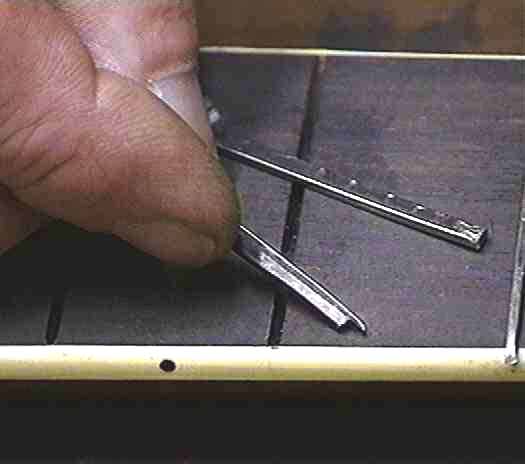
By the way, here's what the frets look like. One is clean and untouched with the overhang still intact. The other (like about half of them) has been cut short and nicked heavily on the bottom edge to make it fit more tightly in the slot.
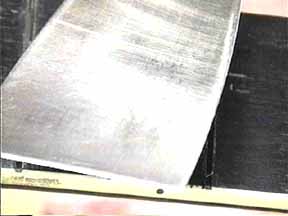
This next bit is difficult to show. In order to reglue the chips, I'll have to work on one at a time. I'll run some thin Cyanoacrylate (superglue) under a loose chip, and spray some catalyst (accelerator) on the blade of my flexible putty knife. Before the catalyst dries, I'll immediately mash the chip down on the fingerboard "ironing" it in place by pressing hard, moving the knife slightly so that it won't become stuck. This little trick works quickly and surely.
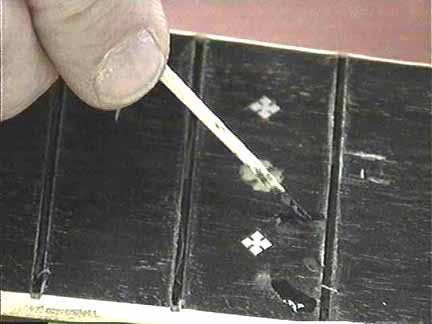
I'll fill open gaps with medium-viscosity cyanoacrylate mixed to a paste with lampblack:
On this guitar there's no hurry so I won't use catalyst. If I were to use the catalyst I'd dab a little into the hole and allow it to dry before adding the paste. That way I'd reduce the chances that it might turn white as it hardens.
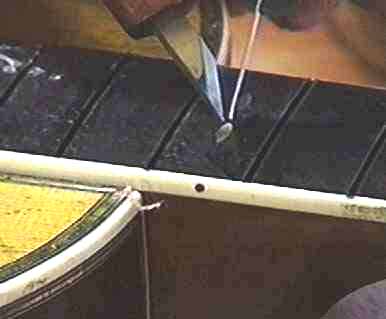
As I look over the fingerboard, I notice that I'll have to level the area near the body to correct a slight hump there, and to eliminate the heavy scarring from previous work. It's probable that I'd sand right through the inlay in that position, so I'll steam it out so I can re-inlay it after leveling the fingerboard. Here's my 1/16" steam nozzle spraying as I gently lift one inlay with the point of my small knife:
These old inlays are done with hide glue, and release easily. Modern inlay, including mine, is usually done with cyanoacrylate or epoxy, neither of which are easily released. Generally it's not considered a big deal either way because new pearl inlay can look just the same as old. In fact, here I was able to reuse only about half of the ones I removed. The others were already too thin.
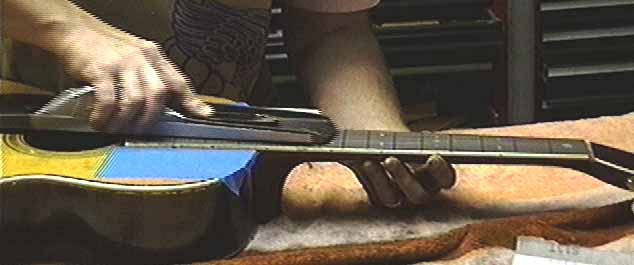
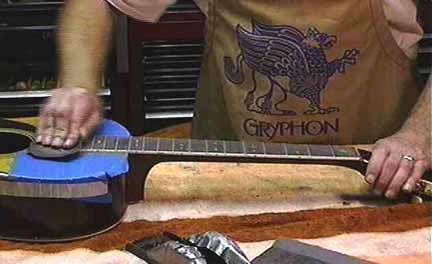
I'll now proceed to level the fingerboard just as I would on a modern guitar, using my favorite sanding block, my old reliable Stanley plane body:
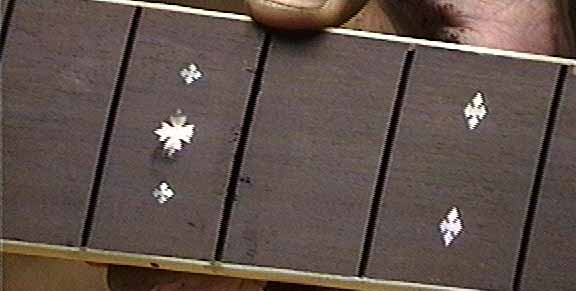
Egad! Even with the filling regluing of all those chips, even more are revealed or knocked loose in the first bit of sanding. I'll fill all these tiny ones before continuing my sanding:
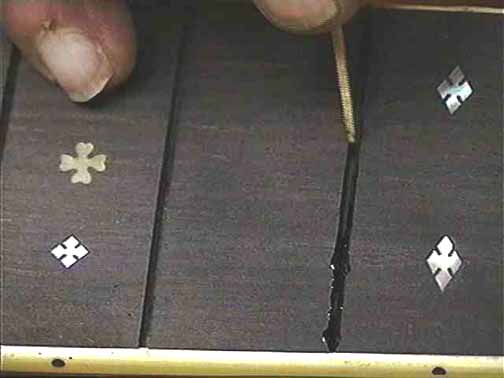
After filling all the voids, I'm going to buy some insurance. I'm taking a toothpick, dipping it into thin cyanoacrylate and carefully wiping the sides of the fret slots, allowing the glue to soak into the end grain. I'll follow immediately with bits of paper towel pushed into the slots with a clean toothpick, and removed to wipe off any excess. I don't want to change the width of the slots, I just want to get a little glue to wick into the grain to find any cracks or other defects that remain.
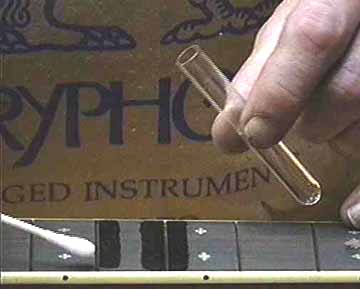
On the face of the fingerboard I can be pretty sloppy. I have a test tube with a little thin cyanoacrylate mixed even thinner with acetone. I'll wipe this stuff on the edges of the fret slots to soak a little glue in from the top. This trick REALLY works!
Only problem is that I have to work super fast. If I really hustle, I can only do about 6 frets per batch of thin glue. It seems that the acetone (or the water in the acetone) acts as a catalyst, and the glue starts to thicken in the test tube. No big deal, I'll just use a lot of small batches. Almost always I'll see the glue drain into little cracks I didn't even notice before. I make sure I fill these little guys with full strength cyanoacrylate before I move on.
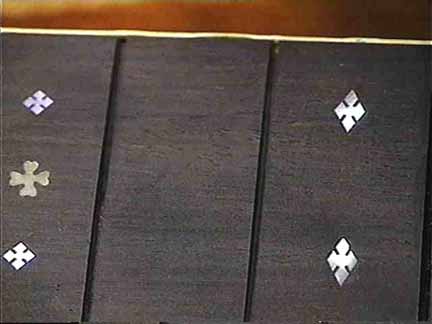
Now I've replaced the inlays I removed and I've sanded the fingerboard to its final finish (280 grit.) It looks just like new!
It should look like new. Now is the last chance I'll have to work on the fingerboard without having frets in the way, so I'd better do the best I can.
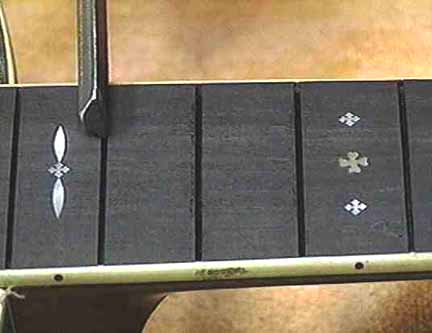
In order to avoid chipping when I tap frets in position I'll chamfer the top of the fret slots just a little. This little bevel will also make it safer to remove frets in the future. Here I'm using my cantsaw file and very little downward pressure:
Preparing the frets for installation is not a complex process, but it is time consuming. The new fretwire comes in straight lengths and is just flat bar stock. You can see a little piece of it laying flat under the hammer head in the picture below. It's a trifle too wide (0.055" compared to the original 0.050") so I'll try the fit of each fret and hand file it thinner as needed to achieve a tight fit. Too tight, and I'll spring the neck into a monumental back-bow.
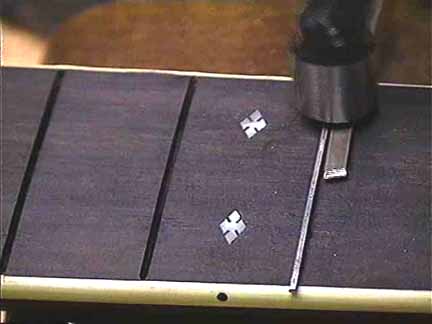
I cut each fret a little overlength and file a notch into each end so it will overhang the binding.
As I tap the frets in place it would be easy for me to drive some of them too deep, so I place a scrap piece of 0.052" thick fretwire next to the fret as I tap. That way I can't over-drive the fret. I'm aiming for a finished fret height of 0.040" I'm using a steel hammer for these frets because I don't have to worry about making scars on the tops - I'll be filing them like crazy soon.
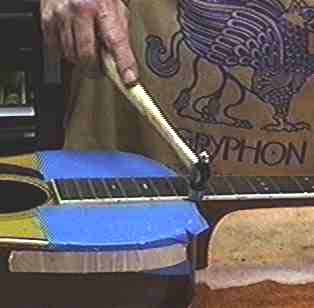
This wire is incredibly stiff stuff, so my overhanging ends must be bent down over the curved edge of the binding. I just tap with my 2oz. ball pein hammer.
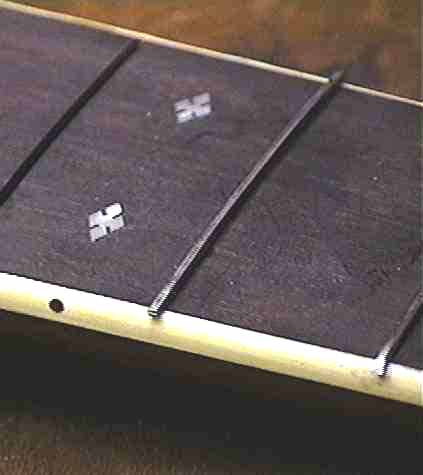
Here's the way the ends look before and after bending down:
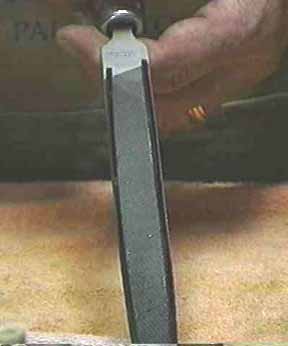
To achieve a final height of .040" I have to remove a LOT of material from the tops of some of these frets, and as little as 0.012" from the ones I drove the deepest. to make the job a little easier, I've glue some plastic strips (about 0.042" thick) as "rails" on the face of a double-cut mill bastard file. This is an aggressive cut and I'm using a new file to make the work go smoothly.
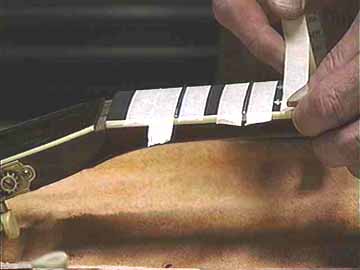
I must protect the fingerboard from being scraped by the rails of my file, so I'll apply masking tape over everything but the frets themselves. As I dig into the tape during the next processes, I'll peel it off and replace it. I can't afford to scratch the fingerboard now, or I'll have a really tough time making it look right later.
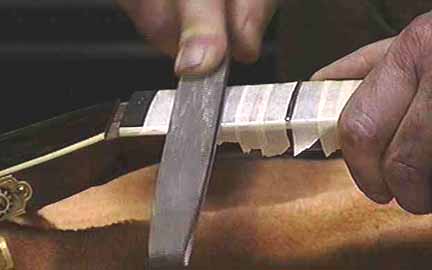
I can now fil the frets along their length with good, strong strokes. I have to work relatively slowly, though, to avoid heating the frets by friction. If the frets get hot, they might shift in their positions.
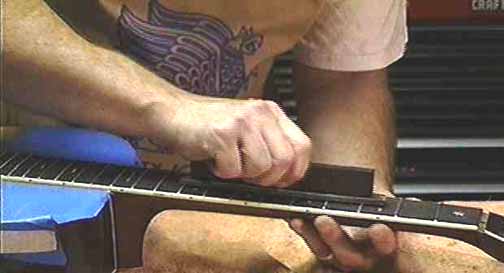
I have another double cut mill file with the tang broken off, to which I've glued a wooden handle, and I'll use this to graze over the tops of all the frets to start the leveling process:
(It was this job that convinced me to get into making ergonomic tool handles!)
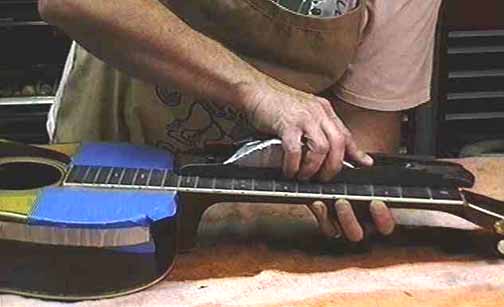
Things are almost under control now. I'm leveling the frets with my plane body sanding block and 600 grit waterproof silicon carbide paper:
I'm now confident that the frets are perfectly level along their length.
Only problems is that they are flat, square and sharp:
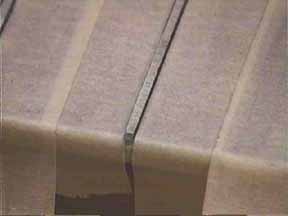
I've again covered the fingerboard with tape so now I can proceed to profile the frets. I've never been able to handle fret files, so I turn to my cantsaw file with the safe edges.
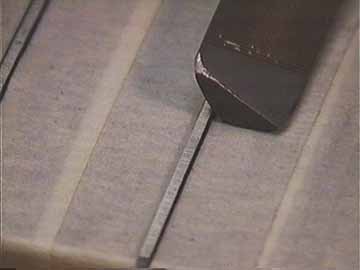
I'll file the corners off, and slowly round the top until there's just a teeny little strip of the original
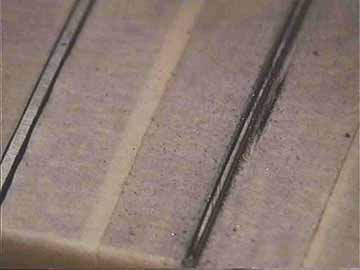
Here's a rounded fret next to a flat one. . .
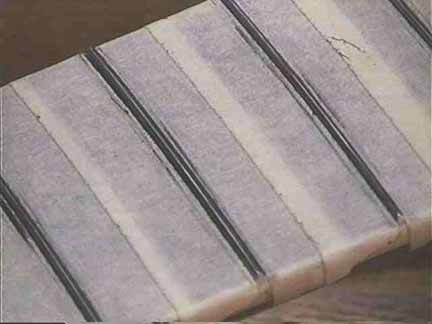
And now they are all done, with just the littlest bit of original flatness on the top surface.
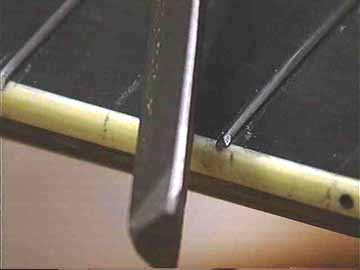
I'll bevel and round the ends just the way I normally do when I'm refretting with modern "T" frets. There's a more clear description in the article on refretting the D-35.
One more pass with my jack plane body sanding block and 600 grit paper to make sure I've leveled all the frets evenly:
And now, a rubdown starting with 600 grit, and buffing with Micro Mesh and 0000 steel wool:
Set up & restrung, done at last!
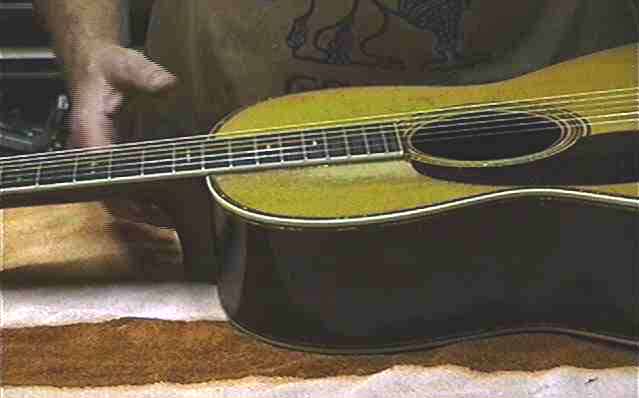
The effort was worth it. This fine guitar plays like a new instrument, has full height at the saddle, and the fingerboard looks as good as the day it was born.