
5-String Banjo Anatomy
Lots of pictures of banjo skeletons and guts: a short course in
I've organized this tour along very general lines, featuring the two major styles of five string banjo, so you can compare some of the differences and similarities.
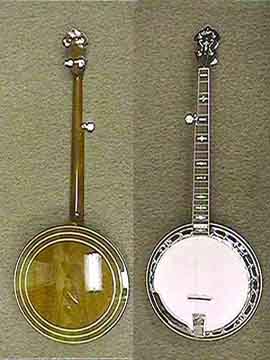
Here's a resonator, or Bluegrass banjo:
Notice that it has a resonator (the back) which reflects the sound in a forward direction. The resonator banjo maximizes tonal volume, sustain and sharpness. It weighs almost three times as much as a good guitar! (Yes, lots of Bluegrass banjo players complain about back trouble.)
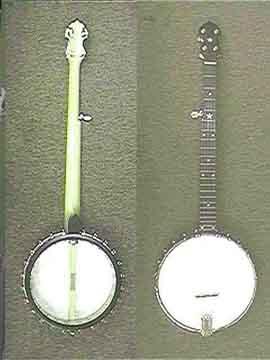
Its predecessor, the "open back" banjo, is sometimes known as an "old time," "frailing" or "clawhammer" banjo, referring to the styles of music commonly associated with it:
Open back banjos weigh significantly less, and have a different sound because of their construction. They have no resonator to project the tone, and their lighter weight causes them to be less "metallic" sounding with less sustain to the notes. In general, these are desirable characteristics for their style of music. There are more subtle differences as well, and a lot of different styles of both resonator and open back banjos.
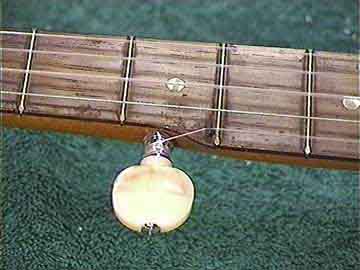
The most special part of the five string banjo is the fifth string, of course, and its short length sets the five string banjo apart from most other fretted instruments.
The fifth string actually starts at the fifth fret and the tuner is jammed into the side of the neck at that point:
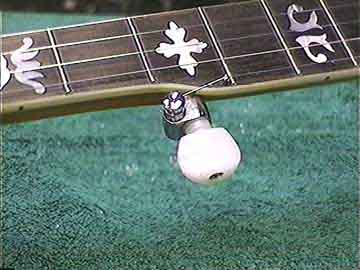
Traditionally, the fifth string tuner, or "peg" is a friction device, with a screw adjustment right in the center of the button that controls the amount of friction holding the peg in tune.
Modern better quality instruments have a geared fifth string peg:
This one has a 12:1 gear ratio and tunes very easily and smoothly. If your banjo doesn't have a geared fifth string peg, you would do well to consider one! It's generally a cheap and effective upgrade.
Unlike those on guitars and mandolins, the tuners on banjos are universally called "pegs." That's because the early instruments really had tapered pegs that were jammed into the wood of the neck, and held there by friction. These early pegs worked well for the gut strings that were popular on banjos before 1900.
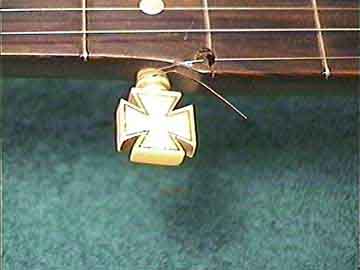
This old timer has a fancy fifth string peg carved from bone:
It is over a hundred years old now, and the peg works just fine with the nylon strings that replace the original gut ones. Use steel strings on this banjo, and the higher tension will make tuning quite a fight indeed!
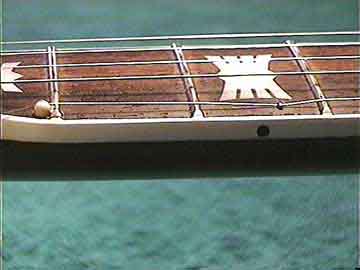
Guitar players just snap a "capo" on to fret all the string at once so they can play easily in different keys. Five string banjo players do that too, but they must also readjust the fretting position of the fifth string.
This banjo has a "spike" at the seventh fret"
Then, when the player puts a capo on the second fret raising the pitch a whole step, the fifth string can be raised easily to the same pitch by simply catching it under the spike.
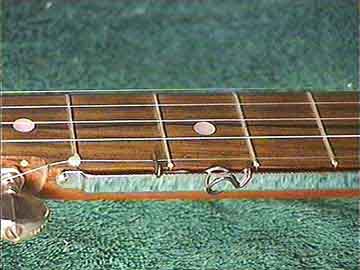
This banjo has a sliding fifth string capo:
Its player can simply slide the capo to any fret. This capo is a light weight spring device; a better and more sophisticated one is a screw-down affair that holds the string more firmly.
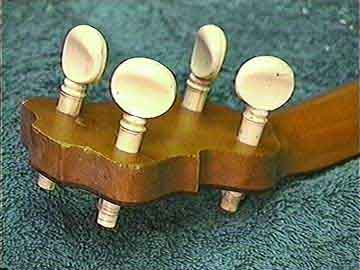
Here are the pegs at the peghead. (That's why we call it a "peghead")
These pegs are celluloid and they slip like crazy. It would be hopeless to use them with steel strings.
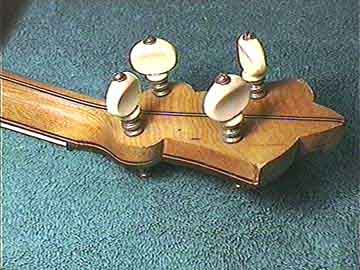
These are "patent pegs"
Still known as "friction pegs" because they have no gears and rely on the friction generated by tightening the central screw at the back of the button. This banjo is about a hundred years old, and is typical of the period.
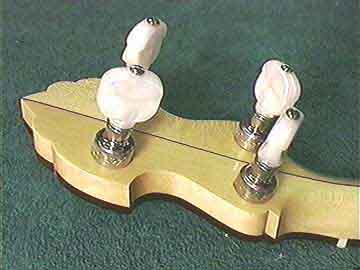
The general style of banjo pegheads has not changed in all that time, but now we have geared banjo pegs. Notice that, unlike guitar and mandolin gears, the pegs stick straight back just like their old time counterparts:
This is a very important piece of banjo styling. Banjo makers stick to their traditions. Unfortunately, making geared pegs that look like friction pegs is an expensive business.
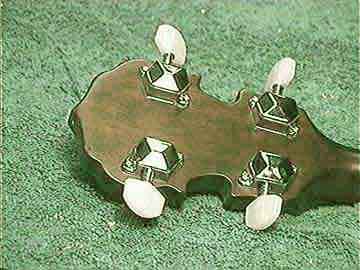
This is an inexpensive, imported banjo with right angle guitar gears:
These gears work perfectly and cost a small fraction of the price of the complex geared banjo pegs. Most banjo players consider them to be so unsightly and nontraditional that they would never consider using them on anything but beginner instruments! Nobody argues about tradition on cheap instruments. There, function is the only thing to worry about.
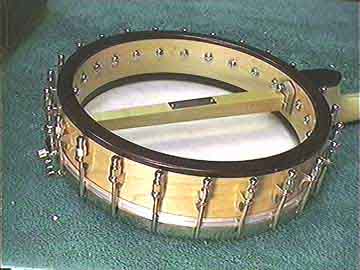
In the old days when open back banjos were the only ones around, banjo necks were held on by a central "dowel stick."
This open back banjo has a very traditional look. The body of the instrument (the "pot," "rim" or "shell") has 24 hooks and nuts holding the head tension. They pass through "shoes" that are bolted through the shell. The neck is held against the shell with a U-shaped clamp that fits around the dowel stick. Additionally, the dowel stick is screwed from the outside at its other end. Open back banjo necks are seldom adjustable, but they are very strong and generally don't need adjustment.
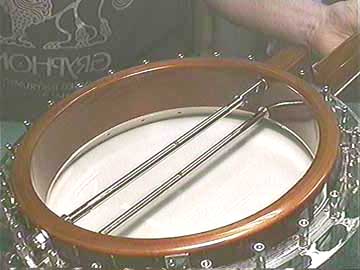
Modern resonator banjos have their necks held on by two coordinating rods:
These rods are used to adjust the action and keep the neck aligned. With its resonator off, you can see this banjo has a heavy "flange" through which the head tensioning hooks are bolted. This flange is extremely strong, and resonator banjos usually need them to handle the extra head tension that players demand. The higher the head tension, the louder and sharper the tone.
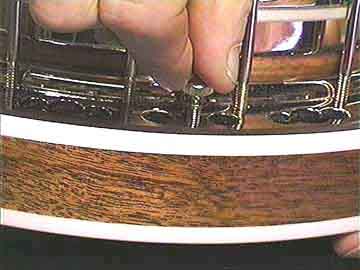
The resonator usually screws in place easily to allow access inside for adjustments.
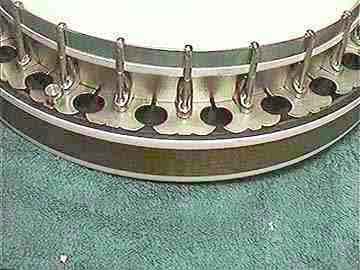
Here's a banjo that's been converted for use with a resonator:
It has the individual shoes of the open back, and some decorative trim pieces or "flange plates" to make the resonator look like it belongs there. A few high grade instruments are made with individual shoes and plates, but they are unusual, and as heavily built as those with cast flanges.
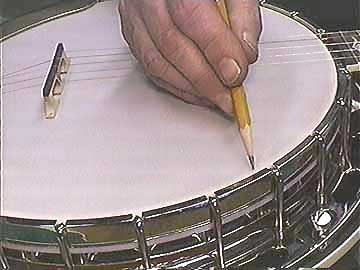
The body of any stringed instrument is the real determiner of tone. Among resonator banjos, by far the most popular sound and style is the "flathead" configuration"
Here, the head is stretched over a cast "tone ring" which imparts a clear ringing tone with a good range and balance. It's easy to spot because the head is flat all the way to the edge.
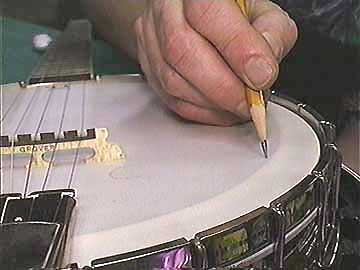
The other major style is known as the "raised head" or "arch top"
This one has a tone ring with an inner raised portion over which the head makes a bend downward toward the edge. Because the vibrating surface of the head is an inch and a half less in diameter, this banjo has a higher natural pitch. The instrument then has greater power in the high registers, and less strength in the bass region. Raised head banjos have less sustain and a more percussive tone.
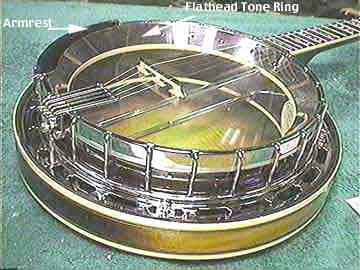
Here's a flathead resonator banjo with a clear head:
You can see the large cast tone ring sitting on top of the 3/4 inch thick wooden shell.
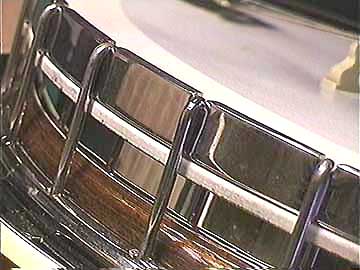
The head of virtually all banjos is held in place by a "tension hoop" which is a brass (usually nickel plated) ring that's gripped by 24 hooks:
This is the most standard style, where the tension hoop is notched to accept the hooks to keep them neatly aligned. These hooks are very strong and securely mounted. They need to be to tighten the head and hold it tight for decades!
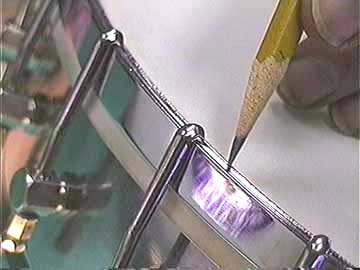
This tension hoop is grooved through its length and the hooks fit right into the groove:
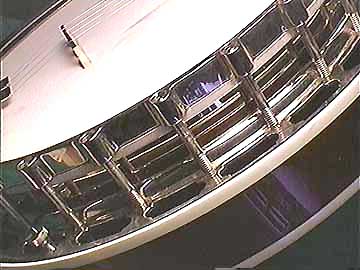
It's just as secure as the notched hoop as long as the hooks are strong and well made. The grooved hoop was more common on older instruments, because it will accommodate a variety of hook positions and arrangements.
Here's an unusual high grade banjo:
Its hooks are not hooks at all but are really bolts that pass through a heavy cast tension hoop and thread directly into a heavy flange. This is the famous "top tension" style Gibson Mastertone introduced in the late 1930s. The idea is that you can tighten the head without removing the resonator. Immensely strong, but expensive to make, this style is really not in use today, except as reproductions of the vintage Gibsons. (There were other much less desirable top tension instruments made by a variety of makers.)
Here's something to watch out for!
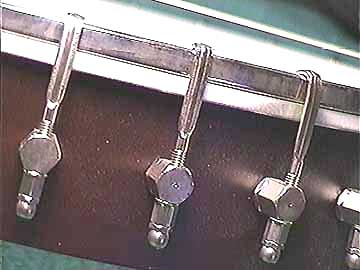
This banjo was made in Korea, so it's a beginner model. Notice the hooks:
They're wide and flat, and they hold a tension hoop that's way below standard width and strength. But the hooks are the real problem.
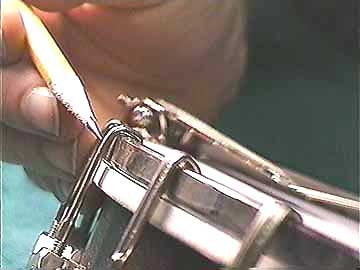
These imported hooks are so weak that if you tighten them very much they straighten right out and drop off. Look at this one, it's just about to fail:
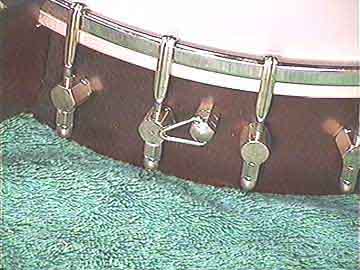
Here's the same banjo with another feature only found on inexpensive imported banjos:
It's a loop to hold a strap. Ordinarily, a strap mounting device is a good thing, but here, it's redundant because banjos have 24 hooks, any of which will hold a strap very nicely. Besides, these little loops rattle like crazy if you don't have a strap on them.
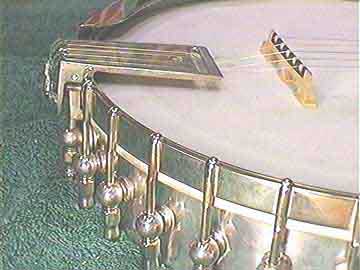
The strings are held in place by a tailpiece, which may be adjustable. This one is a "tension tailpiece" because it may be adjusted up and down to vary the downward pressure of the strings against the bridge:
Most resonator banjos and a few open backs have tension tailpieces. The more downward tension, the louder and sharper the tone, with a consequent loss of bass response.
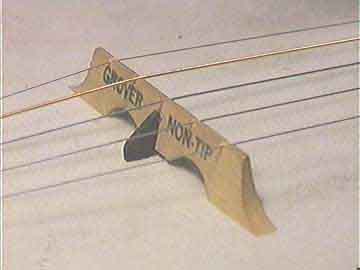
Banjo bridges come in a wide variety of styles, some of which have even been patented, like this one:
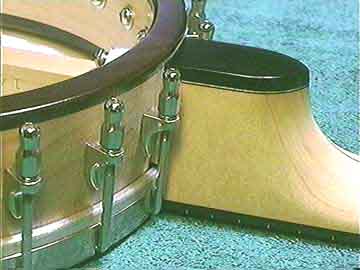
Open back banjos have different traditions of styling from those of the other fretted instruments. Colored neck laminations such as those on the heel of this banjo are very common with open back banjos
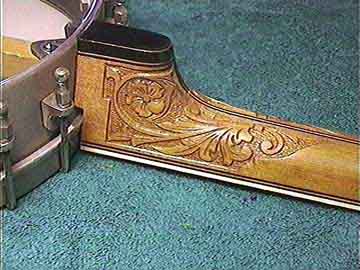
Heel carving is very rare on guitars or mandolins, but is considered a standard form of ornamentation for open back banjos:
More to come. . .