
Very Thin Circular Back Saw
I didn't know what to call this one, so it's a Circular Back Saw
A few days ago, my friend, Bill Sveglini ("Uncle Bill" the band instrument guru) about a tool he was using to cut a very narrow kerf when slicing through a key support for a clarinet, or some such. Anyhow, I managed to misunderstand what he was up to, and somehow got the idea that he was using a circular saw blade held rigidly in some device so he could cut this thing by hand. It took me a while to come back to Earth when he finally got it through to me that he was using a 1" diameter saw in his Dremel tool. Meanwhile, I'd fantasized about this saw thingy, and later just had to try it out.
My idea was much the same as Bill's. Namely, I wanted a saw that would cut the narrowest kerf possible. As it happened, I had a 0.006" thick metal slitting blade which was intended for a 1" arbor machine.
Here's how I went about my little project:
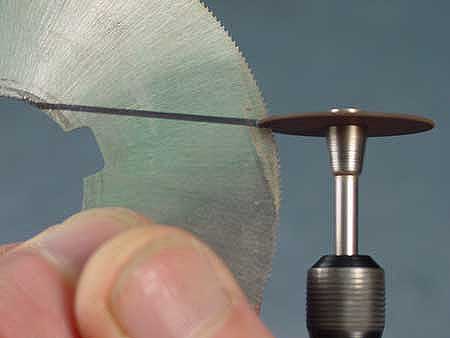
I drew a line across this thin saw blade and simply cut it with my Dremel tool loaded with the carbide cutoff wheel:
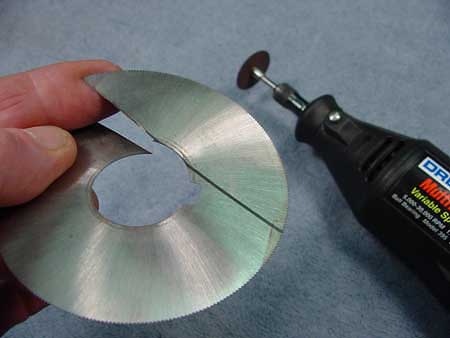
This little carbide cutoff wheel is the greatest! If you haven't tried one, you've missed the bestest tricks your Dremel can do:
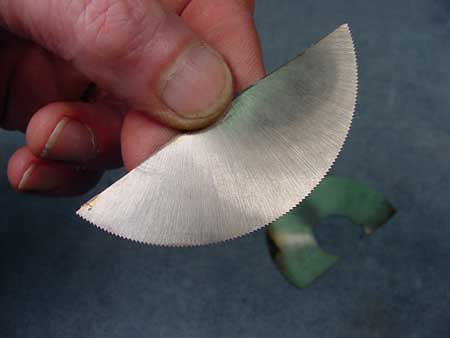
Then, I had a segment of a circular saw blade, neatly cut out:
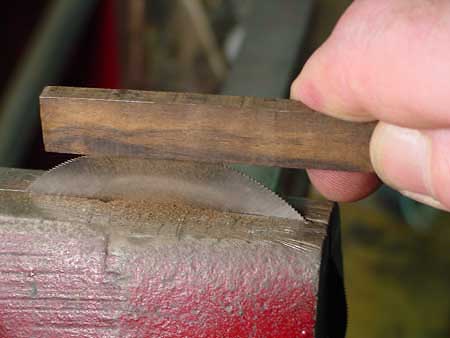
I simply gripped the blade in my Versa Vise, and cut a slit in a piece of 3/6" thick ebony scrap:
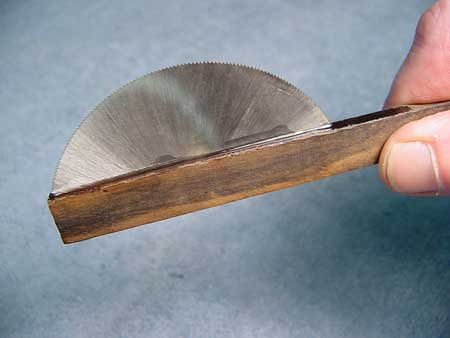
Then I glued the saw blade into the recess with some medium viscosity cyanoacrylate:
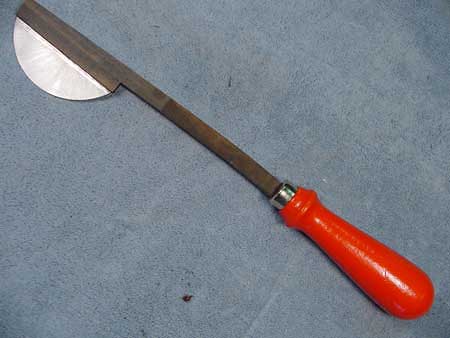
And, mounting the ebony into a standard handle, I had a cool little circular blade hand saw:
This turns out to be the greatest little saw for cutting a tiny kerf right behind a mortised-in nut. It's easy for me to see exactly where the saw is cutting. Unlike when I'm using a straight saw, I don't have to worry about where one end is cutting while I'm looking at the other end:
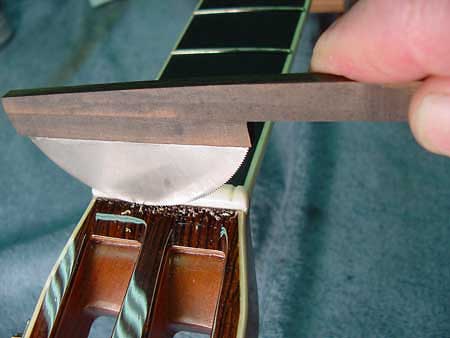
Its very flexible, so I can hold it right next to the back edge of the nut. And this slitting saw has no set to the teeth, so its kerf is only .006 inches!