
Technique for Tone
Watch those hands, buster!
"Can you hear that buzz?"
"It buzzes when I play hard."
"I raised the action but it still buzzes."
"It buzzes in first position, high on the neck, everywhere."
I frequently hear complaints about buzzing only to notice that the cause is partly or completely in the hands of the player, and not the fault of the instrument!
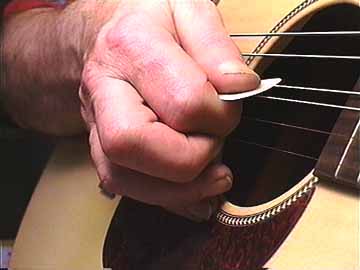
Check out the next 4 photographs.
If your pick attacks the string at a 45 degree angle, two things will certainly happen:
First, you'll cause the string to bounce and vibrate straight up and down perpendicular to the fingerboard. You'll get that familiar buzz if you play hard because the string will bump into the frets right away.
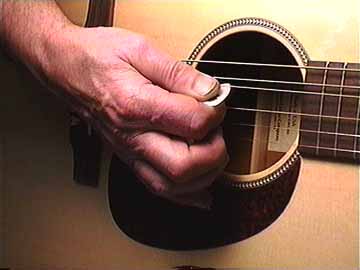
Second, when you try to make an upstroke or "back pick" you'll snag the pick under the string every time:
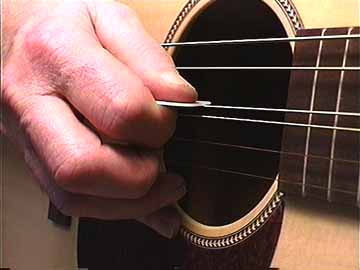
If you hold your pick firmly at 90 degrees perpendicular to the fingerboard, then you'll cause the string to vibrate sideways, parallel to the frets:
That way the string is much less likely to bump into the frets when you play hard!
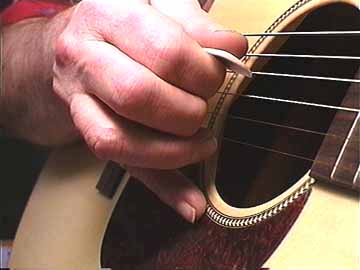
Not only that, but the return stroke or up-pick will be at the same angle and efficiency as the down-stroke:
This really is a big deal.
Lots of experienced players are unaware that the way they attack the string makes a real difference in how it vibrates.
It's not only the flatpick. The same thing goes for fingerstyle players. Dig in hard with your thumb and make the string squirt straight up and down against the fingerboard, or catch it more gently so that it vibrates sideways parallel to the frets. The choice is yours!
By the way, this isn't exactly new information. Look a the last sentence in this little leaflet Gibson packed with new instruments 90 years ago.
Now on to the left hand.
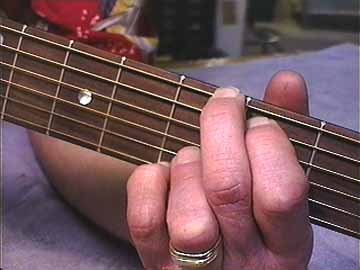
Here's a more obvious problem:
You can see my middle finger is too far from the third fret to get a clear note on the sixth string. I'll either get a dull note or a buzz because I can't hold the string down tight enough to the fret to get a solid contact.
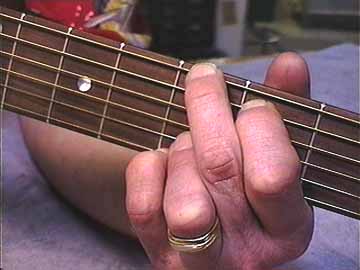
Now, I've got it right:
This example makes it very plain, but lots of chord positions are far more subtle, so it's a good idea to analyze what your left hand is doing if you get that occasional buzz or dull sound.
The same thing happens if you're not strong enough to hold the string down against the fret. Suppose the action is really too high for you to get a clean contact in more complex positions. This is a fairly common problem, especially in the case of a high nut.
Sometimes the frets are to blame.
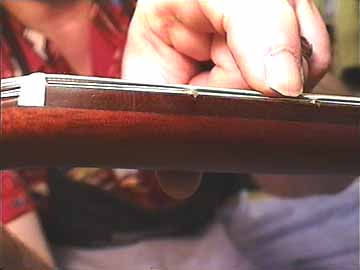
Here, I can hold the string down to the fret and get a very solid and clean contact:
Notice that my finger isn't touching the fingerboard, and neither is the string.
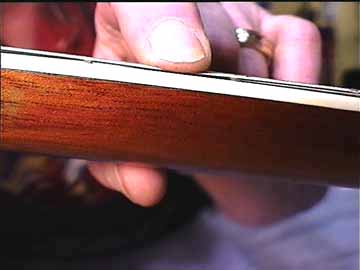
If the frets have been filed or worn too low, I can't hold the string down to get a good contact with the fret because I "bottom out" against the fingerboard:
In an effort to get a clear note, I'll have to mash really hard, if I can do it at all!
This is a very serious and quite common problem. Many repair technicians appear to be unfamiliar with this situation because they file all the frets really low in an effort to make them all level. The result is an instrument that is very difficult to play cleanly.
Of course there are lots of other causes for buzzing and playability problems. I just wanted to bring up the technique issue in this article.
I should mention that some electric players like really low frets and they can get away with them because their strings are very light and under low tension.